

Last Updated: November 5, 2026
Quick Summary
To shuffle oracle cards, mix the deck over a flat, clean surface until no card stays in its original spot, usually about one to two minutes. Gentle overhand packets work for standard decks, while cutting large decks into smaller piles makes shuffling easier on the hands.
- Clear a flat table or tray and remove anything that could catch a card edge.
- Use overhand packets of about 5 to 10 cards for a standard deck.
- Split large decks into three piles, shuffle each one, then restack them in a new order.
- Try a table shuffle or dealing into piles if your hands tire easily.
- Stop shuffling when the cards feel evenly mixed and your focus feels calm.
Table of Contents
- Start With Your Intention and a Clean Surface
- How to Shuffle Oracle Cards Effectively for Beginners
- How to Shuffle Large Tarot Cards Without Straining Your Hands
- How to Shuffle Tarot Cards for Jumpers and Cards That Fall
- How Long to Shuffle Oracle Cards and When to Stop
- Troubleshooting Common Shuffling Problems
- Choose Your Next Oracle Deck to Practice With
- Frequently Asked Questions
Start With Your Intention and a Clean Surface
Shuffling your oracle deck is more than a physical step. It is the moment you begin your reading, so it helps to slow down. A calm start can make the cards easier to hear.
Before you shuffle, clear a flat table or tray. Remove crumbs, loose papers and anything that could catch a card edge. A soft cloth or a small mat works well.
Next, take one breath and name your question or intention in a few words. There is no required phrase. Simply hold the question in mind as your hands begin to move.
How to Shuffle Oracle Cards Effectively for Beginners
Most people shuffle oracle cards in one of two ways. The overhand shuffle uses your hands. The table shuffle uses a flat surface. Either method works, and the cards do not care which you pick.
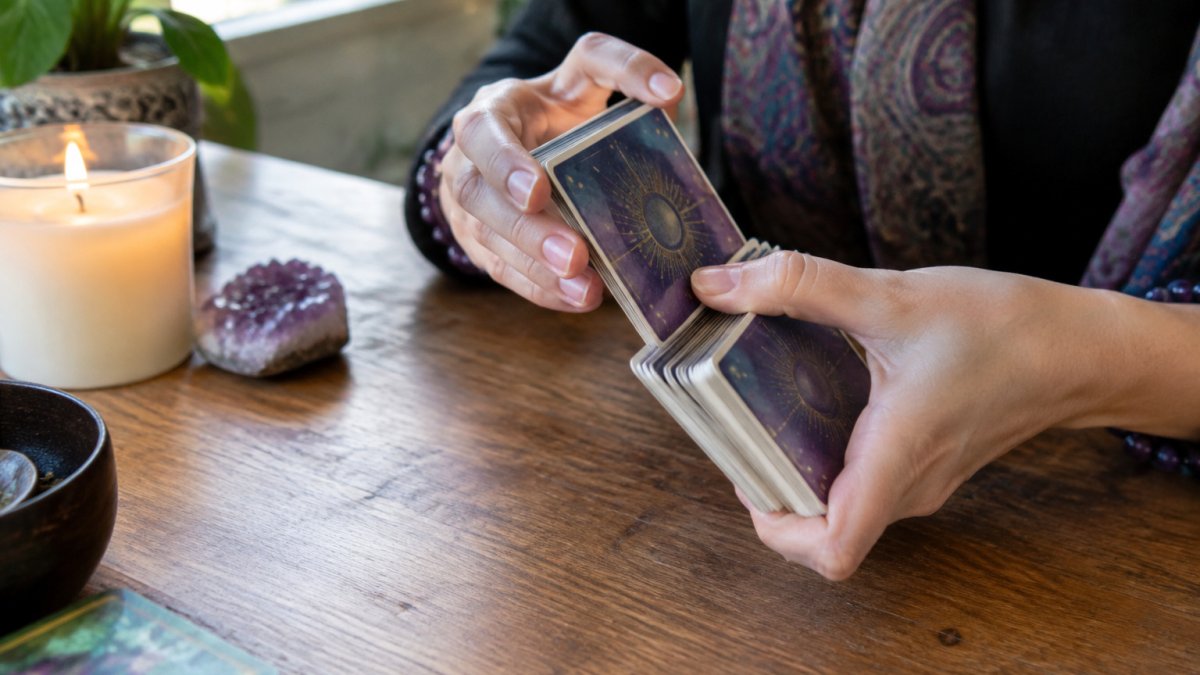
Shuffle oracle cards effectively by mixing the deck enough that no card stays in its original spot. A good rule is to shuffle until the deck feels fully mixed in your hands.
- Hold the deck in one hand, with your thumb on one side and fingers on the other
- Shuffle gently rather than fast
- Mix the cards for about one to two minutes
- Stop when the deck feels ready
Overhand Shuffle Step by Step
The overhand shuffle is the most common method for beginners.
- Hold the deck in your dominant hand, face down.
- Use your thumb to lift small packets from the top, about 5 to 10 cards at a time.
- Let each packet drop onto the deck in your other hand.
- Repeat until the deck feels mixed.
- Cut the deck into two piles and stack them in the opposite order.
A common mistake is shuffling too hard. Gentle movements help protect the edges. Shuffling softly also keeps the edges from bending.
Table Shuffle and Spread Method
If your hands tire easily, try the table shuffle. Spread the deck face down on a flat surface. Slide the cards around with both palms in wide circles. Gather them into a pile and repeat a few times.
Many readers like to finish with a spread. Fan the cards out face down so you can choose intuitively. Feel drawn to a card, then pick it.
How to Shuffle Large Tarot Cards Without Straining Your Hands
Oversized decks are where most shuffling advice falls apart. Oracle decks in particular vary widely in size and card stock. A deck that large may not overhand shuffle comfortably in small hands, and forcing it can bend corners.
The fix is to stop treating the deck as one unit. Split it into two or three smaller packets and shuffle each packet on its own, then stack the packets back together in a different order. Smaller packets need less grip strength, slide more freely, and put far less torque on the card edges.
A repeatable routine for large or stiff decks:
- Set the deck face down on a flat, non-slip surface such as a cloth mat.
- Cut it into three roughly equal piles.
- Overhand shuffle each pile separately, using packets of about 5 to 8 cards.
- Stack the three piles in a new order, for example, middle pile first, then bottom, then top.
- Repeat the cut-and-stack two or three times so cards from different parts of the deck interleave.
If grip strength is the limiting factor, the table shuffle is the better primary method. Spread the cards face down and mix them with both palms in slow, wide arcs rather than tight circles; wide arcs keep the cards from piling on top of each other and reduce the urge to press down hard. Gather them into a pile, rotate the pile a quarter turn, and repeat.
For readers with limited dexterity, arthritis, or very small hands, a dealing method works just as well and is often easier than any shuffle. Deal the deck face down into four or five piles, one card at a time, then stack the piles in a random order. It takes longer, but it mixes thoroughly and requires almost no grip.
Watch out: thick, gilded, or freshly opened decks are stiff and tend to spring apart mid-shuffle. Break them in first by fanning the whole deck gently in both directions a few times before you shuffle, and keep packets small until the stock loosens up.
Many readers reserve the overhand shuffle for standard-size decks and switch to packet or table methods when a deck feels unwieldy.
How to Shuffle Tarot Cards for Jumpers and Cards That Fall
Sometimes a card jumps out of the deck or slides off the top. This is normal and not a sign that anything is wrong.
To reduce jumpers, shuffle over a flat surface and keep your packets small. Cards that fall during shuffling can simply be picked up and placed back into the deck.
Keep in mind that a card that falls out during shuffling is often a matter of handling, not meaning. Most readers simply continue and mix the deck again.
How Long to Shuffle Oracle Cards and When to Stop
There is no official time limit. Most people shuffle for about one to two minutes. The right stopping point is when the cards feel mixed to you and your question feels clear.
Watch for these signs that you can stop:
- No single card keeps returning to the top
- The deck feels evenly mixed in your hands
- Your focus feels calm and steady
Do not shuffle endlessly. Extra shuffling rarely adds much, and it can make you feel rushed.
Troubleshooting Common Shuffling Problems
Most shuffling problems come down to three things: card stock, surface, and hand pressure. Diagnosing which one is causing the issue saves a lot of guesswork.
Cards clump or stick together. New decks and glossy finishes carry a slight tackiness, and humid air makes it worse. Fan the entire deck face down and run your thumb along the edges to separate them, then shuffle on a matte cloth rather than a bare table or a slick tray. If clumping persists, deal the deck into four piles and restack, this separates cards that have been pressed together.
The same card keeps surfacing. This usually means the deck is not actually mixed, not that the card is trying to send a message. Cut the deck into three piles, shuffle each pile separately, then stack them in a new order and repeat. Several cut-and-restack cycles can mix a deck more thoroughly than continuous overhand shuffling.
Multiple cards jump out at once. Jumpers are a handling issue before they are a reading issue. Large packets and fast thumb movements cause cards to spring free. Reduce packet size to about 5 cards, shuffle over the table rather than in the air, and slow the thumb release. If several cards still fall, gather them, place them back in the deck, and reshuffle rather than reading every fallen card.
Corners bend or edges fray. This is almost always pressure, not frequency. Avoid squeezing the deck, avoid riffling the corners against each other, and store cards flat in their box rather than loose in a bag where they can warp. Sleeving a well-loved deck is an option, though sleeves change the feel and make thick decks thicker.
Hands ache after a few minutes. Switch methods rather than pushing through. Table shuffling and dealing into piles both mix the deck with minimal grip. Shuffle in shorter sessions and take a break between them.
You are not sure your method is working. A quick check: fan the deck face down and look for runs of cards that are still in their original order. If you see long sequences, cut and restack again. If the cards look scattered, you are done.
Watch out: storing a deck in a hot car or a humid room warps the stock and makes every one of these problems worse. Keep decks flat, dry, and out of direct sun.
Choose Your Next Oracle Deck to Practice With
Once you are comfortable with shuffling, a beginner-friendly deck makes practice easier. Look for cards with clear images and a size you can hold comfortably. Many readers like a deck with a short guidebook.
Our Oracle of Visions Deck, by Ciro Marchetti, includes 52 cards and a 140-page booklet, priced at $22.95. The Wild Wisdom Australia Oracle Deck & Book Set is another option at $25.95. For a smaller budget, the Auspicious Symbols Oracle Deck & Book Set is $19.95.
If you want to compare decks before you choose, you may also enjoy our guide on how to use tarot and oracle cards together. For a deck that is easy to handle while you practice, you can browse the Power Animal Oracle Cards by Steven Farmer, an oracle option. Another gentle choice is the Whispers Of Lord Ganesha Oracle Cards, which many newcomers find approachable. If you are also exploring tarot, our list of 7 best tarot decks for beginners is a helpful next read.


For more on reading your cards once you have shuffled them, see how to interpret oracle cards without a guidebook.
Frequently Asked Questions
How do you properly shuffle oracle cards?
Hold the deck in one hand, split it into two smaller packets, and riffle or overhand-shuffle the cards together. Repeat several times with gentle, consistent motions. Keep the cards face down and avoid bending the edges. Most readers find that a steady, unhurried rhythm produces a more relaxed session than rushing through the deck. There is no single correct method, so choose the one that feels comfortable and stick with it for your practice.
How long should you shuffle oracle cards?
There is no fixed number of shuffles. Many readers shuffle until the deck feels mixed and their focus settles, which often takes somewhere around five to ten passes for a standard deck. Stop when you feel ready rather than counting strictly. Shuffling too long can make the cards feel overworked, and a few calm passes are usually enough to begin a reading with intention.
How do you shuffle large oracle cards?
Oversized or heavier decks are easier to manage with a table shuffle. Lay the cards face down on a flat surface, slide them into a few overlapping piles, then gather them back together. This avoids straining your fingers and wrists. If you have limited dexterity, a table shuffle or a slow spread-and-gather method works well and still keeps the cards well mixed.
Should you shuffle oracle cards until a card jumps out?
Many readers stop shuffling when a card seems to fall out or jump from the deck, reading it as a sign that the deck is ready. This is a personal practice rather than a rule. If you use this approach, keep the decision gentle and consistent. Whether you follow a jumper or simply stop after a set number of passes, the choice to trust your instinct is what matters most.
