

Table of Contents
- What Oracle Cards Are and How They Differ from Tarot
- Preparing for an Oracle Card Reading
- How to Read Oracle Cards for Yourself: Setting Intention and Asking a Question
- Shuffling and Selecting Cards
- Reading Card Imagery, Symbols, and Keywords Without a Guidebook
- Oracle Card Spreads for Beginners and Single-Card Readings
- Connecting Card Meaning to Your Oracle Card Reading Questions
- Distinguishing Intuition from Projection and Building Confidence
- Frequently Asked Questions
Last Updated: October 8, 2026
What Oracle Cards Are and How They Differ from Tarot
Oracle cards are divination tools designed to provide guidance and insight through imagery and intuition.
The key distinction is this: tarot requires memorization of complex meanings, while oracle cards invite personal interpretation. Tarot cards have reversed meanings and intricate symbolism tied to historical traditions.
Oracle decks come in many themes: animal guidance, affirmations, crystal energy, and spiritual wisdom. Each deck has its own visual style and messaging approach. This variety makes oracle cards especially welcoming for people new to card reading.
The beauty of oracle cards is their simplicity paired with depth. A single card can spark meaningful reflection. Multiple cards can reveal patterns and themes relevant to your question.
Preparing for an Oracle Card Reading
Before you interpret oracle cards, create space for focused intention. Find a quiet location where you won't be interrupted. This could be your bedroom, a meditation corner, or even a peaceful outdoor spot.
Cleanse your energy and your cards before beginning. You can do this through several methods:
- Hold your deck and set a clear intention for the reading
- Pass the cards through smoke from sage or palo santo if that resonates with you
- Visualize white or golden light surrounding the cards
- Simply state aloud: "I'm open to guidance that serves my highest good"
Ground yourself in your body. Take three deep breaths. Notice your feet on the ground. Feel your connection to the present moment. This simple practice shifts you from mental chatter into intuitive awareness.
Hold your oracle deck in your hands. Feel the weight and texture. Notice any sensations or emotions that arise. This physical connection helps you attune to the cards' energy.
Clear your mind of expectations about what you "should" receive. The best readings come from genuine openness, not from forcing a particular outcome. Trust that the right message will appear.
How to Read Oracle Cards for Yourself: Setting Intention and Asking a Question
The foundation of any meaningful oracle card reading is a clear intention or question. Vague requests produce vague answers. Specific questions generate specific guidance.
Your intention should be personal and honest.
Write your question down if it helps you clarify it. Speak it aloud to anchor it in your awareness. Some readers like to write their question on a piece of paper and hold it while shuffling.
The question can be about:
- Life direction and purpose
- Relationships and connections
- Personal growth and healing
- Creative projects or work
- Timing and next steps
- Reflection on current situations
Avoid yes-or-no questions with oracle cards. They work better for open-ended exploration. Instead of "Will this relationship work out?" ask "What do I need to understand about this relationship right now?"
State your intention with conviction but without attachment to a specific answer. You're inviting wisdom, not demanding it. This balance between clarity and openness creates the best conditions for meaningful guidance.
Shuffling and Selecting Cards
How you shuffle your oracle deck matters less than your intention while shuffling. Some readers use traditional riffle shuffles. Others prefer to spread cards face-down and mix them with their hands.
As you shuffle, hold your question or intention in your mind. Let it guide your hands. Some readers find that certain cards seem to want to jump out. This is fine.
When you feel ready, stop shuffling. You'll sense when the moment is right. There's no magical number of shuffles.
For a single-card reading, place your shuffled deck face-down on a surface in front of you. Run your hand over the deck.
For multi-card spreads, lay cards out in a specific pattern:
- Three-card spread: Past, Present, Future or Situation, Action, Outcome
- Five-card spread: Challenge, Strength, Action, Outcome, Message
- Seven-card spread: One card for each day of the week
Some readers prefer to fan out the shuffled deck and have someone else (or themselves) point to cards. Others draw from the top.
Reading Card Imagery, Symbols, and Keywords Without a Guidebook
Observing Visual Details
The artwork on your oracle card is your primary source of meaning. Spend time truly looking at what's depicted. Notice colors, shapes, objects, and the overall mood the image creates.
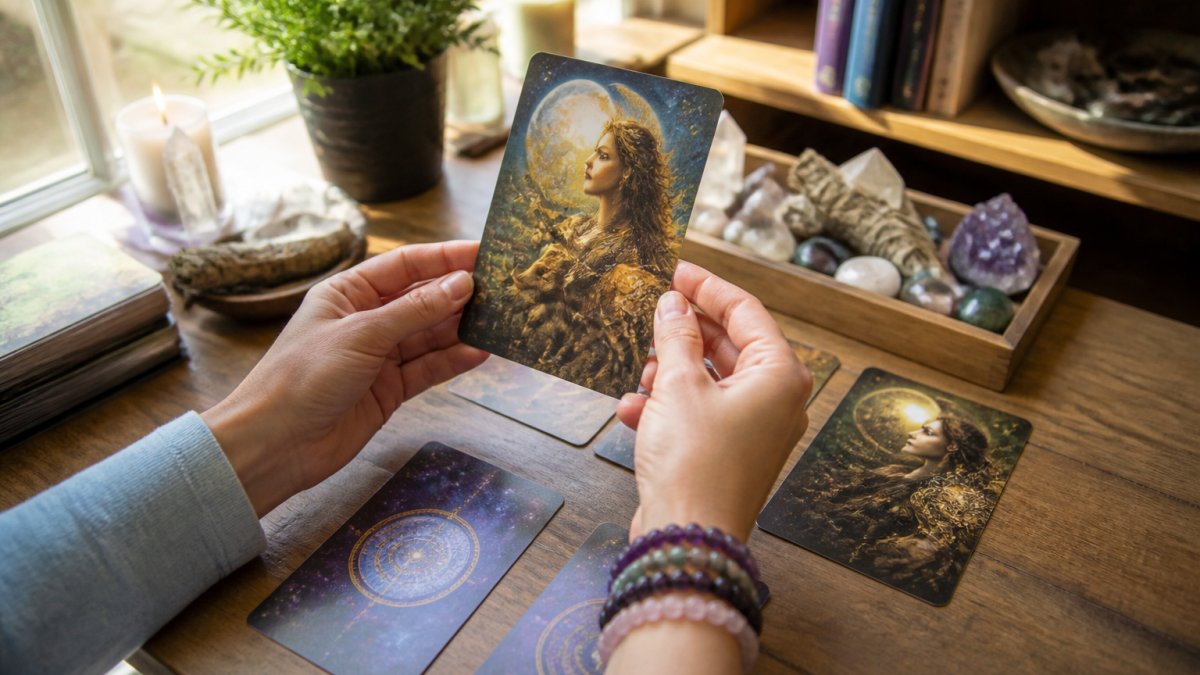
Ask yourself these questions:
- What colors dominate the card? What do those colors evoke in you?
- What is the main subject or focal point? What is it doing?
- Are there any symbols or objects that stand out? What do they represent to you personally?
- What's the overall energy or feeling of the image? Peaceful? Energetic? Mysterious?
- Are there people, animals, or nature elements? What role do they play?
Your first impression matters. Don't overthink it. What does the image make you feel in your gut? That emotional response is valid guidance. Your intuition recognizes meaning faster than your analytical mind.
Notice the composition. Is the image balanced or asymmetrical? Does it feel grounded or expansive? These visual qualities communicate messages about stability, movement, and energy flow.
Interpreting Printed Words and Keywords
Many oracle cards include printed words, affirmations, or keywords. These are gifts from the deck creator to guide your interpretation.
Read the text on the card carefully. How does it land for you? Does it feel directly relevant to your question, or does it spark a different insight? Both responses are valid.
If the card includes a keyword like "Abundance" or "Trust," explore what that word means in the context of your question. Abundance might relate to financial resources, emotional richness, or creative flow. Trust could mean trusting yourself, trusting others, or trusting the timing of life.
Some cards have longer affirmations or messages. Read these slowly. Underline or mentally note the words that resonate most strongly. Those emphasized words often hold the core message for you.
The Light Within: Affirmations for Daily Inspiration and Guidance Deck →
Trusting Your First Impression
Your first instinct when you see a card is often your most accurate reading. That split-second knowing comes from your intuition, not your thinking mind.
Don't dismiss your initial response because it seems too simple or too obvious. The best oracle card messages are often clear and direct. Your job isn't to complicate the meaning but to receive it.
If your first thought is "This card is about letting go," trust that. If you see the image and immediately think "This is about new beginnings," that's your answer. Your intuitive mind already knows what you need to hear.
Write down your first impression before second-guessing yourself. This practice strengthens your trust in your intuitive voice. Over time, you'll notice how accurate those initial reads become.
Oracle Card Spreads for Beginners and Single-Card Readings
The simplest way to interpret oracle cards is the single-card draw. Pull one card and sit with its message. This is perfect for daily guidance or quick reflection on a specific question.
For beginners, single-card readings build confidence. You're not managing multiple cards or complex positions. You're simply receiving one clear message. This focused approach helps you develop your interpretation skills.
A three-card spread is the next level:
- Position 1: What I need to know
- Position 2: How to move forward
- Position 3: The outcome or message
This spread works for any situation. It provides context, action, and result in a simple framework.
For deeper exploration, try a five-card spread:
- Position 1: The core of the situation
- Position 2: What's blocking progress
- Position 3: My inner strength or resource
- Position 4: What action to take
- Position 5: The potential outcome
The beauty of oracle card spreads is flexibility. You can create your own positions based on your specific question. Just decide what each position represents before you draw.
Connecting Card Meaning to Your Oracle Card Reading Questions
The final step is bridging the card's message to your original question. This is where interpretation becomes personal and powerful.
Look at the card again. Read any text. Recall your first impression. Now ask: "How does this card speak to my question?"
Let's say your question was "What do I need to know about this job opportunity?" and you drew a card showing a person climbing a mountain.
Or your question was "What's blocking my creativity?" and you drew a card with an image of a locked door. The message could be: "Fear or self-doubt is keeping you from expressing yourself.
The card's meaning should feel relevant to your situation. If it doesn't immediately connect, ask yourself:
- Am I resisting what this card is showing me?
- Is there a different angle or perspective I haven't considered?
- Does this card speak to a deeper truth I've been avoiding?
Sometimes a card's message becomes clear days or weeks later. Trust the process. The right interpretation often arrives when you're ready to receive it.
Distinguishing Intuition from Projection and Building Confidence
This is the most important skill for reading oracle cards without a guidebook: learning to recognize genuine intuition versus wishful thinking or fear-based projection.
Intuition feels calm and clear. It arrives without effort. It often surprises you slightly because it's not what you expected to hear.
Projection feels urgent and emotional. You're trying to make the card say what you want it to say.
Here's how to tell the difference:
- Intuition: "This card suggests I need to be patient and trust the timing." (Calm, accepting)
- Projection: "This card definitely means I'm getting the promotion I want!" (Hopeful, attached to outcome)
Build your confidence by keeping a card journal. After each reading, write down:
- Your question
- The card you drew
- Your initial interpretation
- How the message unfolded in your life over the next week or month
Over time, you'll see patterns. You'll notice which interpretations proved accurate and which reflected your own bias. This practice trains your intuitive muscle.
Start by reading for yourself. This is safer than reading for others because you know your own situation deeply.
Remember: you're not trying to predict the future with certainty. You're receiving guidance that helps you see your situation more clearly.
Learning to interpret oracle cards without a guidebook is a skill that deepens with practice and trust. We carry several beautifully crafted oracle decks designed to support your spiritual journey. The Light Within: Affirmations for Daily Inspiration and Guidance Deck features 54 cards with illuminating artwork and affirmations that help you interpret meaning without relying on a guidebook.

Frequently Asked Questions
How do I interpret oracle cards without a guidebook?
Start by observing the card's imagery, colors, and symbols. Notice your first emotional reaction. Read any printed words or keywords aloud. Ask yourself what the visual elements mean to you personally, then connect that impression to your question. Trust your intuition and personal associations, oracle cards are designed to speak to your inner wisdom. Write your interpretation in a card journal to build confidence over time.
Can you read oracle cards for yourself, or do you need a reader?
You absolutely can read oracle cards for yourself. Many people find self-reading more powerful because you know your situation intimately. Set a clear intention before drawing, stay open to the message, and avoid forcing meanings. Self-reading is an excellent way to develop your intuition and connect with your inner guidance. If you're new to this, starting with a single-card reading about a specific question makes the process less overwhelming.
How can I trust my intuition when reading oracle cards?
Intuition grows through practice. Start by noting your first impression of each card before overthinking it. Keep a card journal documenting your readings and what unfolds afterward, patterns will emerge that validate your intuitive hits. Remember that intuition is different from projection: intuition feels calm and resonant, while projection is attached to a specific outcome you want. The more you read, the more you'll recognize the difference and trust yourself.
What should I do if an oracle card has little or no text on it?
Focus entirely on the imagery and symbolism. Notice colors, objects, people, animals, landscapes, and emotions the visual conveys. What story does the image tell? How does it relate to your question? Your personal associations matter most, a single symbol can mean different things to different people based on their life experience. This is where oracle cards shine: they invite you to create meaning rather than memorize fixed definitions.