

Last Updated: November 6, 2026
Quick Summary
You can wear crystals in the shower, but most crystal jewelry should come off first. Soap, hot water, steam and shampoo can dull, crack or loosen stones and their settings over time. Remove the piece, rinse it only if needed, and let it dry on a towel.
- Remove crystal jewelry before showering to protect both stones and settings.
- Elastic cord stretches and weakens when it stays wet and exposed to soap.
- Selenite and malachite should avoid water entirely, even brief splashes.
- Blot, rinse only if needed, dry the hardware first, then air dry fully.
- Never put a damp bracelet into a closed jewelry box.
Table of Contents
- Can You Wear Crystals in the Shower?
- Why Most Crystal Jewelry Should Come Off Before Showering
- Which Crystals Should Not Touch Water
- Can Amethyst Get Wet?
- How Soap, Heat, and Chemicals Affect Crystal Jewelry
- Jewelry Construction: Cords, Elastic, Glue, and Metal Settings
- How to Cleanse a Crystal Bracelet Without Soaking It
- Can You Wear a Crystal Bracelet While Sleeping?
- Frequently Asked Questions
Can You Wear Crystals in the Shower?
Taking crystal jewelry off before you shower is the safest habit. Soap, hot water, steam and shampoo can dull, crack or loosen stones and their settings over time. Remove the piece, rinse it only if needed, and let it dry on a towel.
Keeping crystals dry protects both the stone and the jewelry around it.
Why Most Crystal Jewelry Should Come Off Before Showering
Crystal jewelry is rarely just stone. It usually includes elastic cord, metal clasps, glue and plated caps, and each part reacts to water differently.
- Elastic stretches and weakens when it stays wet and gets exposed to soap.
- Metal can tarnish or discolor in warm, humid bathroom air.
- Glue can loosen, which lets beads slip off the cord.
- Plating can wear away faster when exposed to shampoo and conditioner residue.
Taking the piece off before you step in is the easiest way to avoid all of these problems.
Which Crystals Should Not Touch Water
Water safety is not one property. A stone's risk in the shower depends on how hard it is on the Mohs scale, how porous or cleavable it is, whether it contains water in its structure, and how long and how often it gets wet.
Use the chart below as a quick reference. "Brief splash" means incidental spray that is dried within a minute or two. "Repeated exposure" means daily showering, soaking, or sitting in steam.
| Stone | Mohs hardness | Main water risk | Brief splash | Repeated exposure |
|---|---|---|---|---|
| Selenite | 2 | Dissolves and pits; can lose surface sheen | Avoid | Avoid |
| Malachite | 3.5-4 | Soft, porous; dulls and can chalk; reacts with acids | Avoid | Avoid |
| Black obsidian | 5-5.5 | Volcanic glass; thermal shock can cause cracking | Dry quickly | Avoid |
| Tiger's eye | 6.5-7 | Fibrous structure; luster can fade with soap film | Tolerates | Dry fully; avoid soaking |
| Lapis lazuli | 5-6 | Contains calcite and pyrite; water and soap can dull or discolor | Avoid | Avoid |
| Turquoise | 5-6 | Porous; often stabilized or treated, and water can affect treatments | Avoid | Avoid |
| Opal | 5.5-6.5 | Contains water; can craze or crack with rapid moisture and heat changes | Avoid | Avoid |
| Pyrite | 6-6.5 | Can rust or tarnish with moisture | Dry quickly | Avoid |
| Clear quartz | 7 | Durable; main risk is soap film and metal tarnish | Tolerates | Tolerates with drying |
| Smoky quartz | 7 | Same as clear quartz | Tolerates | Tolerates with drying |
| Rose quartz | 7 | Durable; dye or treatments on some beads may fade | Tolerates | Tolerates with drying |
| Amethyst | 7 | Durable; heat and soap can dull surface over time | Tolerates | Dry fully; avoid steam |
| Citrine | 7 | Durable; heated treatments can be heat-sensitive | Tolerates | Dry fully |
| Garnet | 6.5-7.5 | Durable; some varieties are fractured and heat-sensitive | Tolerates | Dry fully |
Hardness alone does not settle it. Quartz at Mohs 7 will not dissolve in your shower, but the elastic cord holding the beads can fail long before the stone does. Conversely, a soft stone like selenite can be ruined by a single long soak even though a quick splash wiped dry may leave no visible mark.

Watch out: "water-resistant" is not the same as "shower-safe." A stone can survive the water and still be damaged by hot steam, shampoo residue, or the metal and adhesive around it.
If you are unsure about a specific piece, ask before you wear it into the shower. When in doubt, take it off, that is the only answer that protects both the stone and the jewelry.
Can Amethyst Get Wet?
Amethyst can handle a quick rinse, but it should not be soaked, scrubbed or left in a steamy shower. Repeated exposure to heat and soap can dull the surface over time. After any water contact, dry the piece with a soft cloth and let it air dry fully before wearing it again.
How Soap, Heat, and Chemicals Affect Crystal Jewelry
Soap and shampoo leave a film that can cling to stones and metal. Over time that film can make a piece look cloudy. Heat and steam add stress, especially to stones with fine fractures or uneven surfaces.
Chemicals are the biggest concern. Bath bombs, salts, oils, bleach-based cleaners and hair products can all damage metal settings and stone surfaces. Keep crystal jewelry away from these products, and wash your hands before handling your pieces.
Jewelry Construction: Cords, Elastic, Glue, and Metal Settings
Most shower damage to crystal jewelry happens in the hardware, not the stone. The stone may be fine while the elastic, glue, plating, or clasp quietly degrades. That is why the practical question is not only "can this stone get wet" but "can this piece survive getting wet."
What fails first, and how to spot it
- Elastic cord: Stretch cord absorbs water and soap, then loses rebound. Signs of failure include a bracelet that feels looser than when new, visible fraying at the knot, or beads that slide instead of staying snug. Replace elastic before it snaps, not after.
- Nylon or cotton cord: These absorb water and can stretch or grow mildew if stored damp. Look for a cord that feels soft or fuzzy, or a knot that has slipped.
- Glue and adhesive: Water softens many craft adhesives. Check for beads that have shifted, caps that rotate freely, or a gap where a bead used to sit flush.
- Metal settings and clasps: Silver tarnishes faster in humid air, and plated base metals can discolor or flake. Look for darkening around prongs, a clasp that sticks, or a spring that feels weak.
- Plating: Shampoo and conditioner residue can accelerate wear on plated caps and spacers. If the edges of a plated bead look lighter than the center, the plating is thinning.
If a crystal piece gets wet
A quick recovery routine prevents most long-term damage:
- Blot, do not rub. Use a soft, dry cloth to lift water from the stone and metal.
- Rinse only if needed. If soap or shampoo residue is visible, a brief rinse in plain water is gentler than leaving the film on the stone. Do not soak.
- Dry the hardware first. Pat the clasp, caps, and any metal dry before the stone, since trapped moisture around metal is what drives tarnish.
- Air dry fully. Lay the piece flat on a dry towel in a ventilated spot. Do not use a hair dryer; heat and rapid temperature change stress both stone and adhesive.
- Check the settings. After drying, gently test beads and caps for movement. If anything shifts, stop wearing the piece until it is restrung or repaired.
- Rest before rewearing. Give the piece a few hours to dry completely, especially if it has a cord or glue.
Watch out: putting a damp bracelet back into a closed jewelry box traps moisture against metal and cord. Let it dry in the open first.
A well-made piece with tight settings and fresh elastic holds up better, but no construction makes a soft or porous stone shower-safe. Check the hardware as carefully as the stone, and replace worn elastic or cord before water exposure turns a small repair into a lost bead.
How to Cleanse a Crystal Bracelet Without Soaking It
You do not need to soak a crystal bracelet to clean it. Try these simple methods:
- Wipe the stones with a soft, dry cloth after each wear.
- Use a slightly damp cloth for dirt, then dry it right away.
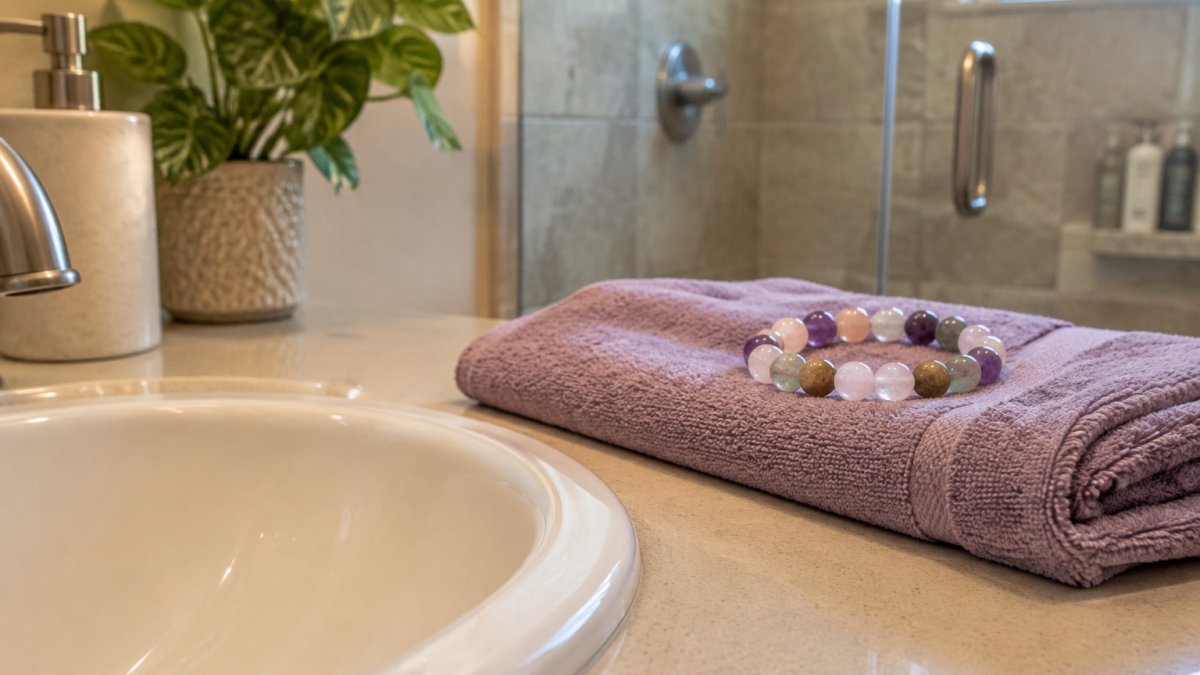
- Let the bracelet rest on a clean towel to air out.
- Store pieces separately so they do not scratch each other.
For many people, a quick wipe is enough. Save deeper cleaning for rare occasions, and keep water to a minimum.
Can You Wear a Crystal Bracelet While Sleeping?
Many people wear crystal bracelets overnight without problems. Sleeping in a bracelet is usually fine, as long as the piece stays dry and the cord is in good shape. Take it off if you plan to shower, swim or use cleaning products the next morning.
Ready to find the right crystal for your daily routine? Browse our collection and pick up a piece you can wear with confidence.
Frequently Asked Questions
What crystals can I wear in the shower?
Most crystal jewelry is better removed before showering. Harder, less porous stones such as quartz varieties, including clear quartz and many agates, generally hold up better to brief water contact than softer or porous stones. Even so, soap, shampoo, steam, and heat can dull polish and loosen settings over time. The safest habit is to take jewelry off before you shower, dry it afterward, and store it away from the bathroom. Check the specific stone and the jewelry construction before deciding otherwise.
Can amethyst get wet?
Amethyst can get wet for brief moments, such as a splash of water, but repeated soaking or long exposure is not recommended. The stone is a variety of quartz, so it is harder than many decorative stones, yet it can still be affected by soap, chemicals, and heat. Dry amethyst with a soft cloth after contact with water and avoid leaving it in a steamy bathroom. Keep amethyst jewelry off during showers, baths, and swimming to protect both the stone and its metal setting.
How do I cleanse a crystal bracelet without soaking it?
You can cleanse a crystal bracelet without water by placing it on a bed of dry sea salt or in sunlight for a short period, or by smoking it with a dried herb such as sage, depending on your preference. Many people also wipe the stones gently with a soft, dry cloth. Avoid harsh cleaners and never soak elastic bracelets, since water can weaken the cord. Store the bracelet in a dry place afterward, and keep it away from direct heat for long periods.
Can I wear a crystal bracelet while sleeping?
Sleeping in a crystal bracelet is generally fine if the bracelet is comfortable and the stones are not sharp or heavy enough to cause discomfort. Elastic cords stretch and wear out faster with constant body contact, so check the bracelet regularly for loose beads or thinning cord. Taking the bracelet off at night also gives your skin a break and lets the piece dry out completely. Store it in a dry spot, such as a jewelry box, when you are not wearing it.
