

Table of Contents
- Understanding Tarot and Oracle Cards
- Key Differences Between Tarot and Oracle Decks
- Preparing Your Space and Setting Intention
- How Many Cards to Pull for a Tarot Reading with Oracle Cards
- Tarot and Oracle Card Spreads That Work Together
- Using an Oracle Card Clarifier for Tarot Readings
- Interpreting Messages and Handling Conflicting Guidance
- A Worked Example: Combining Both Decks in Practice
- Frequently Asked Questions
Last Updated: October 5, 2026
Understanding Tarot and Oracle Cards
Tarot cards are a deck of 78 cards divided into two sections: the Major Arcana (22 cards representing major life themes) and the Minor Arcana (56 cards covering everyday situations). Oracle cards are a more flexible divination tool, typically 30-50 cards with themes chosen by the deck creator, designed to offer guidance and clarity. Both serve as mirrors for reflection and tools for accessing your own intuition.

Tarot follows a consistent framework used for centuries; oracle decks are newer and more intuitive. Together, they layer structured guidance with intuitive messaging.
Key Differences Between Tarot and Oracle Decks
Tarot decks follow a specific structure with 78 cards and consistent symbolism, making them easier to study deeply.
Oracle decks are more flexible, each creator designs their own around a specific theme. This freedom makes them feel personal and intuitive.
Here's what sets them apart in practice:
- Tarot: 78 cards, numbered positions, archetypal meanings, deeper study required
- Oracle: 20-60 cards, themed by creator, intuitive meanings, easier for beginners
- Tarot spreads: Specific layouts with defined positions (past, present, future; etc.)
- Oracle draws: Flexible, pull one card, three cards, or however many feel right
- Tarot learning curve: Steeper; you're learning a symbolic language
- Oracle learning curve: Gentler; the guidebook does most of the work
Combined, tarot provides depth and structure while oracle adds clarity and intuitive insight, creating a fuller picture.
Preparing Your Space and Setting Intention
Set up your reading space:
- Clear a flat surface and remove distractions
- Add a grounding element (candle, crystal, or plant)
- Take three slow breaths to settle your energy
Set a clear intention. Your intention is the question or topic you're exploring. Write it down or speak it aloud; naming what you're seeking helps your intuition focus.
How Many Cards to Pull for a Tarot Reading with Oracle Cards
Fewer cards (2-3) work best for specific questions like "What do I need to know today?" A single tarot card plus one oracle clarifier gives sharp insight.
Moderate spreads (4-5 cards) balance depth and clarity for layered questions, ideal for weekly readings.
Larger spreads (6-9 cards) suit comprehensive questions. More cards require more interpretation time.
Practical card-count formulas:
For yes/no or quick clarity:
- Pull 1 tarot card (the core answer)
- Pull 1 oracle card (the why or the feeling)
- Total: 2 cards
- Best for: "Should I do this?" "Is this the right time?" "What's the main thing I'm missing?"
For situation-challenge-guidance (the most versatile structure):
- Pull 3 tarot cards in these positions: (1) what's happening, (2) what's blocking or complicating it, (3) what to do about it
- Pull 1 oracle card as an overall theme or clarifier
- Total: 4 cards
- Best for: Weekly check-ins, relationship questions, work decisions, personal growth inquiries
For multi-layered questions:
- Pull 5 tarot cards using a spread like Past-Present-Future-Challenge-Outcome, or Situation-Perspective-Action-Obstacle-Guidance
- Pull 1-2 oracle cards to highlight the most important message or clarify any confusing tarot card
- Total: 6-7 cards
- Best for: Major life decisions, understanding a complex situation, exploring a pattern
For comprehensive life-area readings:
- Pull 7-9 tarot cards in a structured spread (Celtic Cross, or a custom spread with positions for each aspect of the question)
- Pull 1-2 oracle cards after interpreting the tarot to synthesize the overall message
- Total: 8-10 cards
- Best for: Annual readings, deep healing work, exploring a major life transition, when you have 30+ minutes to sit with the reading
Always pull tarot first. Tarot establishes foundation and structure; oracle then clarifies and highlights what matters most.
Resist pulling too many cards. A three-card reading you understand deeply is more valuable than a nine-card reading you're confused by.
Tarot and Oracle Card Spreads That Work Together
A spread is the physical layout of cards where each position has a meaning. Together, tarot and oracle create a conversation: tarot provides detailed answers, oracle provides intuitive summary.
The Simple Three-Card Spread (situation, challenge, guidance)
This is the most versatile spread for combined decks, mirroring how we naturally think: context, problem, solution.
Positions:
- Left card: The situation or context
- Center card: The challenge, block, or hidden factor
- Right card: The guidance, action, or outcome
Pull three tarot cards into these positions. Then pull one oracle card as an overall theme, it often answers "What's the most important thing to remember?"
Example: You pull Five of Pentacles (hardship), Eight of Cups (walking away), and Ace of Wands (new beginning). The story is clear: you're struggling, you're leaving, something fresh is coming.
The Past-Present-Future Spread with Oracle Clarifier
This spread works well for understanding how a situation evolved and where it's heading.
Positions:
- Left card: Past influences or what led to now
- Center card: Current energy or what's happening now
- Right card: Likely outcome or future direction
Pull three tarot cards to tell the story of how you got here and where you're going. Then pull one oracle card overlapping the center card to answer "What do I need to do right now?"
Example: You pull The Hermit (past isolation), The Lovers (present connection), and The Sun (future joy). The oracle card is "Vulnerability." The message: "You've been alone, now you're opening to someone.
The Decision Spread (option A, option B, outcome, oracle theme)
Use this when you're choosing between two paths.
Positions:
- Left card: What happens if you choose option A
- Center card: What happens if you choose option B
- Right card: The likely outcome of your actual choice (your intuition often knows which way you'll go)
- Oracle card: The theme or energy of whichever choice you're leaning toward
Pull two tarot cards for the two options, a third for the outcome, then one oracle card to clarify which option aligns with your values.
Example: Option A (stay in your job) is the Eight of Pentacles, mastery and skill-building. Option B (leave and start something new) is the Fool, risk and new beginnings.
The Chakra Spread (uses both decks beautifully)
This spread maps a question or situation across the seven energy centers of the body. It's excellent for holistic questions about health, balance, or personal development.
Positions:
- Root (base of spine): Foundation, safety, grounding
- Sacral (lower abdomen): Creativity, sexuality, flow
- Solar Plexus (upper abdomen): Power, will, confidence
- Heart (center of chest): Love, compassion, connection
- Throat (neck): Communication, truth, expression
- Third Eye (forehead): Intuition, insight, vision
- Crown (top of head): Spirituality, purpose, connection to something larger
Pull one tarot card for each position. Then pull oracle cards only for chakras that feel blocked or unclear.
Example: Your question is "How do I move forward after a breakup?" You pull cards for all seven chakras. Most are clear, but your Heart and Throat chakras feel stuck.
The Question-Specific Spread (custom positions)
For any question that doesn't fit the above spreads, create your own. The key is making each position match a part of your question.
Example question: "What do I need to know about starting my own business?"
Custom positions:
- My readiness or current skills
- The market opportunity
- The main risk or challenge
- What I need to learn or develop
- The likely outcome if I move forward
Pull five tarot cards into these positions. Then pull one oracle card asking: "What's the most important thing I'm not seeing?" The oracle card often highlights an assumption you're making or a resource you're overlooking.
When to use this spread: Any specific, multi-part question. Create the positions to match your question's natural structure.
Read the tarot spread first as a complete story. Then add oracle card(s) to illuminate or deepen the message. Contradictions invite deeper thinking.
Using an Oracle Card Clarifier for Tarot Readings
An oracle clarifier is a single oracle card you pull when a tarot card feels unclear or contradictory, your tool for getting unstuck.
When to pull a clarifier:
- A tarot card feels ambiguous or confusing
- Two tarot cards seem to contradict each other
- You're not sure how the reading applies to your situation
- You want more specific guidance on one particular card
After laying out your tarot spread, look at any card that feels unclear and ask internally: "What do I need to understand about this card?" Then pull one oracle card for specific, intuitive clarification.
Example: You pull the Eight of Pentacles (mastery, skill-building). Pull an oracle clarifier. "Action" means start learning; "Rest" means integrate what you know.
Interpreting Messages and Handling Conflicting Guidance
When messages align: This is confirmation. If both decks point toward the same theme, trust it, this is your core message.
When messages seem to conflict: This invites deeper thinking. A tarot card about challenge paired with an oracle card about joy might mean: "This situation is difficult, but it's also an opportunity for growth."
To reconcile conflicting messages: Read both cards individually, ask how both can be true, look for the deeper connection, and trust your intuition.
Common conflicts and what they mean:
- Challenge + trust: Get through this by having faith.
- Opportunity + wait: The opportunity is real, but timing matters.
- Closure + beginning: One chapter ends so another can start.
A Worked Example: Combining Both Decks in Practice
Let's walk through a real reading. Your question: "What do I need to focus on this week?"
Step 1: Prepare and set intention. Light a candle, take three breaths, and state your question: "What's the most important thing for me to focus on this week?"
Step 2: Shuffle both decks separately. Shuffle your tarot deck, then your oracle deck.
Step 3: Pull your tarot cards using a three-card spread: situation, challenge, guidance.
- Card 1 (Situation): Five of Cups, loss or disappointment.
- Card 2 (Challenge): The Hermit, introspection and withdrawal; you might be isolating.
- Card 3 (Guidance): The Star, hope, clarity, and renewed direction.
Step 4: Interpret the tarot reading. You're dealing with disappointment and tempted to withdraw, but the path forward is to reconnect with hope.
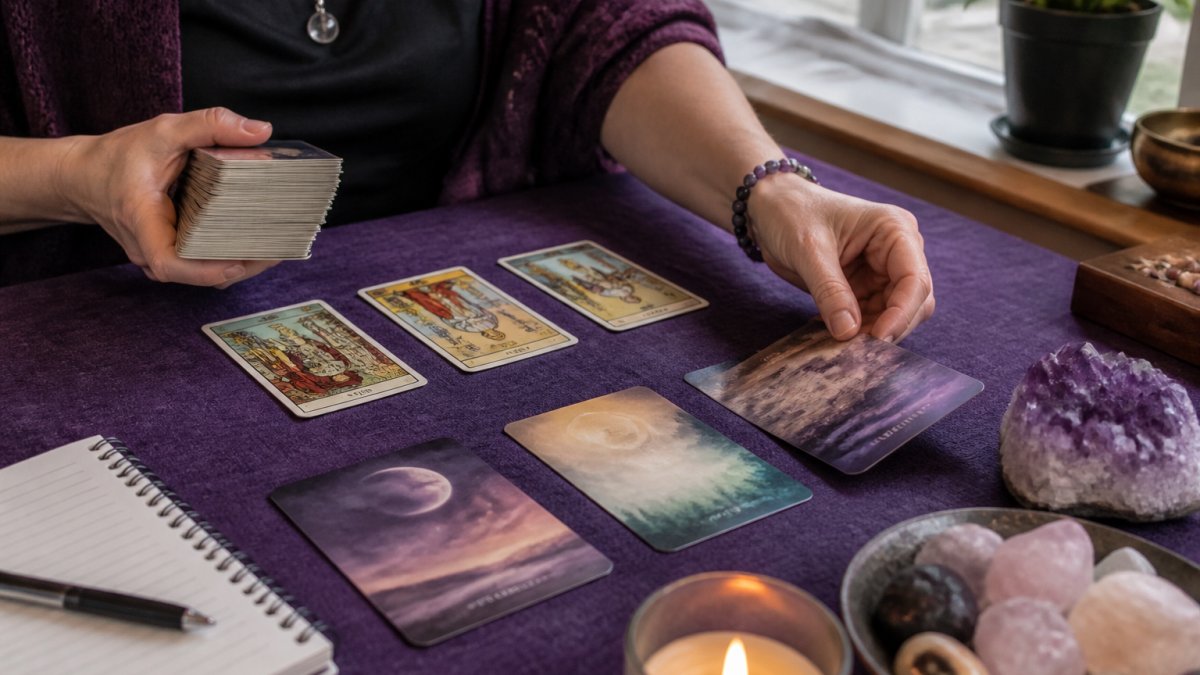
Step 5: Pull an oracle clarifier. The Five of Cups feels heavy, so you pull one oracle card: "Compassion."
Step 6: Synthesize the messages. Tarot says you're disappointed and withdrawing, but hope is available. Oracle says compassion is the key. Combined: This week, treat yourself with compassion. Be gentle instead of isolating. Hope returns when you stop judging yourself for struggling.
Step 7: Journal or reflect. Write down the reading and note what stands out. What action does this suggest?
Combining tarot and oracle cards deepens your spiritual practice and gives you richer guidance. Whether you're new to divination or experienced, having both decks in your toolkit opens new possibilities. For Heaven's Sake carries a curated selection of tarot and oracle decks designed for every level. Visit us at 2680 Youngfield Street, Lakewood, Colorado 80215 to explore decks in person and find the ones that resonate with you.
Frequently Asked Questions
Can you use tarot and oracle cards together in one reading?
Yes, tarot and oracle cards work well together. Tarot provides structured archetypal guidance through 78 cards with fixed meanings, while oracle cards offer flexible, intuitive messaging. Many readers use oracle cards as clarifiers to deepen tarot insights or to open and close readings. The two decks complement each other when you're clear about your intention and willing to interpret how their messages connect.
How many cards should you pull when combining tarot and oracle decks?
Start with a foundation tarot spread (typically 3-5 cards) and add 1-2 oracle cards as clarifiers or additional guidance. For example, a three-card tarot spread (past-present-future) works well with one oracle card drawn after to summarize the overall message. As you gain experience, you can adjust based on your reading question. Keep it simple at first to avoid overwhelming yourself with too many messages.
What should you do if tarot and oracle cards give conflicting messages?
Conflicting messages often point to complexity in your situation rather than error. Look for the deeper truth: the tarot may reveal challenges while the oracle offers encouragement, or vice versa. Journal about both messages and sit with them for a day or two. Sometimes the cards are addressing different layers of the same question. Trust your intuition to synthesize them into guidance that feels true for your circumstances.
Should you pull an oracle card before or after your tarot reading?
Both approaches work. Many readers open with an oracle card to set the reading's energy, then work through the tarot spread. Others draw tarot first, then use an oracle card as a clarifier or closing message. Experiment to find what feels natural. Your intention matters more than the order. Some readers use oracle cards between tarot sections or as a final summary card to anchor the reading's guidance.