

Table of Contents
- What Tarot Actually Is (And What It Isn't)
- Best Tarot Decks for Beginners: How to Choose Your First
- How to Cleanse Tarot Cards Before Your First Reading
- Your Beginner Guide to Tarot Reading: Cards, Shuffling, and Intention
- Simple Tarot Spreads for Beginners to Try First
- How to Read Tarot for Yourself: Intuition, Journaling, and Honest Interpretation
- Building a Consistent Tarot Practice Over Time
- Conclusion
Last Updated: August 28, 2026
What Tarot Actually Is (And What It Isn't)
Tarot reading uses a structured deck of 78 illustrated cards as a reflective tool for self-exploration, decision-making, and personal insight. Each card carries symbolic imagery rooted in archetypes and human experience, helping you examine situations from new angles.
Tarot is not a fortune-telling machine that predicts fixed outcomes. Many beginners expect the cards to hand them answers, but tarot functions like a mirror, it reflects back what's already present in your thinking, fears, and intuitions, giving you a structured way to examine them. The practice has roots in 15th-century Europe, where illustrated decks were originally used for card games before evolving into tools for divination and spiritual practice.
At For Heaven's Sake, we've guided many beginners through their first encounter with tarot. The most common early mistake is treating the cards as an authority rather than a conversation partner. The cards don't decide anything. You do.
Best Tarot Decks for Beginners: How to Choose Your First
The most widely recommended starting point is the Rider-Waite-Smith deck, first published in 1909 (loc.gov). Its fully illustrated scenes on every card, including the Minor Arcana, make interpretation far more accessible than older decks with abstract pip designs. Most tarot guidebooks and online resources use it as their reference point, so learning on it means your study materials will match your cards.
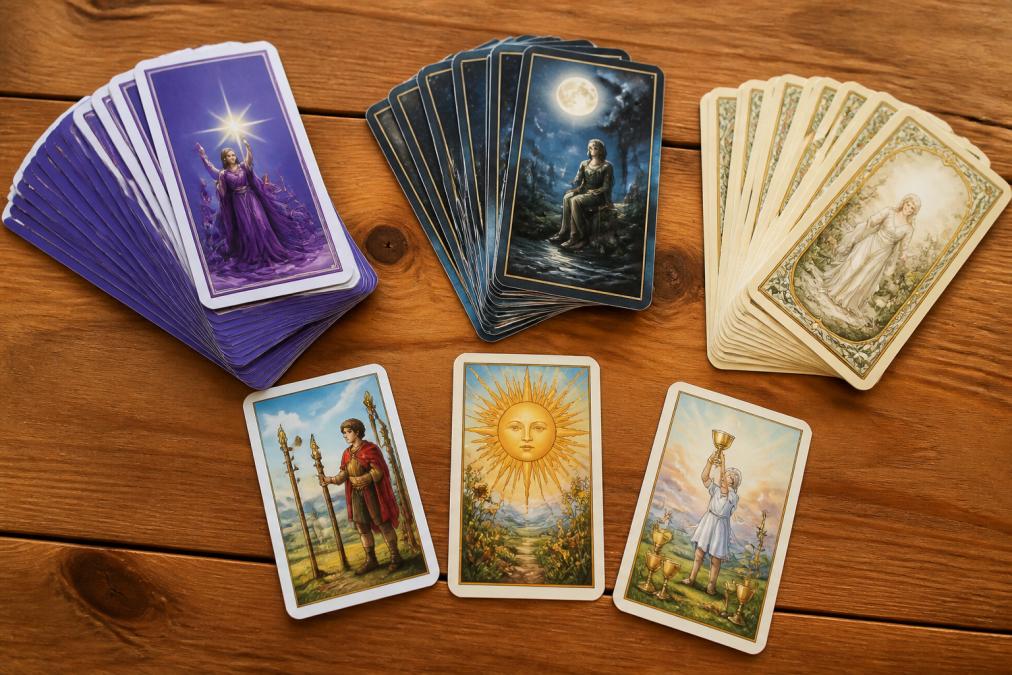
That said, the best deck for a beginner is the one that genuinely draws you in. Symbolism lands differently when you feel a visual connection to the artwork. Many practitioners recommend browsing decks in person, holding a deck, and noticing your reaction.
A few practical criteria worth applying:
- Full illustration on every card: Avoid pip-only decks until you have a foundation
- An included guidebook: A well-written companion makes early interpretation much easier
- Clear symbolic imagery: Heavily abstract decks can be beautiful but harder to read intuitively as a beginner
- A comfortable size: Standard tarot cards are larger than playing cards; some decks offer smaller formats
The Rider-Waite-Smith, Morgan-Greer, and Universal Waite are all solid entry points. Once you've built familiarity with one deck, branching out becomes a natural part of deepening your practice.
| Deck Type | Best For | Key Feature |
|---|---|---|
| Rider-Waite-Smith | Absolute beginners | Fully illustrated, widely referenced |
| Morgan-Greer | Visual learners | Rich color, close-up imagery |
| Universal Waite | Traditional learners | Softer palette, classic symbolism |
| Thoth Tarot | Later intermediate work | Complex esoteric symbolism |
How to Cleanse Tarot Cards Before Your First Reading
Cleansing tarot cards clears residual energy from a new or recently used deck so it feels fresh and aligned with your intention. Whether you approach this literally or symbolically, it serves a real psychological function: it marks a boundary between ordinary handling and intentional practice.
Common cleansing methods include smoke cleansing, moonlight exposure, crystal placement, knocking the deck three times, or intention-setting breath. According to American Psychological Association's overview of ritual behavior, ritual actions can meaningfully reduce anxiety and increase focus before high-stakes tasks. Cleansing your deck functions in exactly this way.
You don't need to cleanse every single time you use your deck. Many readers cleanse after a particularly heavy reading, when someone else has handled their cards, or at the start of a new moon cycle.
Your Beginner Guide to Tarot Reading: Cards, Shuffling, and Intention
Understanding how the deck is organized, how to handle it physically, and how to approach a reading with clear intention will determine how useful tarot becomes for you.
Understanding the Major and Minor Arcana
A standard tarot deck contains 78 cards divided into two main sections.
The Major Arcana consists of 22 cards numbered 0 through 21, beginning with The Fool and ending with The World. These cards represent major life themes, archetypal forces, and significant turning points. When Major Arcana cards appear prominently in a reading, they signal matters of deeper importance or longer-term significance.
The Minor Arcana contains 56 cards divided into four suits: Cups, Pentacles, Swords, and Wands. Each suit runs from Ace through 10, followed by four Court Cards (Page, Knight, Queen, King). The suits correspond to different areas of life:
- Suit of Cups: Emotions, relationships, intuition
- Suit of Pentacles: Material life, finances, work, physical health
- Suit of Swords: Thought, conflict, communication, challenges
- Suit of Wands: Passion, creativity, ambition, energy
Minor Arcana cards address the day-to-day texture of experience rather than sweeping life themes.
How to Shuffle, Draw, and Set an Intention
Setting an intention before a tarot reading is the difference between a purposeful reading and a random card pull. An intention focuses your question and gives the cards something to respond to.
Effective intention-setting looks like this:
- Sit quietly for one to two minutes before touching your deck.
- Formulate a clear, open-ended question. "What do I need to understand about my relationship with work right now?" works far better than "Will I get the promotion?"
- Hold the deck in both hands and bring your question to mind with genuine focus.
- Shuffle in whatever way feels natural. There's no correct method.
- Draw your card or cards from wherever your hand is drawn. Trust your instinct.
A common mistake is shuffling mechanically while thinking about something else. The physical act of shuffling is also the act of focusing.
Reversed Cards: What They Mean and How to Handle Them
Reversed cards, cards that land upside-down during a reading, generally suggest a blocked or delayed expression of the card's energy, an internalized version of the card's themes, or a need to revisit something before moving forward.
The honest answer is that reversed card meanings are interpretive, not fixed. Many experienced readers don't use reversals at all, especially early in their practice. If you choose to include them, approach each reversal as a nuance rather than a negation. If you're just starting out, it's entirely reasonable to read all cards upright until you've built confidence with the standard meanings.
Simple Tarot Spreads for Beginners to Try First
A tarot spread is a defined layout that assigns a specific meaning to each card position before you draw. Spreads give structure to a reading and prevent the common beginner problem of pulling cards without knowing what to do with them.
The One-Card Daily Draw
The one-card daily draw is the single most effective practice for building tarot fluency.
Each morning, shuffle your deck while holding a simple question: "What do I need to focus on today?" Draw one card and spend two to three minutes sitting with it before reaching for your guidebook. Notice your immediate reaction first, then consult the guidebook. Over time, your intuitive observations and the book's meanings will converge, and that convergence is where genuine tarot skill develops.
By evening, look back at the card and notice where its themes showed up in your day. This connecting of cards to personal life events is one of the fastest ways to make the symbolism feel real and relevant.
The Three-Card Past-Present-Future Spread
The three-card spread is the most versatile structure in tarot. The classic layout assigns positions to past, present, and future, but the same three-card format works for many other frameworks:
- Situation / Action / Outcome
- Mind / Body / Spirit
- What to embrace / What to release / What to cultivate
- The challenge / The hidden factor / The way forward
Shuffle with your question in mind, then draw three cards and lay them left to right. Read each card in its position first, then look at the three together as a narrative. According to Psychology Today's overview of reflective journaling practices, structured reflection frameworks help people access insights they wouldn't reach through unguided thinking alone.
How to Read Tarot for Yourself: Intuition, Journaling, and Honest Interpretation
Reading tarot for yourself is harder than reading for others. The difficulty is honesty. When you're reading for yourself, you already have preferences about what the cards "should" say. The temptation to cherry-pick interpretations that confirm what you want to hear is real.
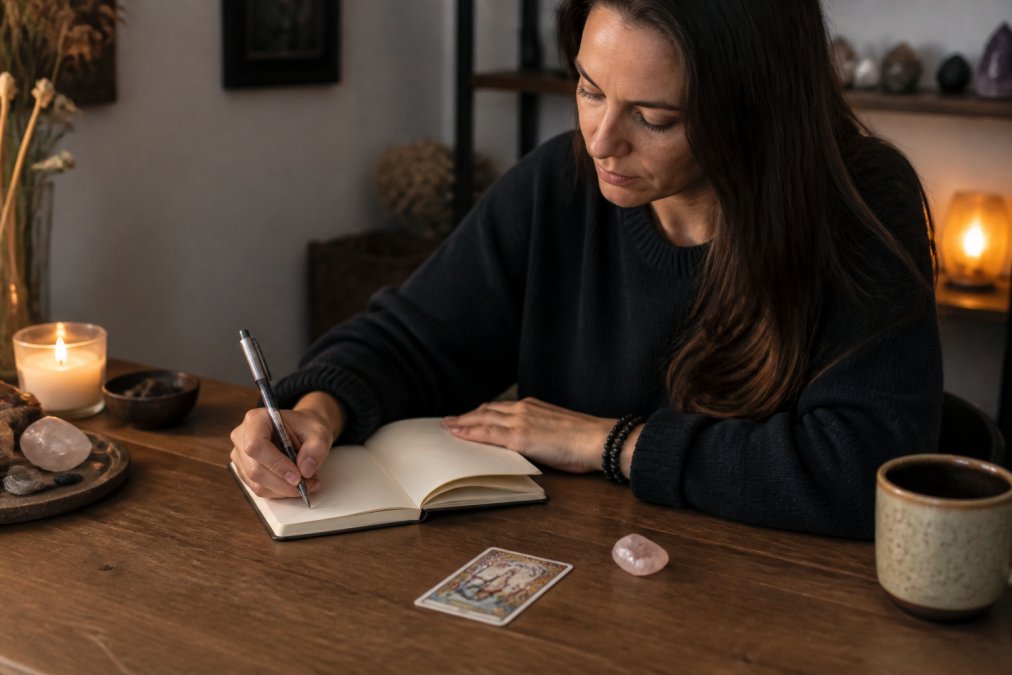
The most effective counter to this is journaling. Write down the card you drew, your immediate reaction, the guidebook meaning, and your interpretation before you know how the situation resolves. This written record prevents retroactive reinterpretation and builds a body of evidence about how the cards actually speak to your life.
A basic tarot journal entry might include:
- Date and question asked
- Cards drawn and their positions
- First intuitive impression (before the guidebook)
- Guidebook meaning
- How you're interpreting the card in context
- Follow-up note: how the reading connected to what actually unfolded
Journaling accelerates your learning faster than any other single habit. After 30 daily draws with written notes, you'll have more practical knowledge of the cards than most people accumulate in a year of casual reading.
Troubleshooting Difficult or 'Scary' Readings
The Death card, the Tower, and the Ten of Swords make beginners put the deck away. Here's the reframe: tarot's most dramatic-looking cards are rarely literal. Death almost universally represents endings and transformation, not physical death. The Tower signals disruption and sudden change, which can be painful but often clears space for something more aligned. The Ten of Swords typically marks the end of a difficult cycle, the worst is already over.
When a reading feels frightening, don't draw again to "cancel" the card. Instead, ask a follow-up question: "What is this card asking me to pay attention to?" Look at the full spread, not just the alarming card. Remember that tarot describes tendencies, not certainties.
Ethical Considerations When Reading for Yourself and Others
Once you've built confidence, friends and family will often ask you to read for them. A few principles worth holding:
- Never read for someone without their explicit consent.
- Avoid making medical, legal, or financial predictions. Tarot can illuminate how someone feels about a situation; it cannot diagnose or prescribe.
- Be honest about your skill level. Frame your reading as a shared exploration, not an authoritative pronouncement.
- Respect what you're told in confidence. Readings often surface vulnerable material.
Building a Consistent Tarot Practice Over Time
Consistency matters more than depth in the early stages. A daily one-card pull practiced for three months builds more genuine fluency than an occasional deep-dive reading.
A few structures that help beginners stay consistent:
- Anchor the practice to an existing habit. Morning coffee, evening wind-down, or a post-meditation moment all work well.
- Keep your deck and journal visible. A dedicated space on your desk or nightstand reduces friction.
- Work through the Major Arcana systematically. Spend a week with each card: pull it intentionally, read about it, journal about it, and notice where its themes appear in daily life.
- Find community. Tarot benefits from conversation. Sharing readings and discussing interpretations accelerates learning.
The thing nobody tells you about building a tarot practice is that the cards become more meaningful as your life experience deepens. This is a long-term relationship, not a skill you acquire and then possess.
For those in the Denver metro area, For Heaven's Sake offers professional readings, community events, and psychic fairs that connect beginners with experienced practitioners in a genuinely welcoming environment. With over 900 five-star Google reviews and more than two decades of serving the community, it's a resource worth knowing about when your practice is ready to expand beyond solo study.
The tarot reading practice you build is ultimately yours. The cards, spreads, and journaling habits should feel like an authentic extension of how you already think and reflect, not a performance of someone else's ritual. Start simply, stay curious, and trust that the practice will deepen on its own timeline.
Frequently Asked Questions
Can I teach myself to read tarot?
Yes. Most experienced readers are self-taught. Start with a beginner-friendly tarot deck that includes a guidebook, practice a daily one-card draw, and keep a journal of your interpretations. Over time, you'll build familiarity with card symbolism and develop your own intuitive reading style. A beginner guide to tarot reading gives you the structure to start confidently without needing a teacher or class.
Do I need to memorize all 78 tarot card meanings?
No. Memorizing all 78 card meanings upfront is one of the most common beginner mistakes. Instead, focus on the Major Arcana first, 22 cards that represent major life themes and archetypes. From there, learn the four suits of the Minor Arcana gradually. Your guidebook is always available, and journaling your personal associations with each card often leads to deeper understanding than rote memorization ever would.
How do I choose my first tarot deck?
Choose a deck whose artwork genuinely speaks to you. The Rider-Waite-Smith tradition is widely recommended for beginners because each card features illustrated scenes that make intuitive interpretation easier. Avoid highly abstract or minimalist decks until you're more experienced. Visiting a metaphysical shop in person lets you hold and flip through decks before buying, that tactile connection matters more than most beginners expect.
What are the best simple tarot spreads for beginners?
The one-card daily draw is the single best starting point, pull one card each morning and reflect on how its symbolism connects to your day. Once that feels natural, try a three-card spread using positions for past, present, and future, or situation, action, and outcome. These simple tarot spreads for beginners build interpretation skills quickly without the overwhelm of larger layouts like the Celtic Cross.
What do reversed cards mean in a tarot reading?
Reversed cards, cards that appear upside-down when drawn, are widely interpreted as blocked energy, an internalized version of the card's theme, or a delay in its expression. Some readers assign distinct reversed meanings to every card; others simply read all cards upright. As a beginner, it's fine to start reading upright-only until you're comfortable with the standard meanings, then introduce reversals gradually.
How do I cleanse tarot cards before using them?
Common methods include passing the deck through smoke from cleansing herbs, placing a crystal such as clear quartz or selenite on top of the deck overnight, knocking on the deck three times to clear old energy, or leaving it under moonlight. How to cleanse tarot cards is largely a matter of personal practice, choose a method that feels meaningful to you and repeat it whenever the deck feels energetically heavy or after readings for others.
For anyone beginning their tarot reading practice, the challenge is usually not finding information, it's finding a starting point that doesn't feel overwhelming. For Heaven's Sake supports that beginning with a curated selection of tarot decks, guidebooks, and ceremonial supplies, alongside professional readings from experienced practitioners who meet you exactly where you are. Visit us to browse our collection and find the tools that feel right for where your practice begins.
This article was written using GrandRanker