

Table of Contents
- Crystals vs Medication for Anxiety Relief: What the Evidence Shows
- What Research Actually Says About Crystals and Anxiety
- The Role of Placebo Effect and Expectancy
- Do Crystals Help With Anxiety
- Evidence-Based Anxiety Treatments and How They Work
- Grounding Techniques for Anxiety and Crystal Integration
- Using Crystals Alongside Therapy and Medication
- Making Your Decision: Crystals, Medication, or Both
- Frequently Asked Questions
Last Updated: October 17, 2026
Crystals vs Medication for Anxiety Relief: What the Evidence Shows
When anxiety takes hold, you're looking for relief that actually works. The question of crystals vs medication for anxiety relief isn't about which is better in some abstract sense, it's which approach fits your situation, your body, and your needs. At For Heaven's Sake, we work with people every day who are exploring options for anxiety relief, and the honest answer is more nuanced than most guides acknowledge.
Crystals and medication operate on completely different mechanisms. One works through your mind and energy; the other through your brain chemistry. Understanding that difference, and what the actual evidence says about each, is the first step to making a choice that's right for you.
What Research Actually Says About Crystals and Anxiety
The scientific evidence on crystals for anxiety is limited and mixed. No peer-reviewed studies demonstrate that crystals have intrinsic healing properties that directly reduce anxiety symptoms in the way medication does.
That doesn't mean crystals are useless. It means we need to be honest about what they do and don't do.
Research from the National Center for Complementary and Integrative Health has examined complementary practices extensively. The findings consistently show that when crystals help with anxiety, the mechanism is often psychological rather than chemical. This isn't a flaw, it's just how they work.
Many people report feeling calmer when holding a crystal or wearing one as jewelry. That experience is real. The question is whether the crystal itself is responsible or whether other factors are at play.
The Role of Placebo Effect and Expectancy
Here's where most conversations about crystals get stuck: the placebo effect isn't fake, and it's not worthless.
When you believe something will help, your brain can actually produce measurable changes in anxiety levels. Your nervous system responds to expectation. This is documented in neuroscience research and it's one reason why context, ritual, and intention matter in any anxiety management practice.
The placebo effect explains a significant portion of reported crystal benefits. You hold an amethyst, you expect it to calm you, and your body responds by actually becoming calmer. Your breathing slows. Your shoulders drop. Your mind settles.

The challenge is that placebo effects tend to fade over time. They're strongest when you first try something. After weeks or months, the novelty wears off and the benefit often diminishes unless something else is reinforcing it.
This is why crystals work best as part of a larger anxiety management routine, not as a standalone solution for clinical anxiety.
Do Crystals Help With Anxiety
Crystals can support anxiety management in specific ways, but they're not a treatment for anxiety itself.
Many people find that holding a smooth stone or wearing a crystal pendant creates a moment of pause. It's a tactile reminder to breathe, to ground yourself, to step out of anxious thoughts for a moment. That pause has real value.
Certain crystals are traditionally associated with calming properties. Amethyst, for example, is widely used for anxiety relief and is believed to promote inner peace and restful sleep.
Blue lace agate is another popular choice, traditionally used to soothe nervousness and promote clear communication, helpful if anxiety makes it hard to express yourself. Our AGATE/BLUE LACE - Tumbled LG is designed to be held or carried as a grounding tool.

The reality is that crystals work best when they're part of your mindfulness practice. You're not relying on the stone to fix your anxiety. You're using it as an anchor for attention and intention.
Popular Crystals for Anxiety Management
Several crystals appear repeatedly in anxiety relief practices, though the evidence supporting them is experiential rather than clinical.
Amethyst is perhaps the most well-known. It's traditionally believed to calm fears and anxieties while supporting restful sleep. Many people keep amethyst on their nightstand or carry a piece with them.
Septarian is known for grounding and stress reduction. The stone is traditionally used to help reduce anxiety and anger while promoting feelings of being protected and understood.
Blue lace agate supports communication and emotional expression. If anxiety manifests as difficulty speaking up or expressing your needs, this stone is traditionally chosen to help clear that blockage.
Lepidolite contains lithium, which is also used in some anxiety medications.
The best crystal for you is one that resonates with you personally. If you feel drawn to a particular stone, that intuitive pull is part of what makes it work for you.
How People Use Crystals in Daily Routines
The most effective crystal practices integrate the stone into a deliberate routine rather than treating it as a passive fix.
Carrying a tumbled stone in your pocket gives you a grounding tool you can touch when anxiety rises. The physical sensation of the smooth stone, the pause you take to notice it, these create a moment of interruption in the anxiety spiral.
Wearing a crystal pendant keeps the stone close to your body throughout the day. Many people choose pieces like our Pendant, Wire Wrapped Assorted Stones, which combines intention with wearable style.
Placing a stone under your pillow or on your nightstand can support sleep, which is often disrupted by anxiety. Holding a crystal during meditation or breathwork deepens your focus and intention.
The key is consistency and awareness. You're not waiting for the crystal to magically fix anxiety. You're creating a practice that reminds you to pause, breathe, and reconnect with calm.
Evidence-Based Anxiety Treatments and How They Work
When anxiety is clinical, when it's persistent, interferes with daily life, or causes significant distress, the evidence strongly supports specific treatments.
Medication and therapy have decades of research backing their effectiveness. They work through different mechanisms, and often work best together.
Medication Options for Anxiety
Anxiety medications fall into several categories, each with different mechanisms and applications.
AGATE/BLUE LACE - Tumbled LG →
SSRIs (selective serotonin reuptake inhibitors) are first-line medications for generalized anxiety disorder and panic disorder. They work by increasing available serotonin in the brain, which helps regulate mood and reduce anxious thoughts. Common SSRIs include sertraline, paroxetine, and escitalopram.
SNRIs (serotonin-norepinephrine reuptake inhibitors) work similarly but affect both serotonin and norepinephrine. They're also used for anxiety and often prescribed when SSRIs alone aren't sufficient.
Benzodiazepines provide rapid anxiety relief but carry risk of dependence, so they're typically prescribed for short-term use or acute anxiety episodes rather than ongoing management.
The effectiveness of medication is well-documented. For moderate to severe anxiety, medication often provides significant symptom relief within weeks. The tradeoff is potential side effects, which vary by individual and medication type.
Therapy and Behavioral Approaches
Cognitive-behavioral therapy (CBT) is the most evidence-supported psychological treatment for anxiety. It works by helping you identify anxious thought patterns and develop new ways of responding to them.
Exposure therapy is particularly effective for specific phobias and panic disorder. It involves gradually facing feared situations in a controlled way, which helps your nervous system learn that the threat isn't as dangerous as anxiety claims.
Mindfulness and acceptance-based approaches teach you to observe anxious thoughts without fighting them, which often reduces their intensity over time.
These approaches work. The evidence is strong. They also take time and effort, therapy is active work, not passive treatment.
Grounding Techniques for Anxiety and Crystal Integration
Grounding techniques interrupt the anxiety cycle by anchoring your attention to the present moment. Crystals can be powerful tools for this practice.
A simple grounding technique is the 5-4-3-2-1 method: notice 5 things you see, 4 you can touch, 3 you hear, 2 you smell, 1 you taste.
Breathing exercises paired with crystal work create a ritual that signals safety to your nervous system. Hold a stone in your palm, feel its weight and temperature, and breathe slowly.
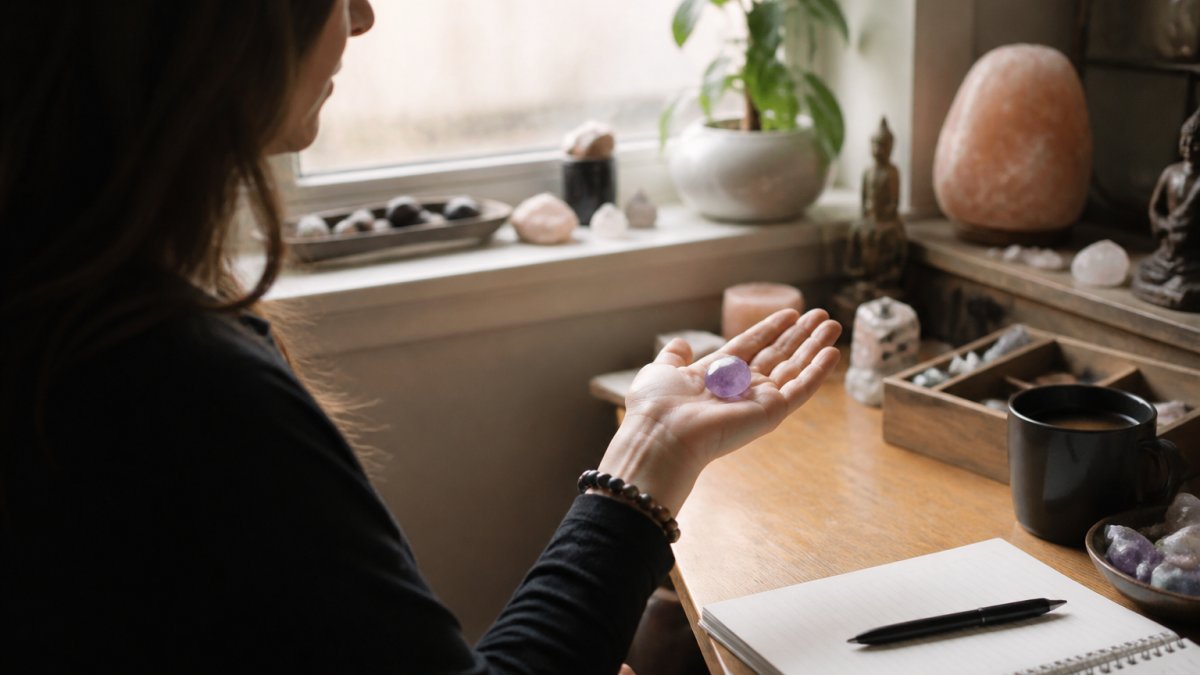
A worry stone like our Worry Stone, Selenite 1.5in. is designed specifically for this practice.

The effectiveness of grounding isn't about the crystal's mystical properties. It's about creating a deliberate pause, engaging your senses, and signaling to your body that you're safe right now.
Using Crystals Alongside Therapy and Medication
If you're on medication or in therapy for anxiety, crystals can complement those treatments without interfering.
Medication and crystals don't conflict. One works through brain chemistry; the other through ritual and mindfulness. They operate on different levels and can coexist.
Many people find that adding a crystal practice to their therapy or medication routine deepens their commitment to anxiety management. The crystal becomes a visible reminder of your intention to heal. It supports the psychological work you're doing in therapy.
The caution: don't use crystals as a reason to avoid or delay medication or therapy if you need them. If your anxiety is moderate to severe, affecting your work, relationships, or daily functioning, that's a signal to seek professional help.
For mild anxiety or as a maintenance tool after medication or therapy has brought symptoms under control, crystals can be genuinely helpful. They give you an active role in your own care, which many people find helping.
Making Your Decision: Crystals, Medication, or Both
The choice between crystals and medication isn't either/or. It depends on your anxiety's severity, how it affects your life, and what you're hoping to achieve.
Mild anxiety or stress: Crystals, grounding techniques, and mindfulness practices can be genuinely helpful. You're managing normal stress, not clinical anxiety, so psychological tools are often sufficient.
Moderate anxiety affecting daily life: Therapy, medication, or both are appropriate. Crystals can support these treatments but shouldn't replace them.
Severe anxiety or panic disorder: Medication is typically necessary, often combined with therapy.
Maintenance after recovery: Once medication or therapy has helped stabilize your anxiety, crystals and grounding practices can support long-term wellness and help prevent relapse.
The honest truth is that crystals work best for people with mild anxiety or as a complementary practice alongside professional treatment.
| Anxiety Level | Best Primary Approach | Role for Crystals |
|---|---|---|
| Mild stress | Mindfulness, grounding | Primary tool |
| Moderate anxiety | Therapy or medication | Complementary support |
| Severe anxiety | Medication + therapy | Supportive practice only |
| Acute crisis | Emergency mental health care | Not appropriate |
Anxiety relief isn't one-size-fits-all. Some people find medication essential; others respond well to therapy and mindfulness alone.
What matters most is choosing an approach that matches your needs and committing to it.
Frequently Asked Questions
Can you use crystals while taking anxiety medication?
Yes, crystals can be used alongside anxiety medication as a complementary practice. Many people find that combining evidence-based treatment like medication with grounding techniques and crystals supports their overall wellness routine. However, always consult your mental health professional before changing any medication or treatment plan. Crystals work best as a supplement to professional care, not a replacement for it.
Do crystals actually help with anxiety or is it just placebo?
Crystals don't have intrinsic healing properties supported by clinical research. However, the calming ritual of holding a crystal, focusing on your intention, and practicing mindfulness can reduce anxious thoughts and stress. This perceived benefit comes from expectancy, mindfulness practice, and the grounding effect of the ritual itself, not from the crystal's energy. If the practice helps you feel calmer, that benefit is real for your wellness routine, even if the mechanism differs from what crystal healing traditions claim.
What are evidence-based anxiety treatments I should know about?
First-line treatments include cognitive-behavioral therapy (CBT), other psychotherapy approaches, and medication like SSRIs and SNRIs. These treatments have strong clinical evidence for reducing anxiety symptoms. Lifestyle changes such as exercise, sleep, and stress management also support anxiety management. A mental health professional can help you determine which approach or combination works best for your situation. Crystals can complement these treatments as part of your self-care routine.
Should I use crystals instead of medication for anxiety?
Crystals should not replace medication prescribed by a healthcare provider. If you're experiencing significant anxiety that affects your daily life, professional help from a mental health professional is important. Medication, therapy, and grounding techniques are evidence-based treatments. Crystals can support your overall wellness as a complementary practice alongside these treatments, but they are not a substitute for professional anxiety care.