

Table of Contents
- Why Crystal Combinations Matter: Spiritual and Physical Considerations
- Crystals That Should Not Be Worn Together
- Crystals That Should Not Be Stored Together
- What Crystals Should Not Be Worn with Amethyst
- Crystals That Go Well Together
- Separating Spiritual Belief from Physical Care
- What to Do If Your Crystals Are Already Paired
- Frequently Asked Questions
Last Updated: October 16, 2026
Why Crystal Combinations Matter: Spiritual and Physical Considerations
When you start working with crystals, one question comes up fast: can you wear or store them together, or are there combinations where crystals cannot be together?
Understanding what two crystals cannot be together protects both your collection and your practice.
Two main factors determine whether crystals work together:
- Energy alignment: Do their spiritual intentions support or oppose each other?
- Physical durability: Will they scratch, crack, or degrade when stored side by side?
The first is about intention, the second about mineral science. Ignoring either leads to wasted money or a broken collection.
Crystals That Should Not Be Worn Together
Wearing crystals carries their energy close to your body all day. When two have opposing intentions, wearing them together creates internal conflict, pulling your energy in opposite directions.
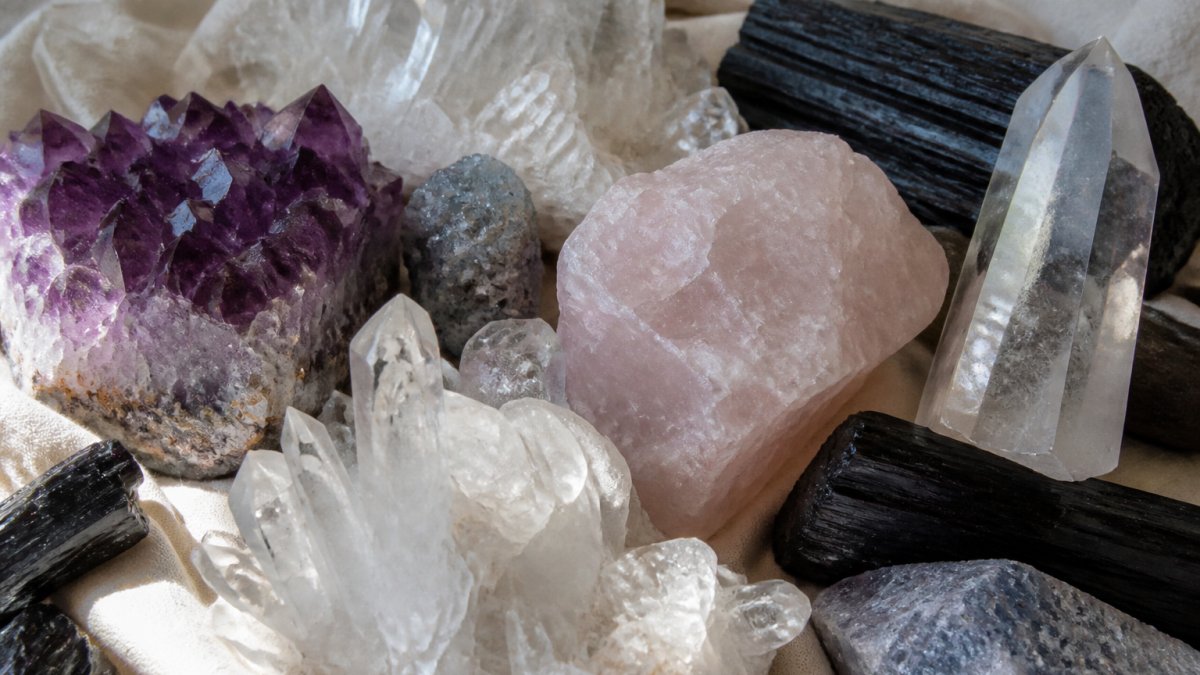
Citrine and Amethyst: Conflicting Energies
Citrine brings uplifting, energizing vibrations. Amethyst promotes calm, introspection, and spiritual connection. When worn together, these stones work against each other.
Citrine pushes energy outward and upward; amethyst pulls it inward and downward. Many people feel scattered or unfocused wearing both.
Neither stone is "bad", they're designed for different states of mind.
Rose Quartz and Black Tourmaline: Opposing Intentions
Rose quartz opens your heart to love and compassion. Black tourmaline creates protection and boundaries. These intentions can clash.
Black tourmaline says "keep things out"; rose quartz says "open your heart." Wearing both sends mixed messages, leaving you guarded and open at once, exhausting rather than balanced.
For both protection and love, wear them on different days: rose quartz when you're ready to connect, black tourmaline when you need firm boundaries.
Tiger's Eye and Labradorite: Energy Imbalance
Tiger's eye brings grounding, confidence, and personal power. Labradorite awakens intuition and spiritual sight.
Tiger's eye roots you in the physical world; labradorite pulls you toward the spiritual. Wearing both can leave you ungrounded, "caught between two worlds."
Choose one: tiger's eye for practical focus, labradorite for spiritual work or intuition.
Crystals That Should Not Be Stored Together
Storage is different from wearing: crystals sit side by side for weeks or months, so physical damage becomes the main concern. A complete storage check looks at five factors: hardness, cleavage, brittleness, moisture sensitivity, and light or heat sensitivity.
Hardness: The Scratch Test
The Mohs scale measures how easily one mineral scratches another; a stone can only be scratched by material of equal or greater hardness.
Soft stones (hardness 2-5) include:
- Selenite (2)
- Calcite (3)
- Malachite (3.5-4)
Hard stones (hardness 7-9) include:
- Amethyst and citrine (7)
- Clear quartz (7)
- Tiger's eye (7)
Store soft and hard stones separately. Hard stones will scratch soft ones during normal movement or handling. Even gentle rubbing can leave permanent marks. A simple rule: if the hardness numbers differ by two or more, do not let the stones touch.
Cleavage and Brittleness: The Breakage Test
Hardness doesn't tell the whole story: some hard minerals break along flat planes (cleavage), and some chip easily despite resisting scratches.
- Calcite has perfect rhombohedral cleavage. A light tap can split it along flat planes.
- Fluorite has perfect octahedral cleavage and is brittle. It chips easily even though it rates 4 on Mohs.
- Selenite has perfect cleavage in one direction and is flexible but fragile. Thin pieces snap.
Two hard stones with perfect cleavage can damage each other through vibration alone. Keep cleavage-prone stones in individual compartments or padded pouches.
Moisture Sensitivity: The Water Test
Some stones are damaged by water, humidity, or damp storage, relevant for cabinets, basements, and bathroom shelves.
- Selenite is water-soluble. It will dissolve or pit if left in standing water or high humidity.
- Malachite is sensitive to acids and can be damaged by acidic moisture; keep it dry.
- Pyrite can oxidize and rust in humid conditions, leaving stains on nearby stones.
Store moisture-sensitive stones with a silica gel packet in a dry cabinet. Do not store them next to a humidifier, under a bathroom sink, or in a damp basement.
Light and Heat Sensitivity: The Fade Test
- Amethyst can fade to pale gray or yellow-brown with prolonged direct sunlight.
- Rose quartz can fade with long sun exposure.
- Citrine (heat-treated amethyst) is generally more stable but still benefits from indirect light.
Keep these stones out of direct window sun. Display them in indirect light or rotate them so no single face is overexposed.
A Practical Storage Method
- Sort by hardness band. Group stones rated 2-4, 5-6, and 7-9 separately.
- Isolate cleavage-prone and brittle stones. Selenite, calcite, fluorite, and malachite each get their own pouch or compartment.
- Control moisture. Add silica gel to cabinets holding selenite, malachite, or pyrite.
- Control light. Keep amethyst, rose quartz, and fluorite out of direct sun.
- Use soft separators. Felt-lined trays, cotton pouches, and compartment boxes prevent contact damage.
Selenite and Malachite: A Case Study
Selenite rates 2 on Mohs and dissolves in water; malachite rates 3.5-4, is brittle, and is acid-sensitive. Storing them together fails three ways: malachite scratches selenite, selenite picks up residue, and moisture damages both.
Keep selenite in its own soft pouch or box away from water. Store malachite separately with other mid-hardness stones, and wash your hands after handling malachite to keep residue off other pieces.
What Crystals Should Not Be Worn with Amethyst
Amethyst is popular. Many people want to layer it with other stones. But amethyst clashes with several common crystals.
Amethyst and Pyrite Pairing
Amethyst promotes spiritual awareness and inner peace; pyrite brings grounding and material-world confidence. These vibrations oppose each other.
Pyrite is also harder, so storing them together risks scratching amethyst. Wearing both creates spiritual confusion with no physical upside.
Wear pyrite for courage in business or financial decisions; save amethyst for meditation.
The Crystal Bible: A Deinitive Guide to Crystals (Quality Paperback) →
Amethyst and Carnelian: Spiritual Conflict
Amethyst calms the mind and opens spiritual channels; carnelian activates passion, creativity, and physical energy, fundamentally different vibrations.
Wearing both asks your body to be relaxed and energized at once, so you access neither stone's full benefits.
Wear carnelian on creative days or when you need physical motivation; wear amethyst during meditation or before sleep.
Crystals That Go Well Together
Not every pairing conflicts, many stones enhance each other.
Clear quartz amplifies whatever stone it's near.
Rose quartz pairs well with amethyst. Both open your heart and spiritual channels.
Citrine and tiger's eye work together.
Black tourmaline pairs well with clear quartz. The combination creates protection plus clarity.
Before pairing any stones, ask yourself: what am I trying to achieve?
Separating Spiritual Belief from Physical Care
Here's what often gets missed in crystal guides: some pairing rules are about spiritual energy.
The spiritual conflicts between citrine and amethyst are based on belief and intention. Different people experience these stones differently.
The physical conflicts between selenite and malachite are not about belief. They're about mineral hardness. Hard stones scratch soft stones.
When choosing crystal combinations, separate these two concerns:
- Spiritual pairing: Listen to your intuition. If two stones feel wrong together, trust that feeling.
- Physical storage: Use the Mohs hardness scale. Keep soft stones away from hard stones.
Both matter. Neither one overrides the other.
What to Do If Your Crystals Are Already Paired
Maybe you have already combined crystals that a guide says should not be together. Do not panic. There is no established universal rule requiring separation, and no scientific finding that two stones cancel each other out. What matters is whether the pairing serves your intention and whether the stones are physically safe together.
Step 1: Separate Belief from Physical Risk
Ask two questions:
- Does this pairing feel right to me? Energetic compatibility is a belief, not a mineral fact. If the combination supports your intention and feels comfortable, that is a valid reason to keep it.
- Are the stones physically safe together? This is a mineral question with a concrete answer. Check hardness, cleavage, brittleness, moisture sensitivity, and light sensitivity using the storage section above.
If the answer to question 2 is no, change the storage even if you keep the spiritual pairing. If the answer to question 1 is no, change the pairing even if the stones are physically compatible.
Step 2: Match the Fix to the Use Case
Different pairings fail for different reasons. Match the fix to how you actually use the stones.
If they are worn together as jewelry:
- Check hardness first. A soft stone like selenite or malachite in the same bracelet as quartz will scratch and pit.
- Check skin contact. Malachite residue and pyrite oxidation can stain skin and fabric; keep these off direct contact with sensitive skin.
- Check water exposure. Selenite dissolves, malachite is acid-sensitive, and pyrite rusts. Remove these before washing hands, showering, or swimming.
If they are displayed together:
- Separate by hardness band and isolate cleavage-prone stones.
- Keep moisture-sensitive stones dry and light-sensitive stones out of direct sun.
- Use felt pads or individual stands so stones do not touch.
If they are stored loose in a box or pouch:
- Move to compartment storage or individual pouches.
- Add silica gel if any stone is moisture-sensitive.
- Check for existing scratches and chips before reorganizing.
Step 3: Choose a Goal-Based Pairing Framework
Instead of memorizing forbidden lists, choose pairings by intention. This framework works for any combination.
- Name the goal. Examples: calm, protection, focus, creativity, grounding, love, clarity.
- Pick one primary stone for that goal. Use a reference such as The Crystal Bible or The Book of Stones to match properties to the goal.
- Add one supporting stone with a compatible intention. Clear quartz is a safe amplifier for most intentions. Rose quartz pairs well with amethyst for calm and love. Citrine pairs well with tiger's eye for confidence and action.
- Check physical compatibility. Confirm hardness, cleavage, brittleness, moisture, and light sensitivity before storing or wearing the pair.
- Test your response. Wear or display the pair for a week. If you feel scattered, ungrounded, or uncomfortable, separate them. If you feel supported, keep the pairing regardless of what a general list says.
Step 4: Handle Delicate Stones with Extra Care
Some stones need special handling no matter what they are paired with:

- Selenite: store dry, separate, and never soak.
- Malachite: keep dry, avoid acids, wash hands after handling.
- Fluorite: pad it, keep it out of direct sun, and avoid knocks.
Step 5: When to Change the Pairing
Change the pairing if any of these apply:
- You notice scratches, chips, or residue on either stone.
- The combination feels draining, scattered, or uncomfortable after a fair trial.
- One stone is moisture- or light-sensitive and the storage conditions cannot be controlled.
If none of these apply, there is no rule that says you must separate them. Trust your intention, verify the physical facts, and adjust only where there is a concrete reason.
Frequently Asked Questions
What two crystals cannot be together without causing problems?
The answer depends on whether you mean spiritual energy or physical safety. Spiritually, many practitioners avoid pairing citrine with amethyst, or rose quartz with black tourmaline, believing they create conflicting energy. Physically, soft stones like selenite shouldn't be stored with harder stones like quartz because they scratch easily. The most important factor is your personal intention and how you care for your collection.
Can you wear multiple crystals together, or will they conflict?
You can wear multiple crystals together. Many people wear crystal combinations intentionally to amplify or balance energy. However, if you're new to crystal combinations, start by learning about each stone's individual properties. Resources like The Crystal Bible or The Book of Stones can help you understand how different stones interact and whether their spiritual properties align with your goals.
What crystals should not be worn with amethyst?
According to crystal practitioners, amethyst may conflict with carnelian (said to have opposing calming versus energizing effects) and pyrite (believed to create overstimulation). However, many people wear these combinations without issue. Your personal intuition and intention matter more than rigid rules. If you feel drawn to wearing amethyst with another stone, try it and notice how you feel.
How do I know if crystals are physically safe to store together?
Check the Mohs hardness scale to understand which stones scratch easily. Soft stones like selenite and malachite should be stored separately from harder stones like quartz or tourmaline. Keep delicate crystals in individual pouches or compartments. If you're unsure about a specific combination, seek guidance on safe storage practices for your collection.
Understanding what two crystals cannot be together protects your spiritual practice and your investment. Some combinations clash energetically. Others create physical damage. The strongest crystal collection respects both concerns. Visit For Heaven's Sake in Lakewood to explore our curated selection of ethically sourced crystals and get personalized guidance on building combinations that work for your unique spiritual goals.