

Table of Contents
- What Makes a Tarot Deck Suitable for Shadow Work
- Comparison Table: 5 Top Tarot Decks for Shadow Work
- 1. Mystic Psyche Tarot: Vibrant Symbolism for Self-Discovery
- 2. Hieronymus Bosch Tarot: Gothic Imagery for Deep Introspection
- 3. Aleister Crowley Thoth Tarot: Esoteric Depth for Experienced Readers
- How to Use Tarot for Shadow Work: Practical Steps and Spreads
- Tarot Spreads for Shadow Work: Layouts That Reveal Hidden Patterns
- Choosing Your Shadow Work Deck: Selection Criteria
- Frequently Asked Questions
Last Updated: October 18, 2026
What Makes a Tarot Deck Suitable for Shadow Work
Shadow work invites you to explore the parts of yourself you typically avoid, unconscious patterns, fears, and suppressed emotions. The right tarot deck becomes your mirror.
Not every deck works equally well. Some offer surface-level guidance; others feature imagery so dark or abstract it creates distance rather than connection. The best decks balance rich symbolism, unflinching artwork, and meanings that encourage honest self-reflection over reassurance.
The decks that resonate most have layered, psychologically complex imagery that reveals something new each time. Beginners often worry they'll misinterpret the cards, but shadow work readings aren't about the "right" answer, they're about what the cards stir up in you.
When selecting a shadow work deck, consider the artwork first: gothic, surreal, or moody imagery supports deeper introspection than bright, cheerful designs. Second, check whether the guidebook emphasizes psychological themes over predictive fortune-telling.
Comparison Table: 5 Top Tarot Decks for Shadow Work
| Deck | Price | Card Count | Best For | Standout Feature |
|---|---|---|---|---|
| Mystic Psyche Tarot | $29.95 | 78 | Beginners & self-discovery | Vibrant, mythological artwork with Celtic symbolism |
| Hieronymus Bosch Tarot | $29.95 | 78 | Deep introspection | Surreal, gothic imagery inspired by historical masterpieces |
| Aleister Crowley Thoth Tarot | $33.95 | 78 | Experienced readers | Esoteric depth with Art Deco symbolism and 48-page guide |
| Hermetic Tarot | $21.95 | 78 | Budget-conscious seekers | Black and white minimalist design for focused reflection |
| Barbara Walker Tarot in a Tin | $19.95 | 78 | Portable practice | Compact keepsake tin for on-the-go shadow work |
1. Mystic Psyche Tarot: Vibrant Symbolism for Self-Discovery
The Mystic Psyche Tarot stands out for readers who want rich, psychologically layered artwork without veering into purely dark territory. Emily Balivet's illustrations blend Celtic symbolism, surrealism, and Art Nouveau design, creating cards that feel both ancient and contemporary.

This deck works exceptionally well for beginners attempting shadow work for the first time. The vibrant colors and detailed symbolism give you something concrete to anchor your reflection, drawing you into mythological narratives rather than abstract darkness.
The 78 cards measure 6.6 inches tall and 4.5 inches wide, comfortable to shuffle and hold during longer readings. The instruction booklet provides clear meanings rooted in tarot, alchemy, and pagan traditions. Many readers find the visual richness prevents reliance on memorized interpretations.
A common mistake is choosing a deck purely for aesthetics. The Mystic Psyche Tarot succeeds because the artwork serves the shadow work process rather than distracting from it.
Jungian psychology and shadow work principles
2. Hieronymus Bosch Tarot: Gothic Imagery for Deep Introspection
If you're ready to sit with genuinely unsettling imagery, the Hieronymus Bosch Tarot transforms your shadow work practice. This deck pulls from the surreal masterpieces of one of history's most enigmatic artists, particularly The Garden of Earthly Delights.

The cards don't shy away from depicting human struggle, transformation, and the strange territories of the psyche. Medieval mysticism, philosophical symbolism, and traditional tarot archetypes weave together. This isn't a deck for comfort. It's a deck for truth.
The Hieronymus Bosch Tarot measures 4.75 inches tall and 2.75 inches wide, slightly smaller than standard decks, which some readers find easier to work with during intensive sessions. The instruction booklet guides you through Bosch's symbolism and its connection to tarot's deeper meanings. Many experienced readers report this deck cuts through avoidance faster than any other.
Shadow work tarot questions feel different with this deck: the cards demand honesty, and avoidance becomes obvious.
3. Aleister Crowley Thoth Tarot: Esoteric Depth for Experienced Readers
The Aleister Crowley Thoth Tarot isn't an entry point, it's a destination. Undertaken in 1938 and completed in 1943, it represents Crowley's restructuring of traditional tarot symbolism through Western esoteric philosophy. Lady Frieda Harris's color-drenched Art Deco interpretations transform his complex theories into visual form.
This deck carries 78 cards measuring 2 7/8" x 4 3/8", included with a 20" x 17" spread sheet and a comprehensive 48-page instruction booklet by James Wasserman, which includes two essays by Lady Frieda Harris herself.
The Thoth Tarot doesn't make shadow work easier, it makes it more precise. The archetypal symbolism and astrological correspondences give your introspection a sophisticated framework, you're not just sitting with feelings, you're mapping them onto centuries of Western occult philosophy.
For experienced readers, this deck rewards repeated study. Each session reveals connections you missed before.
How to Use Tarot for Shadow Work: Practical Steps and Spreads
Shadow work tarot readings follow a different rhythm than predictive readings.
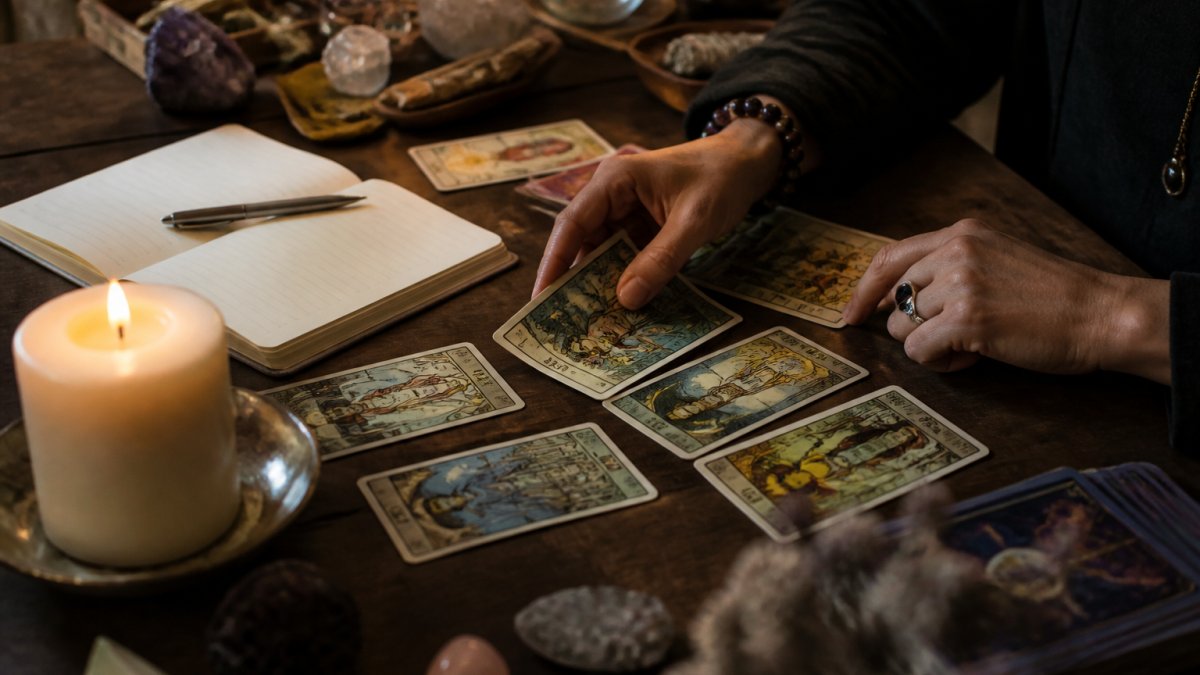
Begin by creating a container for your reading: light a candle, put your phone away, and sit with your deck before shuffling.
State your intention aloud or silently. Shadow work intentions differ from typical tarot questions.
Shuffle slowly and pay attention to how the cards feel in your hands. Some readers meditate while shuffling, breathing deeply to let their nervous system settle, preparation for honest reflection.
Draw your cards according to your chosen spread and let them sit before you read them. Notice your immediate emotional reaction, do you want to dismiss or reinterpret a card? That resistance is often the most valuable information.
Shadow Work Tarot Questions to Guide Your Reading
The questions you ask shape everything. Generic questions produce generic insights. Shadow work questions invite vulnerability.
Instead of "What do I need to know?" ask "What am I refusing to acknowledge?" Instead of "What's my next step?" ask "What fear is keeping me stuck?" These shifts transform the reading from prediction into self-discovery.
Try these shadow work tarot questions:
- What part of myself am I rejecting?
- What emotion am I afraid to feel?
- Where am I being dishonest with myself?
- What belief about myself is no longer serving me?
- What would I have to accept about myself if I stopped blaming others?
- What am I protecting myself from by staying small?
- What truth am I avoiding?
- How am I repeating a family pattern?
- What do I need to forgive myself for?
- What would change if I fully accepted this part of myself?
The best shadow work tarot questions make you uncomfortable. If a question feels safe, it's probably not deep enough. Sit with the discomfort. That's where the real work happens.
Tarot Journaling Prompts for Deeper Reflection
After your reading, write. Don't overthink it. The goal isn't eloquence, it's honesty.
Use these tarot journaling prompts to deepen your reflection:
- What card triggered the strongest emotional reaction? Why?
- What did I want the cards to say instead?
- If this card represented a younger version of me, what would she need to hear?
- What action am I avoiding that this reading suggests?
- How is this pattern showing up in my life right now?
- What would it cost me to change this pattern?
- Who would I become if I healed this wound?
- What does this card show me about my own power?
- If I trusted myself completely, what would I do differently?
- What am I learning about myself through this discomfort?
Journaling transforms shadow work tarot from an intellectual exercise into genuine psychological integration. Many readers find their most profound insights emerge while writing, not while reading the cards.
Tarot Spreads for Shadow Work: Layouts That Reveal Hidden Patterns
The spread you choose shapes what the cards can reveal. Standard three-card spreads work for quick check-ins, but shadow work typically requires more nuance. Spreads with five or more positions allow deeper exploration of pattern, root cause, and path forward.
The Five-Card Shadow Work Spread:
- Position 1: What am I not seeing?
- Position 2: Where does this pattern originate?
- Position 3: How is this pattern protecting me?
- Position 4: What does this pattern cost me?
- Position 5: What do I need to heal?
This spread moves from awareness through understanding to action, pushing you past "I have a problem" toward "I understand why and what I can do."
The Seven-Card Transformation Spread:
- Position 1: What shadow aspect am I ready to integrate?
- Position 2: How does this aspect show up in my life?
- Position 3: What fear underlies this aspect?
- Position 4: What gift does this aspect carry?
- Position 5: What belief must I release?
- Position 6: What belief must I adopt?
- Position 7: Who do I become when integrated?
This spread acknowledges that shadow work isn't about eliminating parts of yourself, it's about integration. The cards help you see how even your most difficult traits carry hidden strengths.
Many readers create their own spreads based on specific questions. The structure simply needs to support deeper inquiry than surface-level divination.
Choosing Your Shadow Work Deck: Selection Criteria
Selecting the right deck matters because you'll sit with it repeatedly, sometimes for months or years.
Artwork Style: Does the imagery draw you inward or push you away?
Guidebook Approach: Read sample card meanings. Do they emphasize psychological insight or predictive fortune-telling?
Beginner-Friendliness: Experienced readers can handle minimal guidance or complex symbolism; beginners benefit from clear, accessible guidebooks.
Physical Feel: Card stock matters. Flimsy cards that bend easily disrupt your focus. Quality decks feel substantial in your hands.
Price and Accessibility: Shadow work is a long-term practice. Starting with an affordable option like the Barbara Walker Tarot in a Tin ($19.95) or Hermetic Tarot ($21.95) lets you explore without overcommitting.

Personal Resonance: Ultimately, the right deck is the one you reach for.
Research on self-reflection and psychological growth from the American Psychological Association
The journey into shadow work through tarot isn't about predicting your future, it's about understanding your present more honestly.
At For Heaven's Sake, we believe the best shadow work deck is the one that calls to you.
Frequently Asked Questions
What makes a tarot deck good for shadow work?
A strong shadow work tarot deck combines intuitive imagery, emotional depth, and symbolism that encourages introspection. Look for decks with dark or moody artwork, rich archetypes, and guidebooks that support self-reflection. Decks like the Mystic Psyche Tarot and Hieronymus Bosch Tarot excel because their visual complexity invites you to explore unconscious patterns and hidden truths within yourself.
Can beginners use tarot for shadow work?
Yes, beginners can absolutely use tarot for shadow work. Start with a deck that feels intuitive to you and has a clear guidebook. The Mystic Psyche Tarot is beginner-friendly with its vibrant imagery and accessible instruction booklet. Shadow work is simply honest self-reflection using tarot as a mirror. Begin with simple spreads and journaling prompts, and let your intuition guide your interpretation of the cards.
What are shadow work tarot questions I should ask during a reading?
Effective shadow work tarot questions target hidden beliefs and patterns. Ask: 'What am I refusing to see about myself?' 'What fear is holding me back?' 'What pattern keeps repeating in my life?' 'What do I judge most harshly in others?' 'What would happen if I accepted this part of myself?' These questions invite deep healing and personal transformation by directing your attention inward, helping you uncover unconscious blocks that shape your behavior.
How do tarot journaling prompts enhance shadow work?
Tarot journaling prompts deepen your shadow work by turning card readings into written reflection. After drawing a card, write about what it reveals about your inner world. Prompts like 'What does this card show me about my shadow self?' or 'How can I integrate this card's message into my healing?' create space for genuine self-discovery. Journaling transforms divination into a tool for emotional healing and personal growth, making insights concrete and actionable.
What's the difference between tarot and oracle decks for shadow work?
Tarot decks follow a structured system with 78 cards organized into major and minor arcana, offering archetypal wisdom and defined meanings. Oracle decks are more flexible, typically with fewer cards and looser themes, allowing greater intuitive freedom. For shadow work, tarot's depth and established symbolism provide clearer frameworks for exploring unconscious patterns, though oracle decks work well for supplementary guidance. Both support inner work; tarot offers more structure, oracle offers more flexibility.