

Table of Contents
- What the Science Actually Says About Crystals for Anxiety
- Best Crystals for Anxiety and Stress
- How to Use Crystals for Anxiety Every Day
- Cleansing Crystals for Beginners: A Simple Starting Routine
- Psychological Grounding Techniques That Work Alongside Crystal Healing
- Integrating Crystals with Professional Therapy and Medication
- Ethical Sourcing and Choosing Authentic Gemstones
- Conclusion
Last Updated: August 30, 2026
Can Crystals Help with Anxiety? What to Know
Many people searching for natural ways to manage stress ask: can crystals help with anxiety? At For Heaven's Sake, we've guided many customers through this question since 2000. The honest answer is nuanced. Crystals won't replace therapy or medication, but for many people, working with healing crystals becomes a meaningful part of a broader self-care practice that supports emotional balance and calm.

What the Science Actually Says About Crystals for Anxiety
Crystal healing sits at the intersection of mindfulness, intention setting, and holistic wellness. The scientific consensus, as summarized by National Center for Complementary and Integrative Health, is that there is no clinical evidence crystals directly alter physical health outcomes. However, researchers acknowledge that ritualistic, mindful use of objects can support relaxation and emotional regulation through well-documented psychological mechanisms.
When someone holds a stone with genuine intention, slows their breathing, and focuses their attention, they practice grounding and mindfulness. The crystal becomes an anchor for that mental state. This is not a reason to dismiss crystal healing, it's a reason to take it seriously as a self-care tool. The ritual matters. The intention matters.
Crystal healing becomes problematic when positioned as a substitute for professional mental health support. Used alongside therapy, medication, and evidence-based approaches, working with gemstones can be genuinely supportive.
Best Crystals for Anxiety and Stress
The most commonly recommended crystals for anxiety share qualities associated with calming vibrational frequency, emotional balance, and grounding.
Amethyst: Calm and Emotional Balance
Amethyst is the most recognized stone in holistic wellness circles. Its deep violet color is associated with the crown and third eye chakras and is traditionally used for calming the mind and easing racing thoughts. Many practitioners describe it as the go-to stone for anxiety management because it creates a sense of spaciousness around anxious feelings rather than amplifying them.
Lepidolite: Emotional Regulation and Sleep
Lepidolite is a lilac-to-gray mica mineral that many energy workers consider the most directly supportive stone for stress relief and restful sleep. It's associated with the heart, throat, third eye, and crown chakras, and practitioners often use it during life transitions when emotional turbulence runs high.
Rose Quartz: Self-Care and Serenity
Rose quartz is the stone of self-love and self-care. These qualities matter when anxiety is driven by self-criticism or fear of judgment. Working with rose quartz turns compassion inward, supporting a gentle, nurturing emotional state, the opposite of the tightness anxiety produces.
Smoky Quartz: Grounding and Releasing Negative Energy
Smoky quartz is a grounding stone, and grounding is one of the most practical tools for managing acute anxiety. When anxious energy pulls attention into spiraling thoughts, smoky quartz draws that energy back down, connecting the body to the earth and creating stability.
Howlite, Sodalite, and Pinolith: Tension and Panic Support
Howlite is associated with patience, clarity, and calming an overactive mind. It's particularly useful when anxiety manifests as obsessive thinking.

Sodalite supports rational thinking and calm communication, making it useful when anxiety spikes in social or professional situations.
Pinolith is sourced from Austria and is specifically known for soothing tension and stabilizing hyperactivity. It's protective and grounding, and gently opens the heart chakra to support emotional processing.
| Crystal | Primary Benefit | Best Used For | Chakra Association |
|---|---|---|---|
| Amethyst | Calm and mental clarity | Everyday anxiety, sleep | Crown, Third Eye |
| Lepidolite | Emotional regulation | Life transitions, insomnia | Heart, Throat, Crown |
| Rose Quartz | Self-compassion | Social anxiety, self-criticism | Heart |
| Smoky Quartz | Grounding | Acute stress, negative energy | Root |
| Howlite | Patience and clarity | Racing thoughts, mental tension | Sacral, Crown |
| Sodalite | Rational calm | Social and professional anxiety | Throat, Third Eye |
| Pinolith | Tension relief | Hyperactivity, panic | Heart |
How to Use Crystals for Anxiety Every Day
The most effective approach is building small, consistent rituals rather than reaching for a stone only in crisis moments. Consistency trains the nervous system to associate the practice with calm.
Holding and Carrying Crystals During Stressful Moments
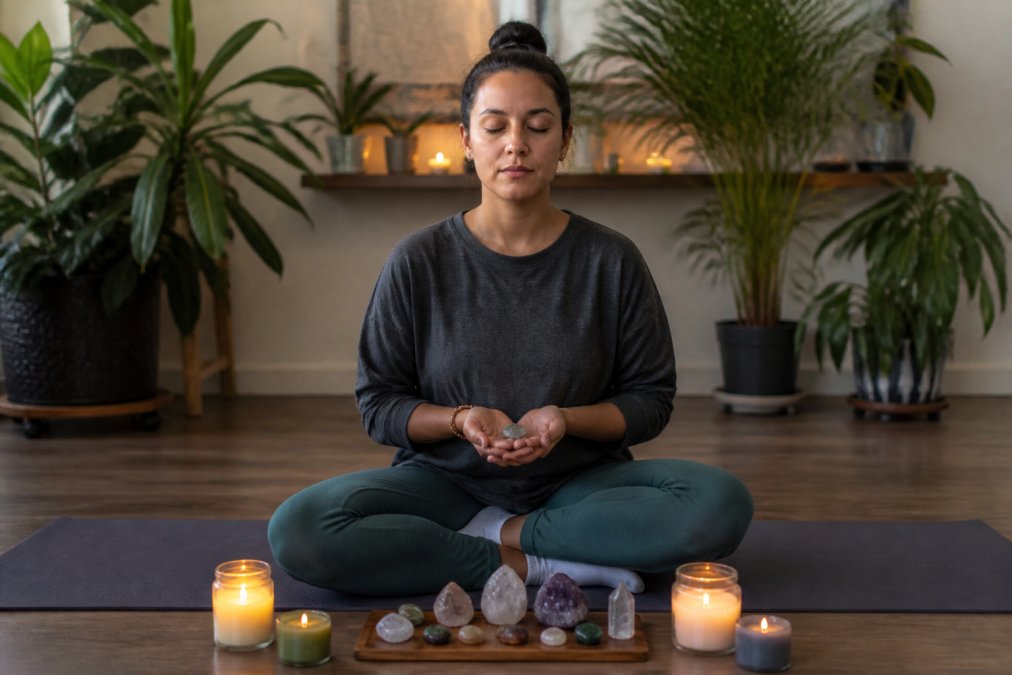
Carrying a tumbled crystal in your pocket is one of the simplest and most effective ways to work with stones for anxiety. The physical act of reaching for it, holding it, and feeling its weight and texture is itself a grounding technique. Rub it between your fingers and notice its temperature.
Placing Crystals for Sleep and Relaxation
Placing lepidolite or amethyst under your pillow or on your nightstand creates an environmental cue that signals to your brain this space is for rest. For maximum effect, place calming stones at the four corners of your bed for a simple crystal grid, keep one stone in your hand during a pre-sleep body scan meditation, and avoid stimulating stones near the sleep space.
Integrating Crystals into Daily Meditation and Intention Setting
Holding a stone during meditation gives the mind a physical anchor, especially helpful for beginners who struggle with wandering attention. Before you meditate, hold your stone and state clearly what you want to cultivate, calm, clarity, or release of tension.
For anxiety, placing an amethyst on the forehead and a smoky quartz near the feet during lying-down meditation addresses both the mental and grounding dimensions of stress relief.
Cleansing Crystals for Beginners: A Simple Starting Routine
Cleansing crystals resets them by clearing absorbed energy from their environment. Here's a simple starting routine:
- Moonlight cleansing: Place your crystals outside or on a windowsill during a full moon overnight. This is the gentlest method and works for all stone types.
- Sound cleansing: Use a singing bowl, bell, or phone app playing a sustained tone.
- Smoke cleansing: Pass your stones through the smoke of sacred herbs.
- Soil burial: Bury crystals in the earth for 24 hours to return them to their natural grounding environment.
- Selenite charging plate: Place your crystals on a selenite slab overnight.
Important note: Some stones are water-soluble, including selenite, lepidolite, and desert rose. Never cleanse these in water. When in doubt, moonlight or sound cleansing is always safe.

Psychological Grounding Techniques That Work Alongside Crystal Healing
Grounding techniques are evidence-based psychological practices that interrupt anxiety by pulling attention back into the body and the present moment. They work through the same mechanism that makes crystal holding effective: sensory engagement overrides the cognitive loop of anxious thought.
The most effective grounding techniques to pair with crystal work include:
- 5-4-3-2-1 technique: While holding a crystal, name five things you can see, four you can feel, three you can hear, two you can smell, one you can taste.
- Box breathing: Four counts in, four counts hold, four counts out, four counts hold. Hold your grounding stone throughout and sync your breath to its weight.
- Body scan: Starting from the feet and moving upward, consciously notice each part of your body. Place a smoky quartz near your feet to anchor lower body awareness.
- Cold water and stone contrast: Alternating between holding a cool crystal and running cold water over your wrists is a rapid de-escalation technique for acute panic.
As noted by American Psychological Association's resources on anxiety management, grounding techniques are a recognized component of anxiety management strategies.
Integrating Crystals with Professional Therapy and Medication
Crystals are a complementary practice. That word means these tools work best in complement to professional care, not in place of it. If you are managing anxiety with prescribed medication, crystals do not interfere with that medication. Using lepidolite for sleep support while taking a prescribed anxiolytic is a layered approach to wellness.
If you are working with a therapist, bringing crystal practices into your sessions as a discussion topic can be productive. Many therapists who practice mindfulness-based approaches are open to clients incorporating grounding objects and rituals into their anxiety management toolkit.
According to National Alliance on Mental Illness guidance on complementary approaches, self-care practices that support mindfulness and emotional regulation can be valuable additions to a treatment plan when they don't replace professional care.
If you are experiencing severe anxiety, panic attacks that impair your daily functioning, or anxiety that has persisted for more than a few weeks, please speak with a healthcare provider.
Ethical Sourcing and Choosing Authentic Gemstones
The crystal industry has a sourcing problem. Mining practices for popular stones have been linked to environmental damage and poor labor conditions in some regions. Buying ethically sourced crystals is both a values question and a quality question, because authentically sourced stones are more likely to be genuine rather than dyed, treated, or synthetic.
Here's how to choose authentic gemstones responsibly:
- Buy from established retailers who can speak to their sourcing. Ask where stones come from and how they were mined.
- Be skeptical of very low prices on rare stones. Pinolith, for example, is genuinely rare and sourced only from Austria.
- Learn basic identification. Amethyst should have natural color zoning; perfectly uniform purple often indicates dyeing.
- Prefer tumbled stones from reputable physical stores where you can handle the stone before buying.
Buying from a physical store where you can handle the stone, ask questions, and work with knowledgeable staff is the most reliable way to ensure authenticity. Our Lakewood location at 2680 Youngfield Street carries a curated selection of genuine stones, and our staff can walk you through what to look for.

Quick-Start Crystal Practice: Your First Week
For anyone new to working with crystals for anxiety, here's a practical framework to begin with:
| Day | Practice | Time Required | Stone to Use |
|---|---|---|---|
| Day 1-2 | Choose and hold one stone | 5 min | Any from list above |
| Day 3-4 | Carry stone in pocket, reach for it when stressed | Throughout day | Amethyst or smoky quartz |
| Day 5 | Place stone on nightstand, set sleep intention | 2 min before bed | Lepidolite or desert rose |
| Day 6 | Combine stone holding with box breathing | 10 min | Your chosen anchor stone |
| Day 7 | Cleanse your stone using moonlight or sound | 5 min | All your stones |
The goal of the first week is building the habit of reaching for the stone, which trains the association between the object and the state of calm you're cultivating.
Can crystals help with anxiety on their own, without any other support? For most people, probably not in a clinically significant way. But as part of a genuine self-care practice that includes mindfulness, grounding techniques, and professional support when needed, they can be a meaningful, tactile anchor for emotional regulation.
For Heaven's Sake has been supporting spiritual seekers in the Denver metro area since 2000. Our Lakewood store carries a curated selection of tumbled crystals, including lepidolite ($2.00), howlite ($3.00), pinolith ($6.00), and desert rose ($2.00), sourced with care and selected by people who use these stones themselves. Visit us at 2680 Youngfield Street, Lakewood, or browse our collection online.
Frequently Asked Questions
Q: What is the best crystal for anxiety?
A: There is no single 'best' crystal for anxiety, it depends on what you need most. Amethyst is widely chosen for its calming, emotionally balancing properties. Lepidolite is favored for anxiety that disrupts sleep, as it supports emotional regulation and restful rest. Smoky quartz works well for grounding during panic attacks. Many people find it helpful to hold a few options in person and choose the one that feels most resonant to them rather than picking based on a list alone.
Q: Can crystals be used alongside traditional mental health practices?
A: Yes, and many therapists who practice holistic wellness actively encourage it. Crystals are not a replacement for therapy, counseling, or prescribed medication, they are a complementary self-care tool. Using a grounding stone during a breathing exercise, or placing amethyst nearby during a journaling session, can reinforce mindfulness habits your therapist may already recommend. Always continue any treatment plan your mental health provider has prescribed, and let them know about any complementary practices you add.
Q: How do you cleanse and charge crystals for emotional support?
A: The most beginner-friendly methods are moonlight charging, sound cleansing with a singing bowl, or placing crystals on a selenite plate overnight. Avoid water for stones like desert rose selenite, which dissolves when wet. Smoke cleansing with ethically sourced herbs is another popular option. Most practitioners recommend cleansing a new crystal before first use and then regularly, especially after intense emotional moments, to clear accumulated energy and reset the stone's vibrational frequency.
Q: Are there specific crystals recommended for sleep and anxiety at night?
A: Lepidolite is one of the most recommended crystals for anxiety-related sleep disruption, as it supports emotional balance and helps quiet an overactive mind. Howlite is another strong option, known for promoting patience and calm before bed. Placing either stone on your nightstand or under your pillow is a common practice. Amethyst is also widely used for sleep, particularly for those whose anxiety peaks in the evening. Pairing these stones with a short mindfulness routine before bed tends to reinforce the relaxation response.
This article was written using GrandRanker