

Table of Contents
- Why Authenticity Matters for Healing Crystals
- Common Fake Crystals List: What Gets Counterfeited Most
- Physical Characteristics of Real Crystals
- How to Test Crystals for Authenticity at Home
- Destructive vs. Non-Destructive Testing: Which Should You Use?
- Best Practices for Buying Crystals: Avoiding Fakes at the Source
- Recommended Resources for Identifying Authentic Healing Crystals
- Conclusion
Last Updated: August 29, 2026
Knowing how to identify authentic healing crystals is essential for any enthusiast. The crystal market has expanded rapidly, bringing a flood of fakes, dyed stones, and glass imitations alongside genuine specimens. At For Heaven's Sake, we've seen firsthand how disappointing it is when someone discovers they've purchased dyed howlite or molded glass.

This guide walks you through the physical characteristics, at-home tests, and sourcing practices that separate real crystals from counterfeits. We cover everything from the temperature test to microscopic analysis, plus a breakdown of which crystals get faked most often.
Why Authenticity Matters for Healing Crystals
Authentic healing crystals carry the mineral composition, crystal structure, and natural properties that practitioners seek. A piece of dyed glass or resin simply doesn't have the same thermal conductivity, refractive index, or physical density as a genuine gemstone.
There's also an ethical dimension. The crystal healing community increasingly values transparency about sourcing, and buying fakes often means supporting supply chains that misrepresent their products. Beyond the spiritual side, authenticity is a consumer protection issue. The Federal Trade Commission's guidelines on jewelry and gemstone marketing provide clear standards for how gemstones must be described in commerce.
Common Fake Crystals List: What Gets Counterfeited Most
Some crystals are faked far more often than others. The most commonly faked crystals include:
- Clear quartz, often replaced with glass or acrylic
- Amethyst, heat-treated citrine is frequently sold as natural amethyst
- Turquoise, howlite dyed blue is one of the oldest widespread fakes
- Malachite, synthetic resin versions with printed patterns circulate widely
- Lapis lazuli, sodalite and dyed jasper are common substitutes
- Rose quartz, glass imitations are prevalent in tumbled form
- Moldavite, one of the most aggressively faked stones, with green glass flooding the market
- Citrine, most commercial citrine is actually heat-treated amethyst
- Selenite, gypsum-based fakes and plastic versions appear regularly
If a seller has an unusually large, uniform stock of any of these, that's worth noting.
Physical Characteristics of Real Crystals
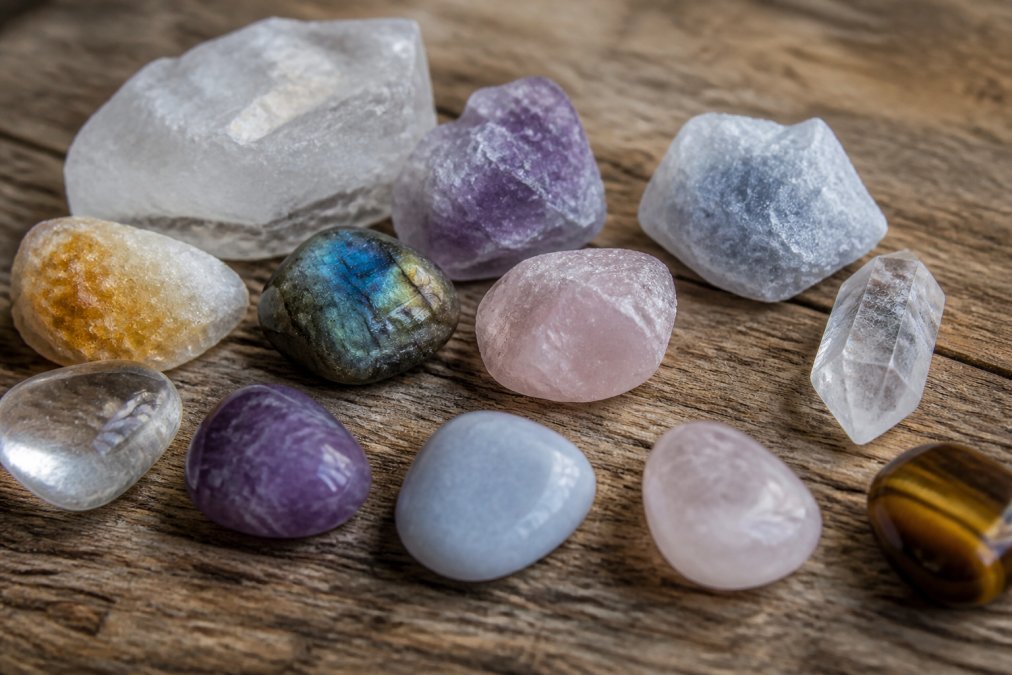
Real crystals are imperfect by nature. Natural specimens form over thousands to millions of years under variable geological conditions, leaving distinctive marks.
Natural Flaws vs. Man-Made Perfection
Natural inclusions are one of the most reliable indicators of authenticity. These are tiny mineral deposits, fracture patterns, cloudiness, or veins trapped inside the stone during formation. Under magnification, genuine crystals show irregular internal structures and variations in clarity that are essentially impossible to replicate in glass or resin.
Glass imitations tend toward optical perfection. The clarity is too even, the color too uniform, and the interior too clean. Air bubbles are the telltale sign of glass: perfectly round spheres suspended inside the stone. Natural crystals don't have air bubbles.
Weight, Density, and Cold-to-the-Touch Feel
Genuine crystals have a specific gravity tied to their mineral composition. Real quartz is noticeably heavier than glass of the same size.
The cold-to-the-touch test is one of the most reliable quick checks. Real crystals, particularly quartz-family stones, conduct heat away from your hand significantly faster than glass or plastic. Press the stone against your cheek or the back of your hand. A genuine crystal feels distinctly cool and stays cool for several seconds. Glass warms up quickly. Plastic warms almost immediately.
This difference comes down to thermal conductivity. Natural gemstones are dense, solid mineral structures that draw heat efficiently. Resin and plastic are poor conductors.
How to Test Crystals for Authenticity at Home
Testing crystals at home doesn't require a laboratory. A handful of simple tools and a systematic approach cover the most common fakes effectively.
Here's a non-destructive testing framework:
- Pick up the stone and assess weight relative to size
- Press it to your cheek for the cold-to-the-touch test
- Examine it under bright light for air bubbles and inclusions
- Use a loupe or phone macro lens to inspect internal structure
- Check color consistency across the entire specimen
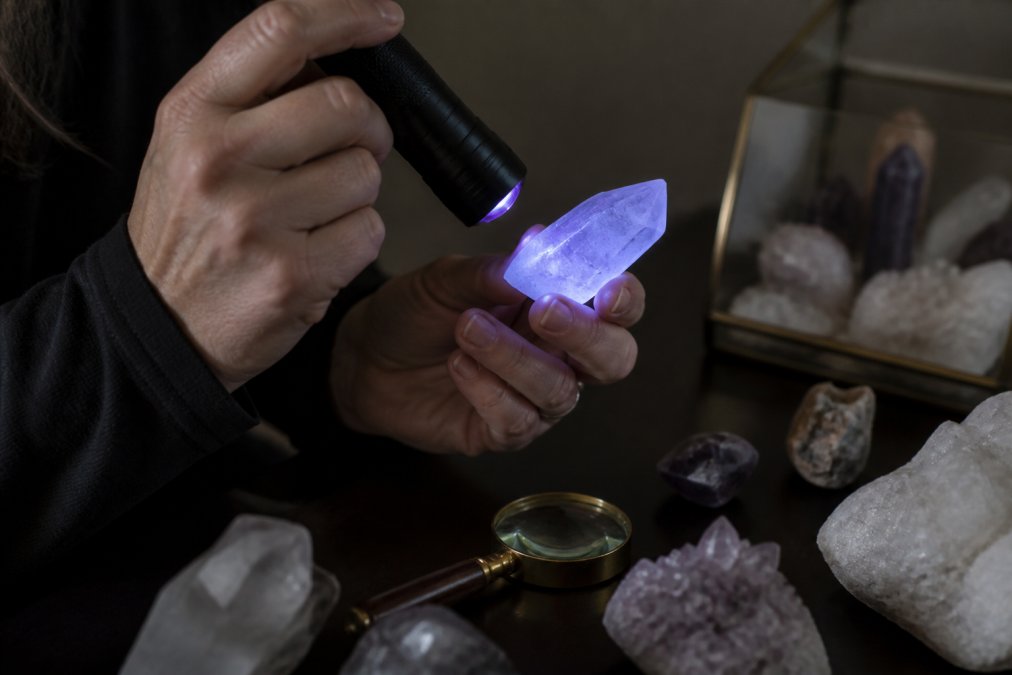
- Run a UV light test if available
- Perform a scratch test only as a last resort on an inconspicuous area
The Temperature Test
Hold the stone in your palm for thirty seconds, then press it to the back of your other hand or your cheek. A real quartz-family crystal will feel noticeably cooler than your skin temperature and stay cool for several seconds. Glass equilibrates to body temperature much faster.
This test works best for clear quartz, rose quartz, amethyst, and other quartz-family stones.
Flashlight and UV Light Tests
Hold the stone up to a bright flashlight in a dark room. Look for:
- Air bubbles (perfectly round, indicates glass)
- Natural fractures (irregular, jagged lines, indicates genuine mineral)
- Inclusions (dark or colored spots, clouds, veins, indicates genuine mineral)
- Uniform, bubble-free clarity (suspicious in large stones)
UV light fluorescence testing adds another layer. Many genuine minerals fluoresce under UV light in characteristic ways. Calcite typically glows pink or red. Scheelite fluoresces bright blue-white. Fluorite shows a range of colors. The Gemological Institute of America's gemstone resources documents fluorescence characteristics for most common gemstone types.
Hardness Testing Using the Mohs Scale
The Mohs hardness scale ranks minerals from 1 (softest) to 10 (hardest). Quartz sits at 7, which means it should scratch glass (hardness 5.5) but not be scratched by it.
| Mineral | Mohs Hardness |
|---|---|
| Talc | 1 |
| Gypsum / Selenite | 2 |
| Calcite | 3 |
| Fluorite | 4 |
| Apatite | 5 |
| Glass | 5.5 |
| Orthoclase Feldspar | 6 |
| Quartz | 7 |
| Topaz | 8 |
| Corundum (Ruby/Sapphire) | 9 |
| Diamond | 10 |
Use a steel nail (hardness ~6.5) or glass to test. If a stone claiming to be quartz can be scratched by glass, it's almost certainly not quartz. Apply this test only to inconspicuous areas.
Microscopic Analysis for Beginners
A smartphone macro lens attachment combined with good lighting gives you enough magnification to spot air bubbles, growth patterns, and inclusion types that reveal a stone's true nature.
What to look for under magnification:
- Growth lines or zones in genuine crystals, appearing as slightly different layers following the crystal's natural growth axis
- Irregular fracture patterns that follow no predictable geometry
- Inclusions with complex shapes (needles, platelets, fluid inclusions) rather than simple round bubbles
- Surface texture on rough specimens, showing crystal faces, cleavage planes, or natural weathering
The American Gem Society's consumer education resources offer additional guidance on evaluating gemstone authenticity.
Destructive vs. Non-Destructive Testing: Which Should You Use?
Non-destructive testing should always be your first approach. The temperature test, visual inspection, UV fluorescence, weight assessment, and microscopic analysis leave the stone completely intact and can be performed before purchase.
Destructive testing, primarily the scratch test, leaves permanent marks. Reserve it for situations where you already own the stone and non-destructive methods haven't resolved your doubt.
The hierarchy is straightforward:
- Non-destructive first: temperature, weight, visual, UV, loupe inspection
- Minimally destructive second: scratch test on an inconspicuous area if needed
- Professional verification last: send to a certified gemologist for lab analysis if the value justifies it
Best Practices for Buying Crystals: Avoiding Fakes at the Source
Physical stores with knowledgeable staff allow you to handle specimens before purchasing, ask about sourcing, and apply tests on the spot. Online purchases remove most of those advantages.
When evaluating any seller, ask these questions:
- Where does your inventory come from, and can you name specific mines or regions?
- Are any of your stones heat-treated, dyed, or lab-grown?
- What is your return policy if a stone turns out to be misrepresented?
Sellers who answer these questions directly and specifically are generally more trustworthy than those who deflect or give vague answers.
Ethical Sourcing and Authenticity
Ethical sourcing and authenticity are increasingly intertwined in the crystal market. A stone mined responsibly with fair labor practices is far more likely to be accurately represented than one that passed through multiple undocumented hands.
Look for sellers who can speak to their supply chain. A seller who knows which country or region a stone came from and can describe the general conditions of its extraction demonstrates engagement with their sourcing that correlates with overall product integrity.
The responsible sourcing standards published by the Responsible Minerals Initiative provide a useful framework for understanding ethical mineral sourcing.
At For Heaven's Sake, we take sourcing seriously and are happy to discuss where our crystals come from. Our Lakewood store at 2680 Youngfield Street carries a curated selection of genuine specimens, and our staff can walk you through the characteristics of any piece in our collection.
Recommended Resources for Identifying Authentic Healing Crystals
Building your ability to identify authentic healing crystals is an ongoing process. Two books stand out as essential references.
The Book of Stones, Revised Edition by Robert Simmons and Naisha Ahsian covers nearly 400 stone varieties with detailed descriptions of their physical characteristics and distinguishing features. It's the most comprehensive single reference available for understanding what you're working with at a mineral level.

The Crystal Bible by Judy Hall is a beautifully illustrated directory format guide that lets you identify an unknown crystal quickly or verify a known one. Its coverage of colors, shapes, and physical properties makes it particularly useful as a field reference when evaluating specimens.
Both books complement the hands-on testing techniques in this guide. Knowing what a genuine specimen should look like sharpens your eye considerably.
The Gemological Institute of America's free gem encyclopedia is an excellent starting point for understanding the physical properties of specific stones before you go shopping.
Identifying authentic healing crystals takes practice, but the framework is straightforward: combine physical inspection, at-home testing, and sourcing awareness before committing to a purchase. For Heaven's Sake, established in 2000 and backed by over 900 five-star Google reviews, offers a curated selection of genuine crystals at our Lakewood location, where knowledgeable staff can help you evaluate any specimen and answer sourcing questions directly. Visit us at 2680 Youngfield Street in Lakewood and go shopping with confidence.
Frequently Asked Questions
Q: What crystals are most commonly faked?
A: Clear quartz, amethyst, turquoise, moldavite, and citrine top the list of commonly counterfeited crystals. Clear quartz is frequently replaced with glass, while turquoise is often dyed howlite or magnesite. Moldavite fakes made from green glass flood the market. Citrine sold at unusually low prices is almost always heat-treated amethyst rather than natural citrine. When buying authentic healing crystals, treat any specimen priced significantly below market value with extra scrutiny.
Q: Do real crystals have imperfections?
A: Yes, and that is one of the clearest signs of authenticity. Natural crystals form over thousands of years inside the earth, so they almost always contain inclusions, natural fractures, color variations, cloudiness, or matrix material. A specimen with flawless clarity, perfectly uniform color, and zero internal features is almost certainly glass or resin. Synthetic and lab-grown stones can also appear too perfect. Visible natural flaws are a feature, not a defect, when it comes to genuine gemstones.
Q: How can I tell if my crystal is real using a flashlight?
A: Hold the crystal up to a bright flashlight in a dark room and look for internal features: natural fractures that scatter light in irregular patterns, inclusions, and uneven color distribution. Glass fakes often show perfectly uniform light transmission with no internal structure and may reveal air bubbles trapped inside. A UV flashlight adds another layer: many genuine minerals fluoresce in characteristic colors, while glass and resin typically do not respond the same way.
Q: Are heat-treated crystals considered authentic?
A: Heat-treated crystals are still natural minerals, so most gemologists consider them authentic, but the treatment changes their metaphysical properties in the eyes of many crystal healing practitioners. Citrine is the most common example: most commercial citrine is amethyst that has been heat-treated to produce an orange-yellow color. Natural citrine is pale yellow with a different color distribution. Reputable sellers disclose heat treatment. If a seller cannot confirm whether a stone has been treated, that is worth factoring into your decision.
This article was written using GrandRanker