

Last Updated: October 27, 2026
Quick Summary
No, it is not hard to learn tarot card meanings, but it is not instant either. Most beginners can read a simple spread within a few weeks of steady practice, and you do not need to memorize all 78 cards before you start. You can learn tarot by recognizing pictures and patterns instead of reciting definitions.
- Start with one deck, one spread, and one question, and skip buying five decks.
- The Major Arcana is 22 cards and the Minor Arcana is 56 cards split into four suits.
- Learn the suits first: Cups mean emotion and Swords mean thinking.
- Twenty minutes a day is plenty for a four-week staged study plan.
- The easiest beginner spread is the single-card draw, one card each morning.
Table of Contents
- Is It Hard to Learn Tarot Card Meanings? The Honest Answer
- How to Read Tarot Cards for Beginners Without Overwhelm
- Do You Have to Memorize Tarot Cards to Read Them Well?
- How Long Does It Take to Learn Tarot? A Realistic Timeline
- Easy Tarot Spreads for Beginners to Practice Every Day
- Memory Techniques for All 78 Cards That Actually Stick
- How to Combine Card Meanings and Know When to Use Your Guidebook
- Pick Up a Beginner-Friendly Deck at Our Lakewood Shop
- Frequently Asked Questions
Is It Hard to Learn Tarot Card Meanings? The Honest Answer
No, it is not hard to learn tarot card meanings, but it is not instant either. Most beginners can read a simple spread within a few weeks of steady practice. The trick is dropping the idea that you must memorize 78 cards before you touch a deck.
Here is the honest part most guides skip. Tarot is a symbolic language, not a test. You are learning to read pictures and spot patterns, not recite definitions. That shift alone makes the whole thing feel lighter.
Below, we break down a timeline, a staged study plan, and memory techniques. If you want a broader starting point, our Beginner Guide to Tarot Reading walks you through tarot reading from scratch.
How to Read Tarot Cards for Beginners Without Overwhelm
Start with one deck, one spread, and one question. That is the whole beginner setup. Everything else, the extra decks, the giant reference books, the fancy cloths, can wait until you have read a few dozen times.
A tarot deck is 78 cards split into two groups: the Major Arcana and the Minor Arcana. Each card carries a picture, a number, and a name. Your job is to notice what the picture shows and how it connects to your question.
Skip the urge to buy five decks. Pick one with clear, busy artwork and stick with it for at least a month.
Start With the Structure: Major Arcana, Minor Arcana, and Suits
The Major Arcana is 22 cards that track big life themes, like change, loss, and growth. The Minor Arcana is 56 cards split into four suits: Cups, Pentacles, Swords, and Wands. Each suit covers a slice of daily life.
- Cups: feelings, relationships, intuition
- Pentacles: money, work, home, the body
- Swords: thoughts, conflict, decisions
- Wands: action, energy, drive
Learn the suits first. For a closer look at the classic deck behind this structure, see our Rider Waite Smith Tarot Deck buying guide. Once you know that Cups means emotion and Swords means thinking, half the deck starts making sense.
Build a Staged Study Plan You Can Actually Keep
Here is a simple four-week structure:
- Week 1: Learn the four suits and the Major Arcana numbers
- Week 2: Study the Aces through the Tens, one suit per day
- Week 3: Add court cards and start a daily single-card draw
- Week 4: Practice a three-card spread and write down every reading
Twenty minutes a day is plenty. Fifteen is fine. The point is showing up.
Do You Have to Memorize Tarot Cards to Read Them Well?
No, you do not have to memorize tarot cards to read them well. You need to recognize them, not recite them. Recognition comes from repetition, and repetition comes from reading.
Think about how you learned faces. You did not memorize a list of features. You saw the same person enough times that their face became familiar. Tarot works the same way.
A common mistake is treating the guidebook like a textbook. Read the meaning once, look at the card, then set the book down and say what you see. You will be wrong sometimes. That is fine.
How Long Does It Take to Learn Tarot? A Realistic Timeline
There is no deadline, and no one is grading you.
| Stage | Timeframe | What You Can Do |
|---|---|---|
| Getting familiar | Weeks 1-2 | Name the suits and spot Major Arcana |
| First readings | Weeks 3-6 | Pull one card daily and interpret it |
| Spread work | Months 2-3 | Read a three-card spread without panic |
| Reading for others | Months 4-6 | Give a simple reading to a friend |
| Confident reader | 6-12 months | Handle most questions with ease |
Easy Tarot Spreads for Beginners to Practice Every Day
The easiest tarot spread for beginners is the single-card draw. Pull one card each morning, look at it for a minute, and write one sentence about what it means for your day. That is it.
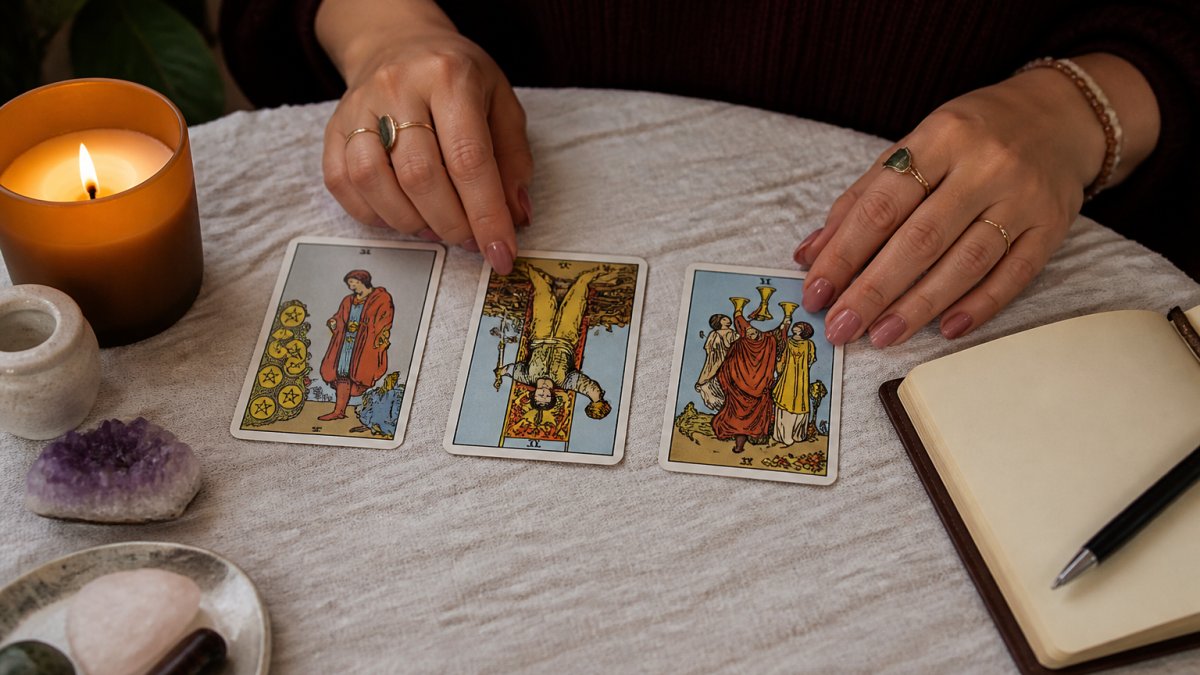
The Single-Card Draw and the Three-Card Spread
The single-card draw answers one question or sets a tone for the day. The three-card spread adds a little structure. Common layouts include:
- Past, present, future: a simple timeline
- Situation, action, outcome: good for decisions
- You, the other person, the relationship: for connection questions
Lay the cards left to right. Read each one on its own first, then look for the story across all three. That story is where the real reading lives.
Memory Techniques for All 78 Cards That Actually Stick
Number anchors across all four suits Learn the number first, then the suit. A Five of Cups is friction (Five) in the emotional realm (Cups), disappointment or focusing on what spilled. A Five of Pentacles is friction in money or health, feeling left out in the cold. A Five of Swords is friction in thought, conflict or a hollow win. A Five of Wands is friction in action, competition or scattered energy. Once you know the number anchor, you only need to remember the suit's flavor.
Suit shortcuts as verbs Turn each suit into a verb so it sticks: Cups feel, Pentacles build, Swords think, Wands act. Then read any Minor Arcana card as [number anchor] + [suit verb]. The Two of Wands becomes "choice about action." The Eight of Pentacles becomes "mastery of building."
Story chains for the Major Arcana The Major Arcana is one long story from The Fool (0) to The World (21). The Fool sets out, meets teachers (The Magician, The High Priestess), faces trials (The Tower, The Devil), and arrives at completion (The World).
Picture cues before definitions Before you recall a card's meaning, say out loud what you see. The Three of Swords shows three swords piercing a heart, say "heartbreak" before you check the guidebook. The Six of Cups shows children and gifts, say "nostalgia" or "innocence."
Flashcard drills with spaced repetition
Personal associations for stubborn cards For the five cards you forget most often, attach a personal memory. If the Nine of Pentacles keeps slipping, link it to a time you felt self-sufficient.
How to Combine Card Meanings and Know When to Use Your Guidebook
- Read each card alone and note its core idea
- Look at pairs and ask how they talk to each other
- Check the suits and numbers for repeats
- Build one story that answers the question
Pick Up a Beginner-Friendly Deck at Our Lakewood Shop
If you want a deck and learning materials in one box, the Beginner's Guide to Tarot Deck Set pairs 78 cards with a 192-page book and a layout template. The Quick & Easy Tarot Deck includes card meanings for standard and reversed cards.

Stop by our Lakewood shop at 2680 Youngfield Street.
Learning tarot is a practice, not a performance. Get started with For Heaven's Sake and explore tarot at your own pace.
Frequently Asked Questions
Is it hard to learn tarot card meanings?
No. The 78 cards follow a structure: 22 Major Arcana cards and 56 Minor Arcana cards split into four suits.
Do you have to memorize all 78 tarot cards before you can read?
No. What matters more is recognizing patterns: which suit a card belongs to, whether it sits in the Major or Minor Arcana, and what the imagery shows. [Your First Tarot](https://forheavensake.com/products/your-first-tarot) is based on the classic Rider-Waite-Smith deck and features keywords on each card to help guide the reader.
How long does it take to learn tarot?
Expect a few weeks to feel comfortable with a single-card draw, three to six months to read a three-card spread with growing confidence, and a year or more to develop real fluency with card combinations. Progress depends on how often you practice. Ten minutes of daily practice beats a three-hour session once a month. Keeping a notebook of your readings helps you track how your interpretations sharpen over time.
What is the easiest way to learn tarot card meanings?
Start with one card a day and write down what you notice in the image before checking the guidebook. Practice easy tarot spreads for beginners, such as the single-card draw and the three-card spread. [Your First Tarot](https://forheavensake.com/products/your-first-tarot) features keywords on each card to help guide the reader.
