

Last Updated: November 8, 2026
Quick Summary
Embodied movement is a way of practicing spirituality through the body, using slow motion and attention to what you feel instead of only sitting and thinking. Choosing a class starts with clarifying your goals and honest experience level, then comparing class types, formats, and schedules. Many beginners start with somatic movement or gentle yoga.
- Clarify your goals and experience level before choosing a class.
- Somatic movement is the closest match for embodied work and surfaces emotion most readily.
- Gentle yoga and restorative styles are the most beginner-friendly starting points.
- Plan about one class per week plus five to ten minutes of home practice on other days.
- Tell the teacher about any injury, pregnancy, or health condition before class.
Table of Contents
- What Embodied Movement Means for Spiritual Growth
- How Movement and Spiritual Practice Connect
- Step 1: Clarify Your Goals and Experience Level
- Step 2: Compare Class Types, Formats, and Schedules
- Step 3: Prepare for Your First Class
- Embodiment Exercises You Can Practice at Home
- Booking Your First Embodied Movement Class at For Heaven's Sake
- Frequently Asked Questions
What Embodied Movement Means for Spiritual Growth
Embodied movement is a way of practicing spirituality through the body. Instead of only sitting still and thinking, you move slowly and pay attention to what you feel. Many people find this makes spiritual ideas feel real and personal.
Many people in the Denver area who start with crystals or books later wonder what comes next. Movement classes can be one of those next steps.
Here is a simple way to think about it:
- Movement gives your body something to do
- Attention keeps your mind on what you feel
- Intention gives the practice a purpose
Embodied movement is not a medical treatment or a cure for any condition. It is a practice for self-awareness. If you have a health concern, talk with a qualified professional before you start any new physical activity.
How Movement and Spiritual Practice Connect
Many spiritual traditions use the body as part of practice. Yoga, tai chi, and qigong all pair slow motion with breath and focus. The idea is that a calm body can make a quieter, clearer mind.
When you move with attention, you may notice patterns. Maybe your shoulders always tighten when you feel stressed. Maybe your breath gets shallow during hard emotions. Noticing these things is often the first step toward self-discovery.
Some people also use movement to set intentions. You might choose one word, like "steady" or "open," and carry it through each pose or motion.
Step 1: Clarify Your Goals and Experience Level
Before you pick a class, ask yourself what you want from it. Your answer will shape which class fits you best.
Common goals include:
- Feeling calmer after a busy week
- Understanding your emotions better
- Building a regular spiritual routine
- Meeting others who share your interests
Next, be honest about your experience. Some classes assume you already know basic poses or breathing. Others are built for complete beginners.
A simple checklist:
- I know what I hope to gain from movement practice
- I know whether I am a beginner, returning, or experienced
- I know how much time I can give each week
- I know any physical limits I should mention to a teacher
If you are new, look for classes labeled "beginner" or "intro."
Step 2: Compare Class Types, Formats, and Schedules
This section separates the modalities by what they actually ask of your body and attention, then covers the practical variables, format, schedule, cost structure, and access, that determine whether you will actually keep showing up.
What the main modalities actually are
- Somatic movement is an umbrella term for practices that prioritize internal sensation over external form. You may be asked to move very slowly, track a single sensation, or repeat a small motion and notice what changes. There is often no fixed choreography. This is the closest match for "embodied" work, and it is the style most likely to surface emotions.
- Yoga (gentle, restorative, or flow) pairs breath with posed shapes. Gentle and restorative styles are the most beginner-friendly; flow styles move faster and assume some familiarity with basic poses. Yoga is the most widely available option and the easiest to find at a range of commitment levels.
- Tai chi and qigong are slow, standing, repetitive practices with roots in Chinese movement traditions. They emphasize balance, weight transfer, and breath coordination. They are often taught in multi-week series rather than drop-in classes, and they tend to be the most accessible for people with limited mobility because almost every movement can be done seated or with a smaller range.
- Intention-based or ritual movement blends movement with reflection, journaling, or ceremony. These are usually offered as workshops or short series rather than ongoing weekly classes, so they suit people who want a contained experience rather than a routine.
A common pattern is that people new to embodied work do best starting with somatic movement or gentle yoga, then adding tai chi or qigong once they have a breath and body-awareness habit.
Format: group, one-to-one, or online
| Format | Strengths | Trade-offs |
|---|---|---|
| Group, in person | Accountability, community, a teacher who can see and adjust you | Less individual attention; pace set by the group |
| One-to-one, in person | Fully tailored; safest for injuries, trauma history, or mobility needs | Highest cost per session; requires finding the right practitioner |
| Group, online | Access from home; often lower cost; good for schedule flexibility | Teacher cannot physically adjust you; you must self-monitor |
| One-to-one, online | Tailored plus convenient | Requires reliable video and a private space |
If you have a history of trauma, chronic pain, or a condition that affects movement, one-to-one or a small group with a trauma-informed teacher is usually the better starting point. Ask directly whether the teacher has training in trauma-informed or adaptive movement.
Schedule and commitment
Class lengths commonly run 45 to 90 minutes. Drop-in classes let you test a style with no commitment; series and workshops usually run four to eight weeks and cost less per session but require upfront payment. A realistic beginner schedule is one class per week plus five to ten minutes of home practice on two or three other days. Trying to attend three or four classes a week in your first month is a common way people burn out.
Cost structure
Rates vary widely by format, length, and region, so ask each provider for current pricing rather than relying on a listing. The structural questions matter more than the number:
- Is it drop-in, a series, or a membership?
- Is there a discounted intro offer for first-timers?
- Is there a cancellation or refund policy if you miss a session?
- Are mats, props, or equipment included, or do you bring your own?
Watch out: A low drop-in rate can hide a required multi-class package or a separate equipment fee. Confirm the total cost of your first month, not just the first session, before you commit.
Accessibility and access
Ask about step-free entry, seating options, class size, and whether the teacher offers modifications for standing, seated, or lying-down participation. Online options remove travel and cost barriers but require a private, quiet space. If cost is the main obstacle, ask whether the studio offers sliding-scale spots or volunteer-for-class arrangements, many do but do not advertise them.
Step 3: Prepare for Your First Class
This walkthrough covers what happens in a session, how to participate without overdoing it, and how to pause or opt out.
What to wear and bring
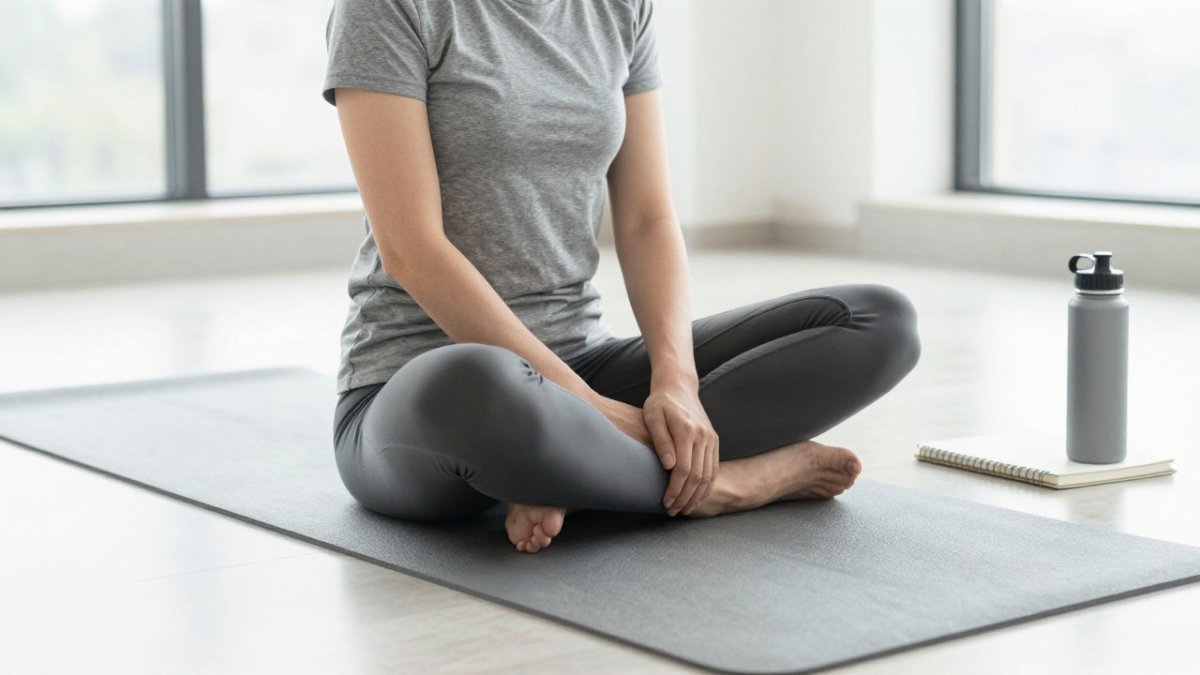
Wear clothing you can move and breathe in, stretchy pants or shorts and a fitted top are typical. Avoid loose jewelry and heavy scents. Bring a water bottle and a small towel. Ask ahead whether mats and props are provided, and bring your own mat if you prefer. A notebook is useful for a few lines of reflection afterward.
What happens in a typical session
A 60-minute class usually follows this arc:
- Arrival and settling (5-10 minutes): you set up your space, the teacher introduces the theme, and you may do a short breathing exercise.
- Warm-up (10 minutes): gentle movement to bring attention into the body.
- Main practice (25-35 minutes): guided movement, often with pauses to notice sensation.
- Cool-down and integration (5-10 minutes): slower movement, rest, and sometimes a short reflection or journaling prompt.
Teachers vary in how they guide a session. You are not expected to know poses or terminology in advance.
How to participate without overdoing it
- Move at roughly 60-70% of what you think you can do. Embodied work is about attention, not exertion.
- Rest whenever you need to. Sitting or lying down and observing is full participation.
- If a movement feels sharp, painful, or wrong, stop and choose a smaller version or a still position.
- Tell the teacher before class about any injury, pregnancy, recent surgery, or health condition so they can offer modifications.
Consent, modifications, and opting out
You can ask a teacher before any hands-on adjustment, and you can decline without needing to explain. You can decline physical contact, leave the room, sit out an exercise, or stop entirely at any point, none of these require an explanation.
Watch out: Some classes use breath retention, intense stretching, or fast movement that can be unsuitable for people with certain cardiovascular, respiratory, or joint conditions. If you have any health concern, check with a qualified professional before your first session and tell the teacher what they advised.
After class
Take five minutes to write down what you noticed: where you felt tension, how your breath changed, whether a feeling or memory surfaced. Keep these notes brief and dated. Over several weeks they become the clearest record of your progress, more useful than any single class feeling.
Embodiment Exercises You Can Practice at Home
You can build body awareness between classes with simple exercises. Practice for five to ten minutes a day.
- Body scan: Lie down and slowly notice each body part, from your feet to your head.
- Mindful walking: Walk slowly and feel each step, the ground, and your breath.
- Breath and gesture: Inhale while raising your arms, exhale while lowering them, and repeat for a minute.
- Grounding: Stand with feet hip-width apart and feel your weight move through your legs.
Keep a short log of what you practiced and how you felt. Patterns often appear within a few weeks.
Booking Your First Embodied Movement Class at For Heaven's Sake
Ready to start? Begin with the goals and experience level you identified earlier. Then compare a few options that fit your schedule and budget.
To explore what is available, visit our Lakewood Spiritual Workshops guide for local options. If you are still deciding on a path, read our guide on choosing a spiritual mentor to clarify your direction first.
For more on getting started, see our beginner's guide to starting a spiritual practice. Stop by the store in Lakewood or check our website for current class details and pricing.
Browse our collection of crystals, books, and ceremonial supplies at For Heaven's Sake to support your practice at home.
Frequently Asked Questions
What is embodied movement?
Embodied movement is a practice that uses slow, attentive physical motion to build awareness of bodily sensations, emotions, and inner states. Instead of focusing on performance or fitness outcomes, participants pay attention to how the body feels while moving. Many people use it alongside spiritual practices to notice patterns, release tension, and feel more grounded. Classes often combine breathwork, guided attention, and gentle movement, and they usually welcome beginners who have no prior experience with yoga or meditation.
What should I expect in an embodied movement class?
Most classes begin with a short intention-setting or grounding exercise, followed by guided movement that moves at a relaxed pace. Instructors often invite you to notice sensations rather than correct your form. Classes typically end with a brief reflection or rest period. You can participate at your own level and rest whenever you need to. Wear comfortable clothing, arrive a few minutes early, and bring water. Ask the instructor beforehand if you have any injuries or physical limits.
Can beginners try embodied movement classes?
Yes. Embodied movement classes are generally designed for people with no prior experience. Instructors usually explain each practice before it begins and offer modifications for different ability levels. If you are new, consider starting with an introductory or beginner-friendly session so you can learn the format. Tell the instructor about any physical limitations or past experiences that feel sensitive, and feel free to opt out of any exercise that does not feel right.
How do I choose an embodied movement class that fits my spiritual practice?
Start by identifying what you want from the class, such as stress relief, body awareness, emotional processing, or a community setting. Compare class length, format, and experience level. Read class descriptions carefully, and ask whether the instructor has training in the modality. Consider your schedule and budget, and check whether the location is convenient. If possible, attend one session before committing to a longer program, and notice how you feel afterward.
