

Table of Contents
- Defining Your Spiritual Starting Point
- Daily Spiritual Rituals for Beginners
- How to Use Crystals for Meditation
- Setting Intentions and Building Consistency
- Spiritual Practice Routine Examples
- Avoiding Spiritual Burnout and Practicing Safely
- Frequently Asked Questions
Last Updated: September 23, 2026
Defining Your Spiritual Starting Point
Starting a spiritual practice begins with one honest question: what do you actually believe, and what do you want more of in your life? A spiritual practice is any repeated activity that connects you to something larger than your everyday concerns, whether that's a higher power, your inner self, or the natural world. At For Heaven's Sake, we've watched many people begin this process, and the ones who stick with it rarely start with a grand plan.
Secular, Religious, or Both: Choosing Your Framework
You can build a spiritual practice inside a religious tradition, entirely outside one, or somewhere in between. Many people combine the two: attending services while also journaling, meditating, or working with crystals at home.
Daily Spiritual Rituals for Beginners
Daily spiritual rituals for beginners work best when they're short, repeatable, and tied to something you already do. Attach your practice to an existing habit: after coffee, before your commute, right after you close your laptop for the day. Consistency beats duration every time.
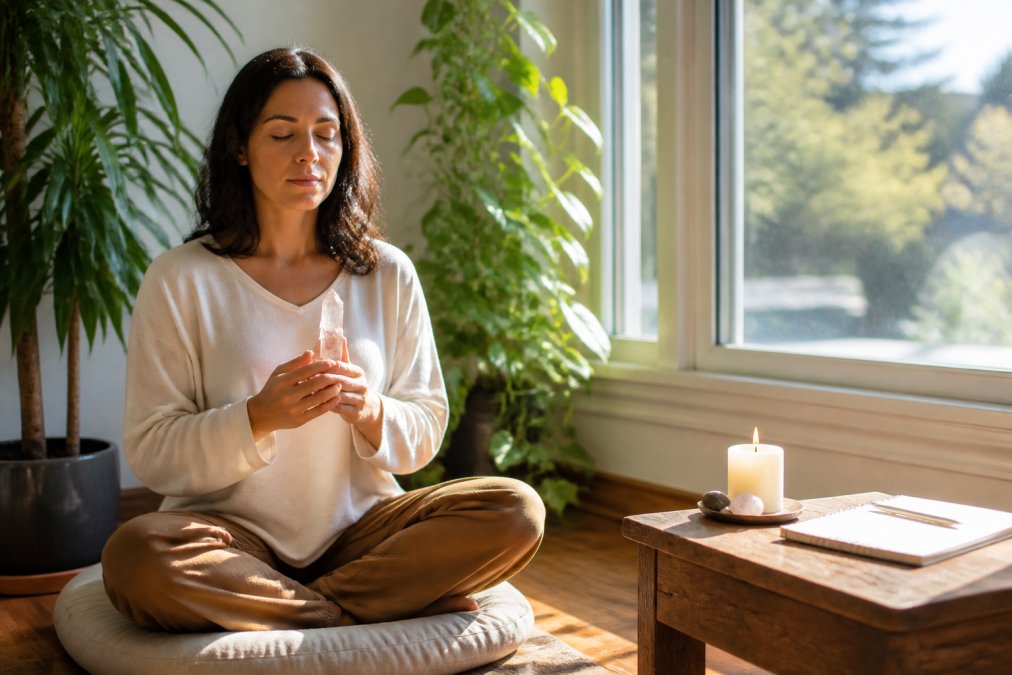
A 10-Minute Morning Routine to Try This Week
Try this sequence for seven days before judging it:
- Minute 1-2: Sit still. Notice your breathing without changing it.
- Minute 3-5: Read one passage from a book that speaks to you, or sit in silence.
- Minute 6-8: Write three sentences in a journal about how you feel right now.
- Minute 9-10: Hold a stone or crystal, set one intention for the day, and sit quietly.
That's it. No app required, no special equipment beyond a journal and something to hold.
How to Use Crystals for Meditation
Using crystals for meditation is simpler than most guides suggest: choose one stone, hold it or place it nearby, and let it serve as an anchor for your attention. The crystal isn't doing the work. Your focused attention is. The stone simply gives your hands and eyes somewhere to rest.
Setting Intentions and Building Consistency
Setting intentions means naming what you want your practice to cultivate, then designing your routine around that. "I want to feel calmer" is a wish. "I will sit for ten minutes each morning to notice my thoughts without judgment" is an intention. The second one you can actually do.
Measuring Progress Without a Scorecard
Progress in a spiritual practice rarely shows up as dramatic breakthroughs. It shows up as small shifts: reacting less sharply, sleeping a little better, noticing when you're overwhelmed before you're already past your limit.
Track consistency, not intensity. A simple approach:
- Mark an X on a calendar for each day you practiced
- Note one word for how you felt afterward
- Review the month and look for patterns
Spiritual Practice Routine Examples
Spiritual practice routine examples vary widely, and that's the point. What separates a routine that survives six months from one that dies in two weeks is not the length of the session, it's whether the routine is anchored to a cue you already have, sized to the energy you actually have at that hour, and flexible enough to survive a bad week.
Here are four structures built around those principles.
| Routine | Time Needed | Best For | Core Elements | Why It Sticks |
|---|---|---|---|---|
| Morning grounding | 10 minutes | Early risers, busy parents | Breath, journaling, one intention | Anchored to the coffee or shower cue you already have |
| Midday reset | 5 minutes | Office workers, remote teams | Silence, gratitude, brief stretch | Fits inside an existing break, so no new calendar block is needed |
| Evening reflection | 15 minutes | Night owls, reflective types | Reading, contemplation, gratitude list | Uses the wind-down window when the mind is already slowing |
| Micro-practice | 60-90 seconds | Shift workers, caregivers, anyone in crisis mode | Three slow breaths, one word, one sentence of thanks | Small enough that skipping it feels stranger than doing it |
The Cue-Routine-Reward Loop
Habit research popularized by James Clear in Atomic Habits and by Charles Duhigg in The Power of Habit describes the same three-part structure: a cue that triggers the behavior, the routine itself, and a reward that tells your brain the loop is worth repeating. Most spiritual-practice advice skips the cue and the reward and only describes the routine, which is why so many beginners quit.
Apply it directly:
As You Feel, So You Heal: A Write of →
- Cue: attach the practice to something you already do without thinking (pour coffee, park the car, close the laptop, brush teeth).
- Routine: the 5-15 minute practice itself.
- Reward: something immediate and small, a favorite tea, a stretch, two minutes of music, the satisfaction of marking an X on a calendar.
Scaling Up Without Quitting
A common pattern is to start strong, feel good, then add a second and third practice within the same month, and burn out by week six. A more durable approach is to add one new element only after the current routine has run for 21 consecutive days without a missed session. That gives you a built-in buffer for travel, illness, and the ordinary chaos of a bad week.
When the Routine Stops Working
Routines go stale. That is normal, not a sign that you are doing it wrong. Three common failure modes and what to do:
- Boredom: the practice has become mechanical. Change one variable, the time of day, the location, the reading material, or the object you hold, rather than abandoning the whole routine.
- Dread: the practice has become another obligation. Shrink it. A 90-second version you actually do beats a 20-minute version you avoid.
- Drift: you keep "forgetting." Move the cue. Put the journal on the coffee maker, or the stone on your keyboard.
Avoiding Spiritual Burnout and Practicing Safely
Spiritual burnout is real, and it usually comes from doing too much too fast. People dive into hour-long meditations, multiple daily rituals, and a stack of books, then quit entirely within a month. The fix is unglamorous: start smaller than feels satisfying, and treat rest days as part of the practice rather than a failure of it.
Recognizing Spiritual Bypassing
Spiritual bypassing is the use of spiritual ideas to sidestep emotional work that still needs doing. It was named and described by psychologist John Welwood in the 1980s, and the pattern is easy to spot once you know what to look for:
- Using "everything happens for a reason" to avoid grief instead of moving through it
- Declaring a conflict "just an ego thing" rather than addressing the actual disagreement
- Substituting meditation for therapy when the issue is trauma, addiction, or depression
- Treating anger or sadness as a spiritual failure rather than information
Screening a Reader, Group, or Teacher
Most people who offer readings, classes, or spiritual mentorship are honest. A small number are not, and the warning signs are consistent enough to screen for in advance. Before you book or join, ask:
- How long have you practiced, and who taught you? Vague answers are a yellow flag. Specific lineages, teachers, or years of study are a green one.
- What is your refund and cancellation policy? A legitimate practitioner will state it plainly.
- Do you ever predict disaster and offer to remove it for a fee? This is the single most common predatory pattern in the space.
- Do you encourage outside support, therapy, medical care, trusted friends? Healthy practitioners do. Controlling ones discourage it.
- What happens if I want to stop? If leaving is framed as dangerous, cursed, or spiritually punishing, walk away.
Psychological Markers of Progress
Because spiritual growth is hard to measure, it helps to track markers that are observable rather than mystical. Most practitioners notice some combination of these over the first six to twelve months:
- Emotional regulation: the gap between feeling a strong emotion and reacting to it gets longer.
- Patience: small frustrations, traffic, a slow checkout line, land with less charge.
- Perspective: you can hold a difficult situation without needing to resolve it immediately.
- Honesty: you notice your own rationalizations faster, including spiritual ones.
- Recovery time: after a bad day, you return to baseline sooner than you used to.
When to Bring in Professional Support
A spiritual practice is a complement to mental health care, not a replacement for it. If you are experiencing persistent depression, intrusive thoughts, panic attacks, or thoughts of self-harm, contact a licensed mental health provider or call or text 988 to reach the Suicide & Crisis Lifeline. A practice can support that work. It cannot substitute for it.
Frequently Asked Questions
What are the first steps to beginning a spiritual practice?
Start with one small action you can repeat daily, such as five minutes of breathing, a short journal entry, or holding a crystal during quiet time. Pick a consistent time, like right after coffee, and keep the first two weeks simple. Once the habit sticks, add a second element. Many beginners visit a metaphysical center to browse books, journals, and crystals before committing to a routine.
Do I need specific tools to start a spiritual practice?
No, tools are optional. A pen and notebook work for journaling, and a quiet corner works as a sacred space. That said, some people find objects help them focus. A guided journal like As You Feel, So You Heal ($19.99) offers structured prompts, and a spiral journal ($11.95) gives you blank, dot grid, lined, or task pages to match your style. Choose based on what keeps you returning, not what looks impressive.
How can I stay consistent with my daily spiritual rituals for beginners?
Attach the ritual to something you already do, like waking up or brushing your teeth. Set a timer for five minutes so it feels manageable. Track it with a simple checkmark on a calendar rather than an elaborate app. If you miss a day, resume the next day instead of restarting the whole plan. Consistency comes from a low bar you can clear even on busy days.
How does a spiritual practice differ from religion?
Religion usually involves a shared tradition, texts, community, and defined beliefs. A personal spiritual practice is what you do regularly to connect with your inner self, a higher power, or simply a sense of meaning. The two can overlap, and many people practice within a faith while also keeping private rituals. You can define your own terms, which is why so many beginners start with journaling, meditation, or contemplation before deciding on a formal structure.
What is an example of a spiritual practice routine I can follow?
A simple weekday routine: five minutes of breathing or prayer when you wake, a two-minute gratitude note at lunch, and ten minutes of reading or crystal meditation before bed. On weekends, extend one session to twenty minutes or attend a workshop. Rotate elements if boredom sets in. The goal is a rhythm you can maintain for months, not a perfect schedule you abandon in a week.
What if I feel burned out or like nothing is working?
Spiritual burnout is common and usually means your routine is too long, too rigid, or driven by obligation rather than interest. Cut back to one practice, drop any tool you dread using, and give yourself permission to rest. Progress often shows up as calmer reactions, better sleep, or more patience, not dramatic experiences. If a practice leaves you anxious or obsessed, pause it and talk with a trusted teacher, counselor, or reader.