

Table of Contents
- What a Local Spiritual Community Actually Provides
- The Benefits of Group Meditation and Shared Practice
- How to Find a Spiritual Community That Fits Your Stage of Life
- Mental Health, Emotional Support, and Combating Isolation
- Spiritual Burnout and Toxic Communities: When to Walk Away
- Digital vs. In-Person Community Dynamics
- Tools and Rituals That Support Shared Practice
- Conclusion: Start With One Visit
- Frequently Asked Questions
Last Updated: September 24, 2026
What a Local Spiritual Community Actually Provides
A local spiritual community is a group of people who practice, study, and grow together in person, sharing rituals, values, and mutual support. This guide from For Heaven's Sake covers what that kind of group offers, how to find one that fits your life, and when to walk away. The pull is real: a growing number of people describe themselves as spiritual but not religious, and many are looking for a spiritual community that meets face to face rather than through a screen.
Belonging, Connection, and a Support System That Shows Up
Belonging is the first thing people notice, and the hardest to fake. A group that meets weekly at the same time in the same place builds familiarity fast. You learn names. You notice when someone is missing.
The Benefits of Group Meditation and Shared Practice
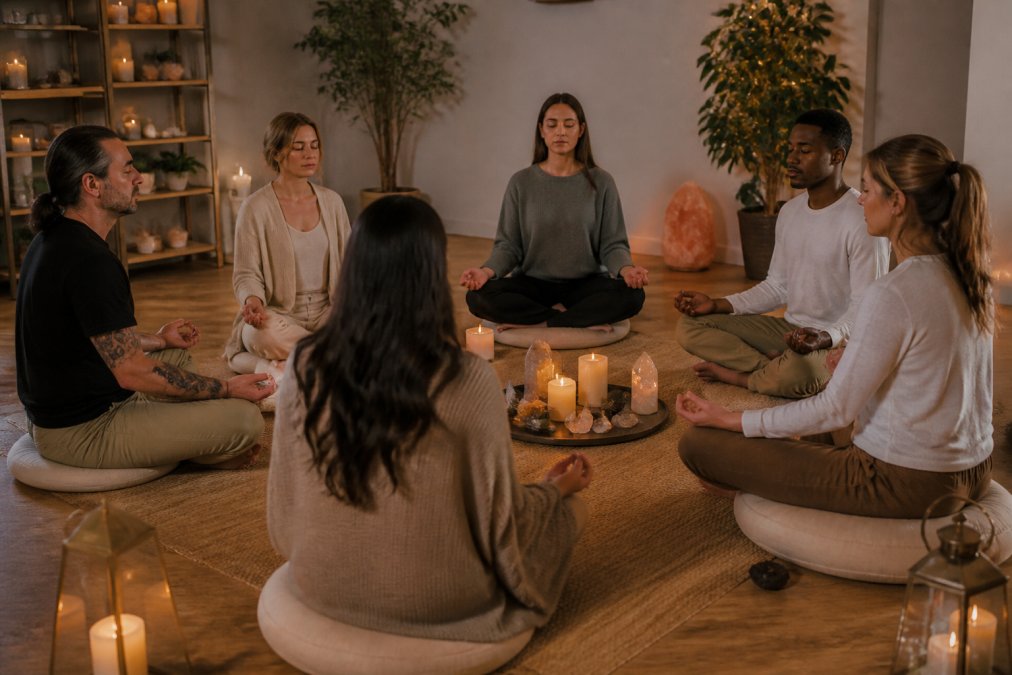
The benefits of group meditation come from several forces working at once, and naming them helps you choose the right format. The first is accountability: when you know someone expects you at 7 p.m. on Tuesday, you go. The second is what practitioners often call entrainment, the tendency of breathing and attention to settle toward the pace of the people around you.
Accountability for Your Spiritual Practice
Accountability is unglamorous and effective. That single social nudge does more for consistency than any app reminder, because a reminder can be dismissed and a person cannot be ignored as easily. A common mistake is treating group practice as optional once you feel "established." In practice, the people who keep a practice for years are the ones who kept a group.
Choosing a Format That Matches Your Goal
Not every group practice works the same way. Match the format to what you actually need:
- Guided group meditation (30-60 minutes): best for beginners and for anyone who struggles to sit without direction. A teacher talks you through the session.
- Silent sits: best for people with an established practice who want depth and minimal instruction. Expect the first few to feel long.
- Chanting or sound circles: best for people who find silence difficult and respond to rhythm, breath, and voice.
- Study-and-sit hybrids: best for people who want teaching alongside practice, often a short talk, then a sit, then discussion.
The Trade-Offs Nobody Mentions
Group practice is not strictly better than sitting alone, it trades one set of benefits for another. A group gives you structure and company but less control over timing, silence, and style. A solo practice gives you flexibility but asks more of your own discipline. Many long-term practitioners keep both: a weekly group for consistency and a short daily sit for depth.
How to Find a Spiritual Community That Fits Your Stage of Life
Finding the right group starts with naming what you actually need right now. A new parent, a recent retiree, and someone in the middle of a career change need very different things from a community, and the same group rarely serves all three well.
Ask yourself three questions before you search:
- What do I want from this group: practice, service, study, or friendship?
- What time and energy can I realistically give each month?
- What beliefs or values do I need shared, and which can I hold privately?
Vetting a Group Before You Commit
Vetting protects your time and your well-being. Sit in on at least three sessions before you decide anything. Watch how leaders handle disagreement and how they treat newcomers.
Red flags to watch for:
- Pressure to give money, time, or personal information early
- A leader who discourages questions or outside relationships
- Claims of exclusive access to truth or special powers
- Shame used as a teaching tool
Mental Health, Emotional Support, and Combating Isolation
Community supports emotional well-being, but it does not replace professional care. That distinction matters, and most articles state it once and move on. The more useful question is how the two actually work together, and where a spiritual group helps, where it can quietly get in the way, and how to tell the difference.
What Community Does Well
What community does well is combat isolation. Loneliness wears people down quietly, and regular in-person contact is one of the simplest counters to it. A group also supplies routine, a listening ear, and shared values and moral guidance that give members a compass for hard decisions. These are real benefits, and for many people they are the difference between a hard season and an unbearable one.
Spiritual Graffiti (Quality paperback) →
What Community Cannot Do
A group can offer compassion and consistency; a licensed therapist offers treatment. That means assessment, diagnosis, and evidence-based methods, not the same thing as a supportive circle, no matter how kind the circle is. A common pattern is that a group becomes the only outlet for a serious problem, and the person stays because leaving feels disloyal. That is a sign to bring in a professional, not to try harder.
A Practical Framework: Community Alongside Care
If you're managing a mental health condition, tell your clinician what you're exploring and keep them in the loop. Spiritual practice and medical care work best side by side, not as substitutes. A simple way to hold both:
- Name the role of each. Your clinician handles symptoms, treatment, and medication questions. Your group handles belonging, meaning, and routine.
- Watch for substitution. If you find yourself skipping appointments because the group "covers it," that's a warning sign, not progress.
- Keep one honest outside voice. A therapist, a trusted friend, or a family member who isn't in the group can see what members can't.
- Reassess every few months. What a group gave you in a crisis may not be what you need six months later.
When a Group Is Helping, and When It Isn't
A healthy group makes you more able to function outside it. You sleep better, you keep your other relationships, you can say no without guilt. A group that is masking a problem tends to do the opposite: it becomes the only place you feel okay, it discourages outside help, and it treats professional care as a lack of faith.
Spiritual Burnout and Toxic Communities: When to Walk Away
Spiritual burnout is real, and it usually arrives after months of overcommitting. You said yes to every circle, class, and ceremony. Now the practices that once felt nourishing feel like another obligation. That's not a failure of faith. It's a signal to pull back.
- Leadership that punishes doubt or exit
- Financial pressure framed as spiritual duty
- Gossip, cliques, or public shaming
- Boundaries treated as a lack of devotion
Digital vs. In-Person Community Dynamics
Online groups win on access; in-person groups win on depth. A digital circle can connect you to teachers and peers anywhere, at any hour, which is a genuine gift if you live far from like-minded people or travel often.
Tools and Rituals That Support Shared Practice
A few simple tools make group practice feel like an occasion rather than a meeting. Many circles open with a cleansing ritual: a bundle of white sage, a stick of palo santo, or a sage and cedar spray to reset the room's energy before anyone speaks.
- Sage, White/Fancy Small 4in. ($8.95) is a traditional choice for clearing a space before practice.
- Palo Santo Single Sticks ($2.95) bring a sweet, woodsy aroma that many groups use to settle into meditation.
- Sage & Cedar 2oz. ($24.95) offers the same cleansing intention in a spray, handy for spaces where smoke isn't welcome.
- Pillar Spirituals ($26.95) burn for roughly 100 hours, which suits a group that meets weekly.
- Taper, 9in. Beeswax Candle ($4.50) gives a warm, steady flame for a simple altar.
- Bracelet, 7 Chakra Elastic w/Q ($18.95) is an easy shared gift or personal anchor for members.
- Goddess Oracle Bk/Deck Set ($31.95) includes 52 cards and a 208-page book with rituals and reflection questions, useful for a study circle.
- Spiritual Graffiti ($19.95) and Sacred America Sacred World ($18.00) both work well as a group's first read.
Conclusion: Start With One Visit
The hardest part of finding a spiritual community is the first visit, when you don't know anyone and aren't sure you belong. That feeling passes faster than you'd expect, usually within the first ten minutes. For Heaven's Sake has served the metro area since 2000 as a minority woman-owned independent shop, and our Lakewood location at 2680 Youngfield Street is open for seekers at every stage.

Frequently Asked Questions
What are the primary benefits of joining a local spiritual community?
A local spiritual community gives you three things a solo practice rarely does: a sense of belonging, a support system during difficult times, and accountability that keeps your spiritual practice consistent. You also get shared values and moral guidance from people at different life stages, which pushes personal growth faster than working alone. In-person groups add physical presence, which many people find more grounding than online-only connection.
How can I find a supportive spiritual community in my area?
Start by visiting local metaphysical shops and asking staff which groups meet nearby. Attend one event, such as a psychic fair or workshop, before committing to anything regular. Ask three questions: who leads the group, what a typical meeting looks like, and whether newcomers are welcome. If the answers stay vague or you feel pressured to spend money, keep looking. A healthy group lets you observe first and join later.
What role do metaphysical centers play in building local community?
Metaphysical centers act as gathering points where seekers meet face to face. They host readings, psychic fairs, workshops, and informal conversations that turn strangers into a support system. For people new to spiritual practice, a center is a low-pressure place to ask questions without judgment. Many also connect you with practitioners for one-on-one guidance, which bridges the gap between reading about spirituality and living it.
How do I know if a spiritual community is unhealthy for me?
Watch for pressure to cut off outside relationships, demands for large financial commitments, leaders who refuse questions, and guilt when you miss meetings. A healthy community respects your boundaries and your existing support system. If you feel drained rather than rejuvenated after gatherings, that is a signal. Step back, talk to someone outside the group, and give yourself permission to leave. Spiritual burnout is real, and leaving is not failure.