

Last Updated: October 29, 2026
Quick Summary
The most important questions to ask gemstone sellers are whether the stone is natural, synthetic, or imitation, whether it has been treated, and what the written return policy covers. Asking these before you pay exposes what a photo hides. A clear, written answer is a good sign, while vague replies are a warning.
- Ask for the stone's category, natural, synthetic, or imitation, to be stated in writing.
- Ask whether the stone is treated, and whether the treatment is permanent.
- Verify any lab report number on the issuing lab's own website before trusting it.
- Get return window, shipping payer, fees, and refund method on the invoice before paying.
- Walk away if the seller cannot answer several key questions clearly.
Table of Contents
- Why Questions Matter More Than Pretty Photos
- Start With Natural, Synthetic, and Imitation Stones
- Ask About Gemstone Treatments and Disclosure
- Request a Gemstone Identification Report
- Clarify the Gemstone Return Policy Before You Pay
- Judge the Seller Reputation and Online Listing Evidence
- Use This Gemstone Seller Checklist on Your Next Purchase
- Frequently Asked Questions
Why Questions Matter More Than Pretty Photos
Gemstone photos are designed to sell. They rarely show the scratches, the color shifts under store lighting, or the treatment that makes a stone look better than it really is.
The good news is that a few well-chosen questions tell you most of what you need. A seller who answers clearly is usually one worth trusting. A seller who dodges is telling you something too.
Start With Natural, Synthetic, and Imitation Stones
The first question should always be what kind of stone this is. A natural gemstone formed in the earth. A synthetic gemstone was grown in a lab with the same chemistry.
Ask the seller to state the category in writing. Then ask:
- Is this stone natural, synthetic, or imitation?
- If it is synthetic, was it lab-grown or simulated?
- Is the price consistent with the category?
Lab-grown stones are not fake. They are real crystals, but they cost far less than natural ones. Price is often the quickest clue. A "natural" stone priced like a glass bead needs a closer look.
Ask About Gemstone Treatments and Disclosure
Many gemstones are treated to improve color or clarity. Heating, oiling, and dyeing are common. Some treatments are stable and widely accepted. Others can wear off or change with heat, sunlight, or cleaning.
Ask these questions directly:
- Has this gemstone been treated or enhanced in any way?
- What kind of treatment was used?
- Is the treatment permanent, or can it fade or need repair?
- Will you disclose this in writing on the receipt or listing?
Watch out: an untreated stone is often worth much more than a treated one. A seller who says "no treatment" without any proof deserves a follow-up question about how they know.
Request a Gemstone Identification Report
A report from a recognized gemological laboratory is one of the strongest pieces of evidence you can get. Our guide to telling authentic stones apart shows what to check on the document itself.
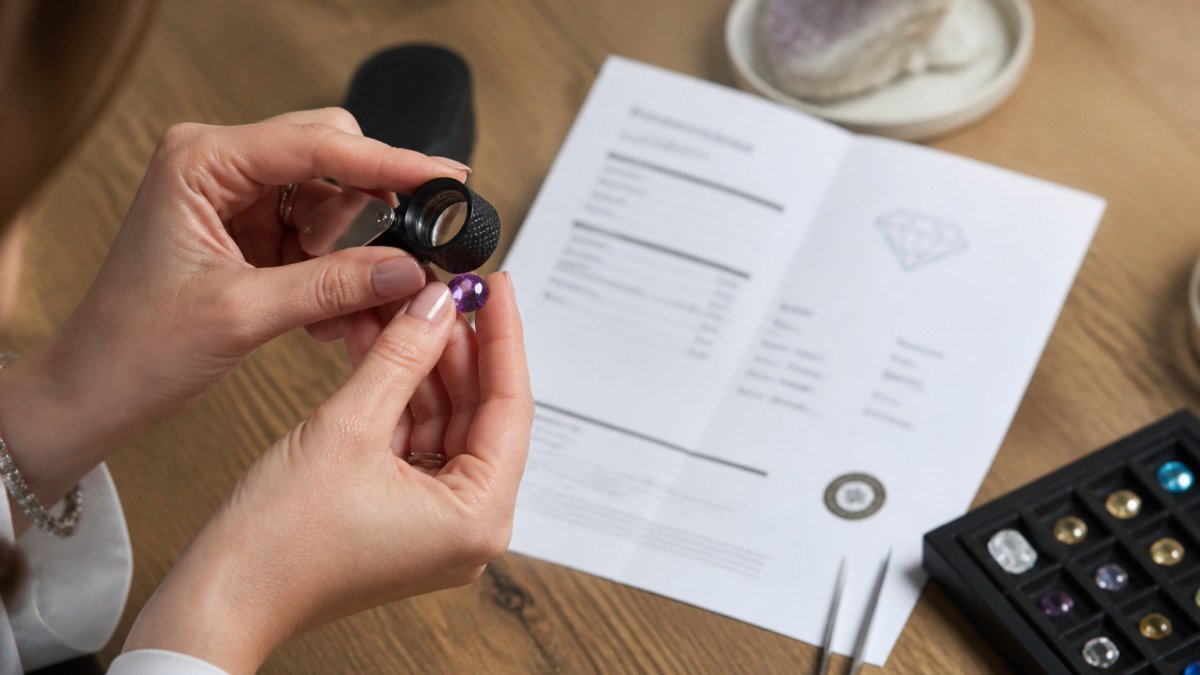
But a report is only useful if you verify it. Many buyers accept a laminated card at face value and never check whether the document is real, current, or even about the stone in front of them. Here is how to close that gap.
Ask which laboratory issued the report
Not all labs are equal. Some are independent and widely recognized; others are in-house labs run by the seller, which creates an obvious conflict of interest. Ask the seller:
- Which laboratory issued the report, and is it independent of the seller?
- Does the report have a unique number I can look up on the lab's own website?
- Can you send me a photo of the full report, including the back page and any appendix?
A legitimate lab will let you verify the report number directly on its site. If the seller cannot or will not provide the number, treat the report as marketing rather than evidence.
Check that the report matches the stone
A real report about a different stone is worse than no report, because it creates false confidence. Compare the report to the listing and to the stone itself:
- Does the stated weight match the weight you were quoted?
- Do the measurements (length, width, depth) match the listing?
- Does the report describe the same shape, cut, and color as the stone being sold?
- If the stone is set in jewelry, was it examined loose or in the mounting? A report on a mounted stone may have limits on what the lab could test.
Ask the seller to confirm in writing that the report accompanies the exact stone you are buying, not a similar stone from the same parcel.
Understand what the report does and does not cover
A standard identification report typically covers species, variety, weight, measurements, shape, cut style, and whether evidence of treatment was found. It usually does not cover:
- Country of origin, unless the lab specifically offers an origin opinion
- Value or price
- Whether the stone is a good buy
- The quality of the cut beyond basic description
If a seller waves a report as proof of origin or value, ask a follow-up: does the report actually state an origin opinion, or is origin coming from the seller's own claim? Those are different things.
Watch for report red flags
A few patterns should slow you down:
- A report from a lab you cannot find independently online
- A report number that does not resolve on the lab's site
- A report that describes a stone with different measurements than the listing
- A seller who refuses to send the full report before payment
- A report presented as a "certificate of authenticity" with no lab name, no number, and no measurements
Ask for an independent appraisal when the stakes are high
For an expensive stone, ask whether you can have it appraised by an independent appraiser during the return window. A reputable seller should not object. If the seller refuses, that refusal is itself information. Pair the report with the written return terms so you have a path to recourse if the stone turns out to be different from what was described.
Clarify the Gemstone Return Policy Before You Pay
Returns are where many buyers get stuck. Before paying, get the return terms in writing. Do not rely on a verbal promise, and do not assume that a generous-sounding policy on a website applies to the specific stone you are buying.
The Book of Stones, Revised Edition: Who They Are and What They Teach →
Ask the seller:
- How many days do I have to return the stone, and does the clock start on delivery or on shipping?
- Who pays for return shipping, and is the return shipment insured?
- Is there a restocking fee, and is it a flat amount or a percentage?
- Will a refund go back to my original payment method, and how long does it take?
- What happens if the stone is not as described, is that treated differently from a change of mind?
- Do I need a return authorization number before shipping anything back?
For online purchases, these answers matter even more. You cannot inspect the stone in person, so your recourse depends entirely on the written terms.
Get the terms on the invoice, not just the website
Website policies change, and a policy page may not name the stone you bought. Ask the seller to put the key terms on the invoice or order confirmation:
- The stone's species, variety, weight, and measurements
- Whether it is natural, synthetic, or imitation
- Any treatments and whether they are permanent
- The return window and who pays return shipping
- The refund method and any fees
- Any origin claim, stated as a claim rather than a fact unless supported by a report
If the invoice is vague, ask for a corrected version before you pay. A seller who will not put terms in writing is telling you something about how a dispute will go.
Ask about an independent appraisal window
A return policy is more useful when it gives you time to have the stone checked. Ask:
- Can I have the stone independently appraised during the return window without voiding the return?
- Does removing the stone from its packaging or setting affect my return rights?
- If an appraiser finds the stone is not as described, what is the process?
A common pattern is a return window that is long enough to receive the stone, have it looked at, and ship it back. If the window is very short, ask whether it can be extended in writing for an appraisal.
Understand shipping risk and recourse
Who bears the risk if the package is lost or damaged in transit? Ask before you pay:
- Is the shipment insured for the full purchase amount?
- Who files the claim if the package is lost or damaged?
- Do I need to sign for delivery?
- If I return the stone, who insures the return shipment?
Keep the tracking number, photos of the packaging as received, and any correspondence. If a dispute arises, those records matter.
Know how a dispute would actually be handled
Ask the seller directly: if we disagree about whether the stone matches the description, what happens next? Look for a written process, a return authorization, an independent appraisal, or a stated dispute procedure. If the only answer is a verbal promise, your practical recourse is limited.
For online purchases especially, treat the written terms as part of the product. A fair seller expects careful buyers and will put the terms in writing without fuss.
Judge the Seller Reputation and Online Listing Evidence
A seller's reputation is part of the purchase. Look for a track record, not just a polished website. Customer reviews, a clear business address, and responsive answers all count.
Check the listing itself:
- Are there close-up photos taken under neutral light?
- Is there a video showing the stone from several angles?
- Are the stone's origin claims specific, or vague like "rare mine"?
Be cautious with origin claims. Many sellers cannot prove where a stone was mined. Ask what evidence supports the claim, and treat unsupported origin language as marketing.
Use This Gemstone Seller Checklist on Your Next Purchase
Print or save this list and bring it to every purchase, online or in person:
- Is the stone natural, synthetic, or imitation, in writing?
- Has it been treated, and is the treatment permanent?
- Is there a lab report, and does its number match the stone?
- Is the price consistent with the stone category?
- What is the written return policy and refund method?
- Does the listing include close-up photos or video?
- Can I verify the seller's reputation with reviews?
If the seller cannot answer several of these clearly, walk away. A fair seller expects careful buyers and will answer without fuss.
For help choosing crystals and reference books, start with The Book of Stones, Revised Edition, which covers nearly 400 stone varieties with color photographs.

Frequently Asked Questions
What should I ask a seller before buying a gemstone?
Ask whether the stone is natural, synthetic, or imitation, and whether it has been treated or enhanced. Request the exact carat weight, dimensions, and origin claims in writing. Ask whether a laboratory report or independent appraisal is available and which laboratory issued it. Confirm the return policy, refund terms, and who pays return shipping.
How can I tell whether a gemstone is natural or lab-grown?
Photos and descriptions alone rarely settle the question. Ask the seller to state the origin in writing and to name the laboratory that identified the stone.
Should I ask for a gemstone identification report?
Yes, especially for stones costing more than a few hundred dollars. An identification report from a recognized gemological laboratory describes the stone's identity, and often its treatments and key characteristics. Check that the report number matches the stone, that the laboratory is named, and that the report is current. If you buy online, ask for the report to be sent before you pay, or confirm the report is included in your order.
What should a gemstone return policy cover?
A solid return policy states how many days you have to return a stone, whether the refund covers the full purchase price, and who pays return shipping. It should also explain what happens if the stone is found to be treated or different from its description, and whether returns require insurance and tracking. Get these terms in writing before you pay, since verbal promises are hard to enforce after a dispute begins.
Shopping for crystals in Lakewood? Visit For Heaven's Sake at 2680 Youngfield Street, where our team can help you ask the right questions before you buy.
