

Table of Contents
- What Is a Metaphysical Shop and How Is It Different?
- Essential Items for Spiritual Beginners: Where to Start
- How to Tell If a Crystal Is Authentic
- Where to Buy Authentic Gemstones: In-Person vs. Online
- Metaphysical Shop Etiquette: Questions You Can Ask
- How to Choose the Right Stone for Your Needs
- Cleansing and Charging Your New Crystals
- Common Mistakes Beginners Make and How to Avoid Them
- Frequently Asked Questions
Last Updated: September 7, 2026
A metaphysical shop is a retail space dedicated to spiritual tools and practices, offering everything from crystals and healing stones to tarot decks, books, and ceremonial supplies. For beginners, these shops can feel overwhelming, which is why this guide from For Heaven's Sake breaks down what to expect, what to buy, and how to shop with confidence. As a minority woman-owned independent business serving the Denver metro area, we've watched thousands of first-time visitors walk through our doors, and the most common feeling they share is uncertainty about where to start.

Here's the truth: you don't need to know anything before you walk in. The best metaphysical shops are designed to meet you where you are, whether you're exploring for the first time or deepening a lifelong practice. Below, we'll walk through the essential items for spiritual beginners, how to spot authentic crystals, and the questions you can ask staff without feeling awkward.
What Is a Metaphysical Shop and How Is It Different?
A metaphysical shop is a curated retail environment focused on spiritual growth, holistic well-being, and personal exploration, distinct from typical gift stores because of its specialized inventory and community role. Unlike a standard boutique, these spaces typically carry gemstones, minerals, books on spiritual practice, ritual tools, and divination items like tarot cards, all selected to support energy work and meditation.
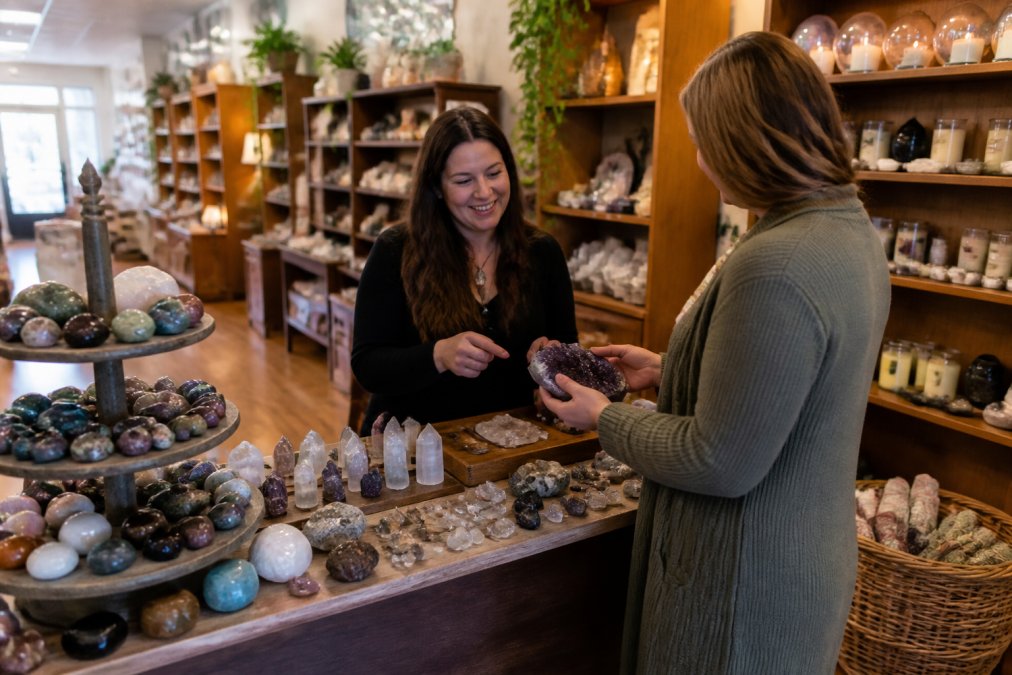
The atmosphere matters as much as the inventory. Many shops, including our Lakewood location at 2680 Youngfield Street, are designed to feel welcoming rather than intimidating, with staff who can explain metaphysical properties without judgment. The retail experience here is relational: you're not just buying a product, you're getting guidance on how to use it in your spiritual practice.
Essential Items for Spiritual Beginners: Where to Start
Starting a spiritual collection doesn't require a large budget or extensive knowledge. A common approach is to begin with one or two items that genuinely call to you, then build from there as your practice develops.
Crystals and Healing Stones
Crystals are often the entry point for most beginners, and for good reason. They're tangible, beautiful, and can serve as focal points for meditation or intention-setting. When you're just starting, choose stones based on what you're drawn to visually or what you hope to address, such as stress relief or focus, rather than trying to collect everything at once.
Books and Learning Tools
Books provide the foundation that crystals cannot. A quality introductory text on chakras, divination, or general metaphysical practice will teach you how to work with your tools meaningfully. For example, beginner-friendly resources on spiritual practice can help you understand the context behind the tools. Titles like Chakras for Beginners by David Pond, available at For Heaven's Sake for $14.99, offer structured learning, while a starter tarot deck such as Your First Tarot at $22.95 gives you a hands-on tool for self-discovery.

How to Tell If a Crystal Is Authentic
Authenticity is the biggest concern for most new buyers, and it's a valid one. Real crystals are natural minerals, which means they form with imperfections, irregular shapes, and variations in color. Synthetic stones, by contrast, often look too perfect, with uniform color and consistent internal structure.
A few practical checks can help you assess authenticity. Real stones typically feel cool to the touch initially and warm slowly in your hand. They may have minor chips, fractures, or inclusions, which are natural characteristics, not flaws. Glass imitations often contain tiny air bubbles visible under magnification, and they warm up quickly. When you're shopping in person, ask the staff where their stones are sourced. Reputable shops will know their supply chain and can tell you whether a piece is natural, treated, or laboratory-grown. If you're buying online, request photos of the actual specimen rather than relying on stock images, since the FTC guidance on authentic product claims requires sellers to represent goods honestly.
Where to Buy Authentic Gemstones: In-Person vs. Online
The question of where to buy authentic gemstones comes down to one key factor: whether you need to feel the energy and see the stone in person. Online shopping offers convenience and often lower prices, but it carries real risks regarding authenticity and quality. Photographs can flatter a stone, and you cannot assess weight, texture, or the subtle variations that indicate a natural specimen.
In-person shopping at metaphysical shops gives you immediate access to examine the stone, ask questions, and feel its vibrational energy before committing. For Heaven's Sake carries a curated collection of ethically sourced crystals and gemstones, and our staff can walk you through each specimen's origin and properties. The trade-off is that physical shops may have smaller inventories than online marketplaces, so if you're seeking a specific stone, calling ahead to check availability is wise.
When vetting online sellers, look for clear photographs of individual items, detailed descriptions of origin and treatments, and transparent return policies. Established shops with verifiable customer reviews, like our 900-plus five-star Google Marketplace reviews, offer more accountability than anonymous marketplaces.
Metaphysical Shop Etiquette: Questions You Can Ask
New visitors often worry about looking inexperienced, but metaphysical shop etiquette is far more relaxed than you might expect. Staff in these spaces genuinely enjoy helping beginners, and asking questions is encouraged, not frowned upon.
Good questions to ask include: How do you source your crystals? Can you explain what this stone is used for? Do you offer guidance on cleansing new purchases? What events or classes do you host? You might also ask about the practitioners who offer readings, including their experience and approach. A reputable shop will answer openly. For Heaven's Sake holds psychic fairs and offers professional readings, and we welcome questions about our readers' credentials and styles. Remember, there is no such thing as a stupid question in a metaphysical shop; the only mistake is leaving with something you don't understand.
How to Choose the Right Stone for Your Needs
Choosing a crystal is more intuitive than analytical. Rather than memorizing a list of metaphysical properties, start with your intention. Are you seeking calm during a stressful period? Do you want support for meditation or manifestation work? Different stones are traditionally associated with different purposes, from rose quartz for emotional healing to amethyst for clarity and spiritual growth.
A practical approach is to let intuition guide your initial selection. Hold a few stones and notice which one you're drawn to. Many practitioners believe that the right stone chooses you. If you're looking for anxiety support, for example, you might select a stone known for grounding properties, but the most effective choice is one you feel connected to. Staff can help match your intention to the appropriate stone, but your comfort with the piece matters most. For beginners, a small tumbled stone is an affordable starting point that you can carry or place on your altar.
Cleansing and Charging Your New Crystals
Most guides tell you to cleanse your crystals, but few walk you through the how and why with the practical detail a beginner needs. This is the immediate 'next step' after your purchase, and getting it right sets the tone for your entire practice. The goal is to reset the stone's energy to its neutral, natural state before you program it with your own intentions.
Why Cleansing Matters
Crystals are natural minerals that are mined, shipped, handled by many people, and displayed in shops. Each step is believed to leave a subtle energetic residue. Think of it like buying a new water bottle, you wouldn't drink from it without washing it first. Cleansing is the energetic equivalent of that first wash. It clears the slate so the stone can work with your energy, not the energy of everyone who touched it before you.
A Step-by-Step Cleansing Ritual for Beginners
Here is a simple, safe, and effective ritual you can do the moment you get home. This method is gentle enough for almost all stones and requires no special tools.
- Prepare a small bowl of dry salt. Sea salt or Himalayan salt is preferred. Important: Do not use saltwater or submerge stones in salt, as it can damage softer minerals like selenite, calcite, and malachite.
- Place your crystal in the dry salt. Let it sit for a few hours, or overnight if possible. The salt is believed to absorb and neutralize stagnant energy.
- Remove the crystal and rinse it briefly under cool, running tap water. This washes away the salt and any residual energy. Again, check if your stone is water-safe first. If not, simply brush off the salt with a soft cloth.
- Dry the crystal with a clean cloth.
- Set your intention. Hold the crystal in your hands, close your eyes, and state clearly what you want this stone to support. For example, say, "I intend for this amethyst to bring me calm and clarity during stressful moments." This personalizes the stone and connects your energy to it.
Once your crystal is cleansed, you can 'charge' it by placing it on a windowsill or outdoors under the light of a full moon. This is a gentle, universal method that works for all stones. The next full moon is a perfect opportunity to charge your new collection.
Common Cleansing Mistakes to Avoid
- Using saltwater on soft stones: This can cause pitting, cracking, or discoloration. When in doubt, use dry salt or skip the salt altogether.
- Leaving stones in direct sunlight: Sunlight can fade the color of many stones, including amethyst, rose quartz, and citrine. A few hours of morning sun is fine, but avoid prolonged exposure.
- Smudging with unfamiliar herbs: While sage and palo santo are popular, they are not the only options. If you are sensitive to smoke or prefer not to use these materials, sound cleansing with a singing bowl or a simple bell is equally effective. Simply ring the bowl near the stone a few times to clear its energy.
Cleansing is not a one-time event. Many practitioners cleanse their crystals monthly, during the new or full moon, or whenever a stone feels 'heavy' or 'dull.' Making this a regular part of your practice keeps your tools energetically clear and ready for use.
Common Mistakes Beginners Make and How to Avoid Them
The most common mistake beginners make is overbuying. Walking into a well-stocked shop and purchasing ten different stones without understanding any of them leads to clutter, not connection. Start small. One or two stones plus a single book or deck gives you room to learn.
Another frequent error is skipping the cleansing step entirely. A new crystal carries residual energy from mining, shipping, and handling, and working with it uncleansed can feel flat or disconnected. Make cleansing part of your ritual from day one.
A third mistake is ignoring your own intuition in favor of what's popular or expensive. A $5 tumbled stone that resonates with you will serve your practice better than a $50 specimen you bought because someone said it was powerful. Trust your instincts, ask questions, and build your collection gradually. For a structured starting point, consider a beginner's tarot kit like The Complete Tarot Kit at $59.95, which pairs a deck with instructional materials, or a foundational text like Divination for Beginners by Scott Cunningham at $16.99 to guide your early exploration.
| Beginner Mistake | Better Approach | Why It Matters |
|---|---|---|
| Buying many stones at once | Start with 1-2 that resonate | Allows genuine connection and learning |
| Skipping cleansing | Cleanse new purchases immediately | Clears residual energy for better results |
| Ignoring intuition | Choose based on personal draw | The right stone is one you feel connected to |
| Avoiding questions | Ask staff freely | Knowledgeable guidance prevents wasted purchases |
Walking into a metaphysical shop for the first time can feel like stepping into an unfamiliar world, but it doesn't have to be intimidating. Start with a clear intention, ask questions freely, and choose items that genuinely resonate with you rather than trying to build a complete collection overnight. At For Heaven's Sake in Lakewood, we've created a space where beginners are welcomed, guided, and supported by staff who remember what it felt like to start their own journeys. Whether you're drawn to crystals, curious about tarot, or simply exploring what spiritual practice might offer you, our doors are open.
Go Shopping and begin your exploration with confidence.
Frequently Asked Questions
What crystals should a beginner get?
Start with clear quartz, amethyst, rose quartz, and black tourmaline. Clear quartz amplifies intentions, amethyst supports calm and intuition, rose quartz encourages self-love, and black tourmaline offers grounding and protection. These four stones cover a broad range of needs and are widely available at most metaphysical shops. Hold each one and notice which you are drawn to; your intuition is a reliable guide when you are first building a collection.
How can you tell if a crystal or gemstone is authentic?
Authentic stones usually feel cool to the touch and warm up slowly in your hand. Look for natural imperfections like tiny cracks, color variations, or irregular shapes; perfect uniformity often signals synthetic material. Ask staff where the stones were sourced and whether they have been treated or dyed. Reputable metaphysical shops welcome these questions and can tell you about ethical sourcing practices. When in doubt, request to see a raw specimen alongside the polished version to compare.
What should a beginner look for in a reputable metaphysical shop?
A reputable shop prioritizes education over pressure. Staff should answer questions patiently, explain the properties of different stones, and never push you toward expensive purchases. Look for clear labeling of crystal types and origins, a welcoming atmosphere, and a willingness to discuss ethical sourcing. Established shops often host workshops and events that signal community investment. Checking online reviews can also reveal how other beginners experienced their first visit.
What is the difference between a metaphysical shop and a standard gift shop?
A metaphysical shop specializes in spiritual tools and practices: crystals, tarot decks, incense, ceremonial supplies, and books on energy work and meditation. Staff typically have working knowledge of these traditions and can offer guidance on how to use the items. Standard gift shops carry decorative objects without that specialized context. Metaphysical shops often also provide services like psychic readings or host community events, creating a space for spiritual practice rather than just retail.
How do you prepare for your first visit to a spiritual supply store?
Come with an open mind and a loose sense of what interests you. You do not need to know exactly what you want; browsing is part of the experience. Set a rough budget so you feel comfortable exploring without overspending. Write down any questions you have about crystals, tarot, or cleansing practices. Wear comfortable clothing and give yourself time to wander. Most shops welcome beginners and expect questions, so there is no need to feel intimidated.
What is the difference between raw and polished crystals?
Raw crystals are unaltered specimens straight from the earth, showing natural formations, texture, and sometimes matrix from surrounding rock. Polished crystals have been tumbled or shaped to create smooth surfaces and uniform shapes. Some practitioners prefer raw stones for grounding work because they retain their natural structure, while others choose polished stones for meditation or carrying in a pocket. The choice comes down to personal preference and how you plan to use the stone.