

Last Updated: November 20, 2026
Quick Summary
Heat treated citrine is usually amethyst that has been heated to change its purple color to yellow, orange, or reddish-brown. Visual clues like even, saturated color suggest heating, while natural citrine tends to look more varied, with paler areas and zoning. Appearance alone cannot prove origin, so ask the seller directly.
- Natural citrine is rare, and most shop citrine comes from heat-treated amethyst.
- Natural citrine often shows zoning that follows the crystal's growth lines.
- Heat-treated stones usually cost less than natural material, so disclosure matters.
- Ask whether the stone is natural citrine or heat-treated amethyst, and whether it has any other treatment.
- Visual inspection has limits, so use a gemologist or lab report for expensive purchases.
Table of Contents
- What Natural Citrine Is and How It Forms
- What Heat-Treated Citrine Is and Why Heat-Treated Amethyst Matters
- Visual Signs of Heat Treated Citrine vs Natural
- Is Heat-Treated Citrine Fake?
- How to Identify Real Citrine Step by Step
- Questions to Ask a Seller Before You Buy
- Choosing Your Next Citrine at For Heaven's Sake in Lakewood
- Frequently Asked Questions
What Natural Citrine Is and How It Forms
Natural citrine is a yellow to golden-brown variety of quartz whose color comes from iron impurities and the geological conditions it formed under. Many shoppers arrive with a single question: is this stone the real thing? Knowing how natural citrine forms is the first step to answering it.
Natural citrine is rare. Most of the citrine sold in shops has been produced by heat-treating amethyst, which is a separate and much more common purple quartz. Genuine natural citrine typically shows uneven color, pale patches, and growth zones that run through the crystal.
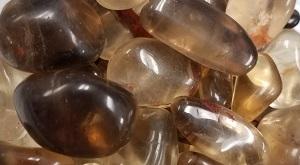
If you are shopping for natural material, a good place to start is our Citrine - Rough (Natural) Points, which are sold as natural rough specimens. Our Quartz/Smokey w/Natural Citrine - Tumbled is another option for buyers who want natural color in a polished stone.
What Heat-Treated Citrine Is and Why Heat-Treated Amethyst Matters
Heat-treated citrine is amethyst that has been heated, usually in a kiln, to change its purple color to yellow, orange, or reddish-brown. The process is well documented in the gem trade, and the heated stones are sometimes sold as citrine without clear labeling.
Heat-treated amethyst matters because it is the source of most commercial citrine. Once you understand that, the question shifts from "is it citrine?" to "was it heated?" Both answers can be true, and buyers should ask the seller directly which applies.
Heat treatment does not make a stone worthless, but it does change what you are buying. Treated stones usually cost less than natural material, so disclosure matters.
Visual Signs of Heat Treated Citrine vs Natural
Visual clues can point you in a direction, but they cannot prove origin on their own. Use the signs below as a starting point for a closer look.
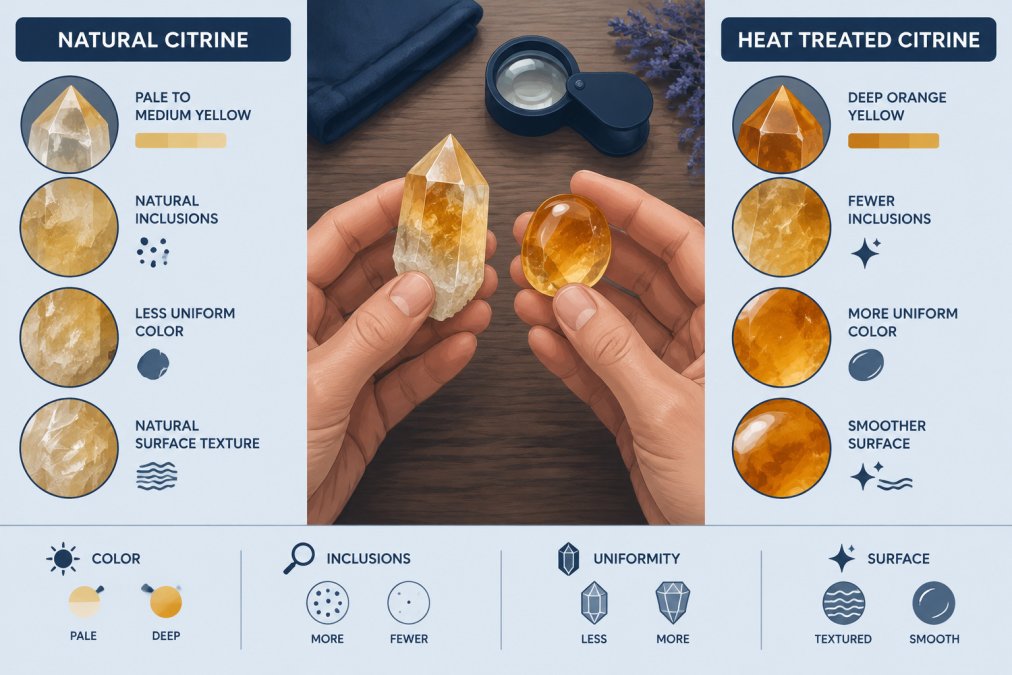
Heat-treated stones often have a very even, saturated color, sometimes with a slightly orange or reddish cast. Natural citrine tends to look more varied, with paler areas and softer transitions between tones.
Color Distribution and Zoning
Look at how the color is distributed across the crystal. Natural citrine often shows zoning, where bands of different intensity follow the growth lines of the crystal. Heat-treated stones are more likely to look uniform throughout, because the heating affects the whole piece at once.
Lighting can change how zoning appears. Examine the stone in daylight and again under a warm lamp before deciding.
White or Opaque Areas Near the Base
Many natural points have a whitish or chalky area near the base, where the crystal was attached to the rock. This is a normal feature of natural formation. Heat-treated pieces may show this area too, so it is useful evidence only when considered alongside other signs.
Is Heat-Treated Citrine Fake?
Heat-treated citrine is not fake in the sense of being a different mineral. It is still quartz, and heat treatment is a recognized trade practice. The issue is disclosure. A heated stone sold as natural is misrepresented, while a heated stone sold clearly as heat-treated is an honest product at an honest price.
Buyers who prefer natural material should expect to pay more and should ask for documentation or a clear statement from the seller.
How to Identify Real Citrine Step by Step
No single check is conclusive, so the useful approach is to run several checks, note what each one suggests, and then assign a confidence level rather than a verdict. The workflow below separates clues that are merely suggestive from those that carry more weight.
- Inspect color distribution under neutral light. Look for zoning, bands of differing intensity that follow the crystal's growth lines. Uneven, banded color is consistent with natural origin. Even, saturated color with an orange or reddish cast is consistent with heat-treated amethyst. This clue is suggestive only; some natural stones are unusually even, and some treated stones retain faint zoning.
- Check the base of any point. A whitish or chalky zone near the base, where the crystal attached to host rock, is a normal natural feature. It is also common on heat-treated points, so treat it as corroborating evidence, never as proof on its own.
- Compare the stone under two lighting conditions. View it in indirect daylight and again under a warm lamp. Color that shifts noticeably between the two is worth noting, but lighting alone cannot establish origin.
- Look for surface and inclusion features. Natural quartz often carries minor surface irregularities, growth striations, or small inclusions. These support a natural reading but do not rule out treatment, since heating does not erase them.
- Ask the seller for origin and treatment history. A specific, consistent answer raises confidence. A vague answer lowers it, regardless of how the stone looks.
- Assign a confidence level, not a label. If the seller discloses origin and treatment and the visual clues agree, confidence is high. If the seller is vague or the clues conflict, treat the identification as uncertain and price your decision accordingly.
Watch out: treating any single feature, even a white base or visible zoning, as proof is the most common way buyers talk themselves into a wrong conclusion.
Visual inspection has real limits. Appearance alone may not establish origin or treatment, and similar-looking material can fool an experienced eye. When a purchase is expensive, or when the seller cannot document treatment, that is the point to involve a qualified gemologist or request a laboratory report rather than rely on a visual read.
Questions to Ask a Seller Before You Buy
The questions matter less than what you do with the answers. A seller who discloses treatment and origin plainly is giving you something you can act on; a seller who answers vaguely is telling you something too. Use the prompts below and read the responses against the notes that follow each one.
- "Is this natural citrine, or was it heat-treated amethyst?" A clear either/or answer is a good sign. If the reply is only "it's citrine," treat that as incomplete, the word is used loosely in the trade and does not by itself confirm natural origin.
- "Has the stone been treated in any way?" Ask specifically about heat, and about dye or coating, since those are separate treatments from heating. "Untreated" is a stronger statement than "natural-looking."
- "Where was the material sourced?" Country or region of origin is useful context, though it is not proof. A seller who can name a source is generally more accountable than one who cannot.
- "Which features did you use to identify it?" A seller who can point to zoning, base features, or documentation is showing their reasoning. A seller who cannot describe any basis is asking you to take it on faith.
- "Can you provide documentation or a lab report?" For higher-value stones, ask whether a gemological report is available or can be arranged. Not every seller will have one, but the willingness to discuss it is informative.
- "What is your return policy if the stone does not match the description?" A clear return window protects you if a later test contradicts the listing.
Watch out: vague terms such as "genuine citrine," "natural color," or "earth-mined" can be technically true while still describing heat-treated material, ask for the specific treatment history rather than accepting a reassuring adjective.
Clear, specific answers are a good sign. Evasive responses, shifting descriptions, or pressure to decide quickly are reasons to slow down, ask for more detail, or shop elsewhere.
Choosing Your Next Citrine at For Heaven's Sake in Lakewood
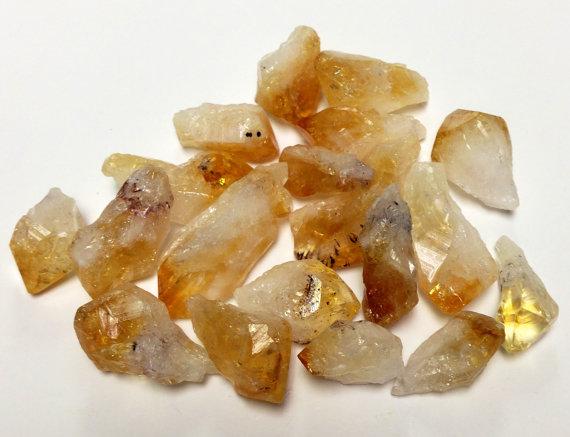
Whatever type of citrine you want, start with a clear idea of what you are looking for. Natural rough points suit buyers who want unpolished specimens, while tumbled stones are a practical choice for pocket carry and gift giving. Our Citrine - Rough (Natural) Points start at $10.00, and our Quartz/Smokey w/Natural Citrine - Tumbled starts at $3.00. For a deeper look at checking authenticity in any crystal, read How to Identify Authentic Healing Crystals. Visit us in Lakewood at 2680 Youngfield Street to see the stones in person.
Frequently Asked Questions
How can you tell if citrine is heat-treated?
Visual clues can suggest heat treatment but rarely prove it. Look for unusually uniform, saturated orange or reddish-brown color, especially in a stone that lacks the pale yellow zoning common in natural material. Many heat-treated amethyst pieces also show a white or chalky area near the crystal base. These signs raise questions, not answers. If the purchase matters to you, ask the seller directly whether the stone is treated, and where possible request documentation from a gemological laboratory.
What does natural citrine look like compared with heat-treated amethyst?
Natural citrine usually ranges from pale yellow to golden or smoky brown, and its color often varies within a single crystal. Heat-treated amethyst, which is purple quartz that has been heated, frequently turns orange, yellow, or reddish-brown. Its color can look more intense and even, and many pieces retain traces of purple toward the base or in the zoning. Because the two can look similar, comparing several specimens side by side under the same light helps you notice these differences.
Is heat-treated citrine fake?
Heat-treated citrine is not fake in the sense of being a different mineral. It is quartz, and it has been treated with heat to change its color. The problem arises when a seller presents it as natural citrine without disclosure. Ethical buying means knowing what you are purchasing and paying a price that matches it. Ask whether the stone is treated, and treat any seller who avoids the question with caution.
What should I ask a seller before buying citrine?
Ask whether the stone is natural or heat-treated, and whether it is heated amethyst. Ask where the stone was sourced and whether the seller can provide any documentation. Ask how the seller determined the answer. A knowledgeable seller will explain the reasoning without difficulty. Visit our Lakewood shop at 2680 Youngfield Street to compare pieces in person before you decide.
