

Table of Contents
- Step 1: Set Up Your Space and Posture for Meditation
- Step 2: How Long Should I Meditate as a Beginner?
- Step 3: Focus on the Breath and Handle a Wandering Mind
- Meditation Tools for Beginners: What Actually Helps
- Mindfulness Practice Tips for Daily Life
- Troubleshooting Discomfort and Neurodivergent Minds
- How to Start Meditation Practice and Make It a Habit
- Frequently Asked Questions
Last Updated: September 13, 2026
Step 1: Set Up Your Space and Posture for Meditation
Learning how to start meditation practice begins with a simple truth: you do not need a perfect room or a special cushion. You need a body that can rest comfortably and a spot where you will not be interrupted for a few minutes. At For Heaven's Sake, we have watched many people in the Denver area begin this practice, and the ones who stick with it almost always start with their setup, not their schedule.
Finding a Comfortable Seated Position
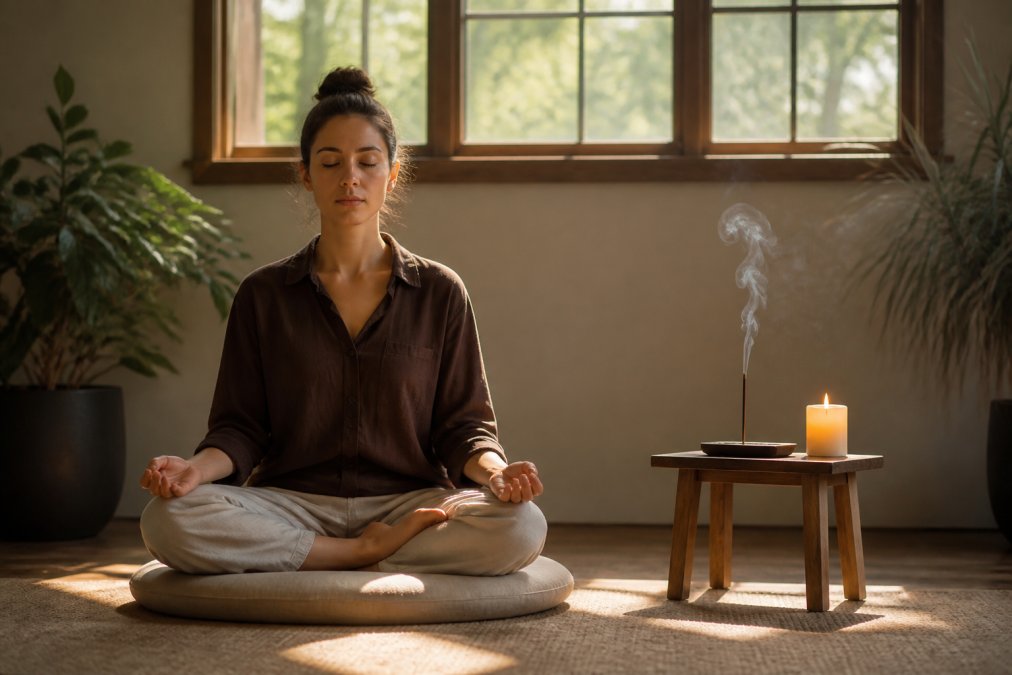
The best seated position is the one you can hold for your full session without pain. Cross-legged on a cushion works for many, but a chair with feet flat on the floor is just as valid. The goal is a stable, upright posture that lets your breath move freely.
A few options to try:
- Cross-legged on a firm cushion, hips slightly higher than knees
- Kneeling on a bench or folded blanket
- Sitting in a chair, spine tall, hands resting on your thighs
- Lying down, if sitting causes pain (though this makes drowsiness more likely)
Rest your hands wherever they feel natural. Palms down tends to feel grounding; palms up more open. Neither is more correct.
Creating a Quiet Space That Works for You
A dedicated space signals to your brain that meditation is about to happen. It does not need to be a whole room, a corner of a bedroom, a spot near a window, or even a specific chair works.
Keep it simple. A cushion, a small table, and one object that settles your attention are enough. Many people keep a candle, a stone, or a stick of incense there. The National Center for Complementary and Integrative Health overview of meditation notes that the setting itself is not what produces the benefit; the regularity of the practice is.
If your household is loud, do not wait for silence that never comes. A pair of earplugs or a white noise app solves most of it.
Step 2: How Long Should I Meditate as a Beginner?
The honest answer is shorter than you think. Most beginners quit because they attempt twenty minutes on day one, feel restless, and decide they are "bad at it." A better question than "how long should I meditate" is "how long can I repeat tomorrow?"
Starting Small: 2 to 5 Minutes
Two to five minutes is a complete, legitimate session. The single most useful thing to understand about habit formation: consistency beats duration, especially in the first month.
Here is a simple progression that works for most people:
| Week | Session Length | Frequency | Focus |
|---|---|---|---|
| Week 1 | 2-3 minutes | Once daily | Just showing up |
| Week 2-3 | 5 minutes | Once daily | Breath awareness |
| Week 4-6 | 8-10 minutes | Once daily | Staying with sensations |
| Week 7+ | 10-20 minutes | Daily or near-daily | Deepening concentration |
Set a timer so you are not checking the clock. A phone timer is fine, though many prefer a kitchen timer to keep the phone out of reach. When it ends, stop, do not add "just a little more" in week one.
Step 3: Focus on the Breath and Handle a Wandering Mind
A wandering mind is not a failure. It is the practice. Every time you notice your attention has drifted and bring it back, you have completed one repetition, the same way a single bicep curl counts. The noticing is the work.
Using the Breath as an Anchor
The breath works as an anchor because it is always available and always changing. You do not have to create it or control it. You simply feel it.
Try this:
- Sit in your chosen posture and let your eyes close or soften downward.
- Notice where you feel the breath most clearly: nostrils, chest, or belly.
- Follow one full inhale and one full exhale.
- When your attention drifts, gently return to that same spot. No commentary needed.
You are not trying to empty your mind. You are practicing the return. Internal dialogue will keep running, observe the thoughts without arguing with them, then come back to the physical sensations of breathing.
Meditation Tools for Beginners: What Actually Helps
Tools are optional, and that is the most important thing to say about them. Nothing you buy will meditate for you. That said, a few items make the early weeks easier by giving your attention somewhere to land and marking the space as separate from the rest of your day. The useful question is not "what should I buy" but "what removes friction between me and sitting down tomorrow."
Guided vs. Unguided: Which Should a Beginner Choose?
Most beginners do better with guided audio for the first two to four weeks. A recorded voice removes the "what do I do now" friction that stops a lot of people before the habit forms. Free guided tracks are widely available through apps, streaming services, and public libraries.
The trade-off is real: guided practice outsources the structure, so when the track ends, some people feel stranded. A common pattern is guided sessions for the first month, then alternating, guided on scattered days, unguided on steady ones. By week six or eight, many prefer silence because they have internalized the rhythm.
If you go unguided from the start, give yourself a single instruction to hold, such as "feel the breath at the nostrils." One instruction is easier to return to than a list.
Incense, Crystals, and Other Anchors
These serve a different purpose than guided audio: they anchor the routine through the senses. Over time, a scent, a visual object, or a physical texture becomes a cue that it is time to sit. That cueing effect is the mechanism, not any property of the object itself.
- Incense marks the transition into practice through smell. A stick lit at the same time each day builds a strong association within a couple of weeks.
- A candle flame gives the eyes a soft, steady resting point, which some people find easier than closing their eyes when drowsy.
- A stone or small object to hold absorbs restless energy and gives fidgety hands somewhere to go, which matters for anyone who finds stillness physically uncomfortable.
- A card or short reading offers a single thought to reflect on before or after sitting, which can replace the urge to check a phone.
We carry Incense, Yogic Meditation 15gr, a simple stick incense many of our customers use to mark their practice space, along with meditation cards and stones for people who want a physical anchor.


None of these are required, and buying more than one at the start usually backfires. Pick at most one anchor, use it for a month, and add another only if the first stops helping you sit down.
What to Skip at the Start
Skip anything that adds decisions. Multiple apps, a new cushion, a special outfit, and a complicated altar all create reasons to delay. The most reliable predictor of whether a beginner sticks with meditation is how few steps stand between them and sitting down. One cushion, one timer, and optionally one anchor is enough for the first month.
Mindfulness Practice Tips for Daily Life
Meditation on a cushion is training. Mindfulness practice tips matter because they carry that training into your day, where it actually changes how you respond to stress.
The simplest bridge is to attach awareness to things you already do:
- Feel your feet on the floor while you brush your teeth
- Take three slow breaths before you open your laptop
- Notice the temperature of water on your hands while washing dishes
- Pause and feel one full inhale before you answer a difficult message
These micro-practices take seconds and require no cushion. A ten-minute sit is useful, but ten seconds of genuine presence in a tense moment is often what you actually needed.
Troubleshooting Discomfort and Neurodivergent Minds
Physical discomfort and a restless mind are the two reasons people quit, and both have practical fixes. Neither means meditation is not for you.
For physical discomfort:
- Numb feet or legs: shift position mid-session. Adjusting is not cheating.
- Lower back ache: sit against a wall or in a chair with back support.
- Neck or shoulder tension: lower your chin slightly and drop your shoulders on each exhale.
- Knee pain from cross-legged sitting: switch to a chair. Hip height above knee height reduces strain.
For neurodivergent minds, the standard "sit still and clear your mind" instruction often does not fit. A few adjustments help:
- Shorten the session to one or two minutes and build from there.
- Try movement-based practice such as walking meditation, where you pace slowly and feel each footfall.
- Use an external anchor like a guided track, a candle flame, or a stone in your hand rather than the breath alone.
- Allow fidgeting. A small object to hold, like a smooth pendant or a piece of blue kyanite, can absorb restless energy without breaking focus.
- Drop the goal of stillness. The aim is returning attention, not freezing in place.
The "clear your mind" instruction is the most common piece of bad advice given to beginners. It sets an impossible standard and makes normal mental activity feel like failure. It is not failure. It is the practice.

How to Start Meditation Practice and Make It a Habit
Habit is built on cues and repetition, not motivation. To start meditation practice and keep it going, tie the session to something you already do at the same time each day. What most guides skip is what to do when that fails, and how to tell whether it is working at all.
Choosing a Time and Stacking the Cue
Choose a consistent time. Morning works for many because the day has not yet filled up; evening works for others. The specific hour matters less than the consistency.
Then stack it:
- Pick an existing anchor, such as your morning coffee or brushing your teeth.
- Meditate immediately after that anchor, every day.
- Keep the first month short enough that you never dread it.
- Track it. A simple checkmark on a calendar is enough.
- Miss a day? Resume the next day. Do not "restart" the streak in your head.
When the Habit Stalls: A Troubleshooting Pass
Cue-stacking fails for predictable reasons. Here is what to do when it does.
- Your anchor is unreliable. If your anchor is "after the kids are asleep," the cue moves every night. Switch to something that happens at a fixed time regardless of the household, such as after you pour your first cup of coffee.
- You keep skipping the same day. If Thursday is always a miss, stop fighting it. Move the session to a different anchor on that day rather than abandoning the week.
- You feel dread, not resistance. Dread usually means the session is too long. Cut it in half for two weeks. A three-minute sit you actually do beats a fifteen-minute sit you avoid.
- You forget entirely. Put the cushion or chair in your path. If the anchor is coffee, leave the cushion next to the coffee maker. Visibility does more than reminders.
- You miss a week. Do not restart at week one. Resume at the length you left off, even if it feels hard. Rebuilding from zero is what kills most practices.
Measuring Progress Without a Scoreboard
Measuring progress is tricky because the benefits are subtle and arrive slowly. Beginners often quit because they cannot tell whether anything is happening. Rather than watching for dramatic shifts, track concrete, observable signals over a month:
- Reaction lag. Do you pause for even half a second before snapping at someone or firing off a tense message? That pause is the practice showing up.
- Sleep onset. Do you fall asleep faster than you did a month ago?
- Return speed. When your mind wanders during a sit, how long does it take to notice? Early on it might be minutes; after a few weeks it is often seconds. That shrinking gap is the clearest sign of progress there is.
- Recovery after a bad day. Does a stressful afternoon feel slightly less sharp, or does it pass a little sooner?
None of these are dramatic. All of them are measurable if you pay attention. Write one sentence in a notebook once a week describing what you noticed. After two months, reread the first entry.
Carrying It Off the Cushion
Formal meditation builds the muscle. The training only changes your day when you carry it into ordinary tasks. The simplest bridge is to attach awareness to things you already do:
- Feel your feet on the floor while you brush your teeth.
- Take three slow breaths before you open your laptop.
- Notice the temperature of water on your hands while washing dishes.
- Pause and feel one full inhale before you answer a difficult message.
These micro-practices take seconds and require no cushion. A ten-minute sit is useful; ten seconds of genuine presence in a tense moment is often what you actually needed.
If you want support, community, or a place to explore tools and readings, For Heaven's Sake has served the area since 2000 and offers a welcoming space for beginners and long-time practitioners alike. Our Lakewood location at 2680 Youngfield Street is open for anyone who wants to look at crystals, books, and ceremonial supplies in person.
Frequently Asked Questions
How should a beginner start meditating?
Start by sitting comfortably for just 2 to 5 minutes. Close your eyes, breathe naturally, and focus on the sensation of your inhale and exhale. When your mind wanders, gently return attention to your breath without judgment. Do this once a day at the same time to build consistency. You do not need special equipment or a perfect quiet space to begin.
Do I need special equipment to start a meditation practice?
No special equipment is required, but some tools can support your routine. A cushion or chair helps with posture. Incense like Satya Yogic Meditation sticks ($2.95) can signal your brain it is time to settle. Angel Meditation Cards ($17.95) offer guided reflections. A crystal such as blue kyanite ($2.00) can serve as a focal point. These are optional aids, not requirements.
How long should a beginner meditate for?
Beginners should aim for 2 to 5 minutes daily. Once that feels manageable, extend to 10 minutes. Research on habit formation suggests consistency matters more than duration. A short daily session builds the routine faster than a long session once a week. If you miss a day, simply resume the next day without guilt.
What are common mistakes to avoid when starting meditation?
Expecting your mind to go blank is the biggest mistake. Thoughts will arise; your job is to notice them and return to your anchor. Other pitfalls include meditating too long too soon, skipping days and quitting, comparing your practice to others, and forcing a posture that causes pain. Adjust your position, shorten your session, and treat yourself with self-compassion as you learn.