

Table of Contents
- What Are Ethically Sourced Crystals?
- How to Identify Ethically Sourced Crystals
- The Environmental Impact of Crystal Mining
- Crystal Supply Chain Transparency and Why It Matters
- Synthetic vs. Natural Crystals: The Ethical Debate
- Crystals to Avoid and Regional Sourcing Risks
- Building a Responsible Crystal Collection
- Conclusion
- Frequently Asked Questions
Last Updated: September 4, 2026
What Are Ethically Sourced Crystals?
Ethically sourced crystals are stones mined and traded with respect for workers' rights, fair wages, and minimized environmental harm. In short, they are crystals you can feel good about owning. For most buyers, the term remains vague marketing language, so this guide from For Heaven's Sake breaks down what it actually means, how to verify claims, and where the industry still falls short.
The crystal market has grown rapidly, but the conversation around mining conditions has not kept pace. Many businesses find that consumers now ask better questions about stone provenance before purchasing. That shift matters because the difference between an ethical stone and an exploitative one is rarely visible to the naked eye.
Below, we'll show you exactly how to vet retailers, what questions to ask, and which sourcing red flags should stop a purchase cold. We'll also cover why supply chain transparency is the single most reliable signal of ethical practices.
How to Identify Ethically Sourced Crystals
Identifying ethically sourced crystals requires asking pointed questions and verifying claims rather than trusting surface-level labels. No universal certification exists for the crystal industry, so your due diligence matters more than any sticker on a display case.

Start with three core checks: mining conditions, certification and traceability, and supply chain transparency. Each one reveals a different layer of the stone's journey from the earth to your shelf.
Ask About Mining Conditions and Labor Practices
Responsible retailers should be able to describe working conditions at their source mines without hesitation. Ask whether miners earn fair wages, whether child labor is prohibited, and whether safety equipment is standard. Vague answers like "we trust our suppliers" signal a gap in oversight.
Artisanal mining employs millions of people worldwide, and many operations are family-run. The ethical concern centers on mines where workers face hazardous conditions without protection or fair compensation. A retailer who cannot name their mining partners likely cannot verify their labor practices either.
Look for Certification and Traceability
Certification bodies exist for gold, diamonds, and other minerals, but the decorative crystal trade lacks an equivalent universal standard. That absence makes traceability documentation more valuable, not less.
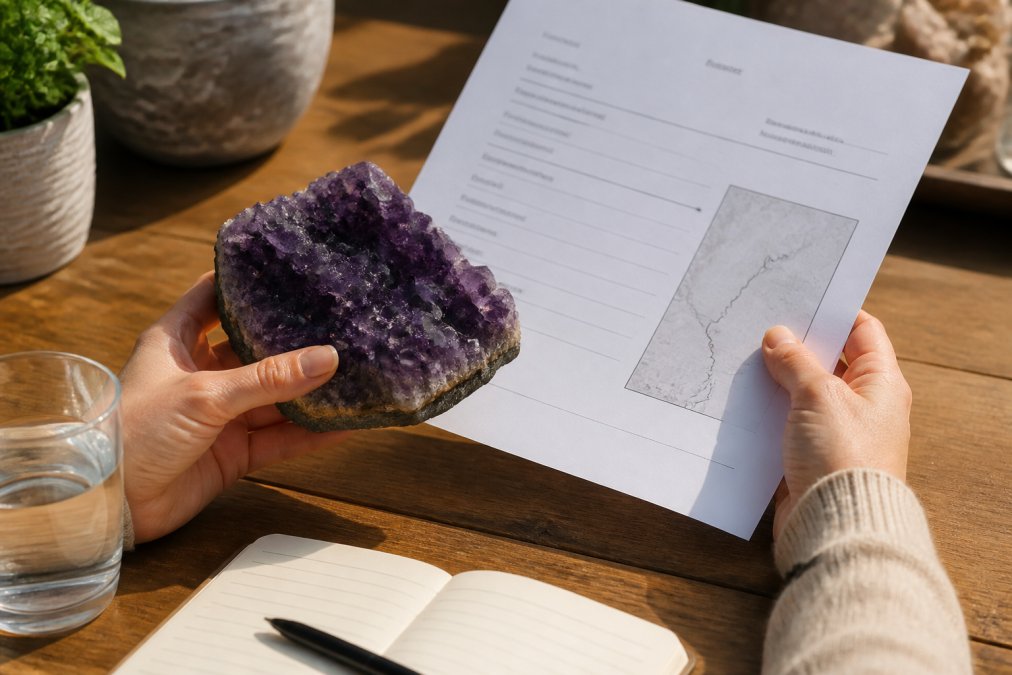
Ask retailers for batch-level information: which mine produced the stone, which country it came from, and who processed it. Some suppliers now provide this documentation routinely. When a seller offers only "we source from Brazil" without specifics, treat the claim as unverified.
A common mistake is assuming that natural stones are automatically ethical. Natural mining can still involve destructive practices or exploitative labor. The mining method and the treatment of workers determine ethics, not whether the stone grew in the ground.
Verify Supply Chain Transparency
Supply chain transparency means the retailer can trace a stone from extraction through processing to your purchase. This requires documentation at every step, not just a handshake agreement with an overseas broker.
Ask to see sourcing policies in writing. Ethical retailers publish their supplier standards and audit processes publicly. If a shop cannot produce a written policy, that absence tells you everything.
The Environmental Impact of Crystal Mining
Crystal mining can scar landscapes, consume water, and release toxic chemicals when done carelessly. The environmental cost varies dramatically by mineral and method, but the risks are real across the industry.
Large-scale operations may clear vegetation and disturb soil, while some small-scale mining uses mercury or other hazardous substances to separate minerals. Water contamination from mining runoff affects local communities long after the mine closes. The United States Geological Survey on mining and the environment documents how mineral extraction can alter ecosystems and water quality when not properly managed.
Responsible operations minimize their footprint through rehabilitation plans, water management systems, and reduced chemical use. These practices cost money, which is one reason ethical stones often carry higher prices. When you pay more for a transparently sourced crystal, you are funding better environmental stewardship.
Crystal Supply Chain Transparency and Why It Matters
Crystal supply chains often span multiple countries, passing through brokers, cutters, and wholesalers before reaching retailers. Each handoff creates an opportunity for ethical standards to slip.
Mine-to-market traceability closes those gaps. When every actor in the chain documents their practices, exploitation becomes harder to hide. This is why organizations working on responsible mineral sourcing and supply chain due diligence emphasize documentation and audit trails as the foundation of ethical trade.
For consumers, transparency translates into accountability. A retailer who can show you the full journey of a stone has put systems in place to verify their claims. One who cannot may still sell beautiful crystals, but you cannot distinguish their products from ones mined under harmful conditions.
The practical takeaway: prioritize retailers who publish their sourcing policies and can discuss their supply chain in specific terms.
Synthetic vs. Natural Crystals: The Ethical Debate
Lab-grown crystals sidestep mining entirely, eliminating both environmental degradation and labor exploitation concerns. For some buyers, that makes them the clear ethical choice.
The trade-off comes down to metaphysics versus footprint. Many practitioners believe natural crystals carry distinct energetic properties that laboratory versions lack. Others find the energetic difference irrelevant and prefer the guaranteed ethical provenance of synthetics.
Both positions have merit. A natural stone from a transparent, fair-trade mine supports artisanal communities and preserves traditional mining livelihoods. A synthetic stone avoids the harms of extraction altogether. Your values determine which trade-off feels right.
Crystals to Avoid and Regional Sourcing Risks
Certain regions carry documented risks of child labor, armed conflict, unsafe working conditions, or severe environmental damage in mineral extraction. While the crystal trade differs from the conflict minerals that dominate headlines, the same dynamics appear in smaller operations. Understanding regional risk helps you make informed choices without requiring you to avoid entire countries, only to demand stronger documentation from those regions.
High-Risk Sourcing Regions
The U.S. Department of Labor's findings on child labor in mineral mining identifies specific minerals and sourcing countries where labor exploitation is most acute. While crystal-specific data is sparse, the same countries that struggle with oversight in other mineral sectors often lack enforcement in decorative stone mining.
Central and West Africa presents complex sourcing challenges. Countries including Madagascar, Tanzania, and Zambia are major sources of amethyst, citrine, and tourmaline. Mining in these regions often occurs in artisanal and small-scale operations with minimal government oversight. Child labor has been documented in some artisanal mining communities, and environmental degradation from unregulated extraction is common. This does not mean every African stone is unethically sourced, many operations are family-run and fair, but it does mean you should demand stronger documentation before purchasing.
South America, particularly Peru, Bolivia, and Brazil, supplies large volumes of amethyst, quartz, and tourmaline. While some operations meet high standards, others operate in regions with weak labor enforcement and limited environmental regulation. The Organization for Economic Cooperation and Development guidance on responsible mineral sourcing notes that supply chain opacity in these regions makes verification difficult. Retailers sourcing from South America should be able to name specific suppliers and provide audit evidence.
Southeast Asia, including Vietnam and Thailand, has emerged as a processing hub for crystals mined elsewhere. While the stones may originate in Africa or South America, they pass through these countries for cutting, polishing, and treatment. Processing facilities in some areas operate under minimal labor and environmental standards. Ask retailers not only where stones were mined but also where they were processed.
India is both a mining source and a major processing center. Some Indian crystal suppliers operate under fair-trade or certified-ethical frameworks; others do not. The variation is significant, so regional origin alone tells you little. Demand supplier-level specificity.
How to Research Regional Risk
Before purchasing a crystal, take three minutes to research the sourcing region:
-
Identify the country of origin. Ask the retailer directly. If they cannot tell you, do not buy.
-
Check the U.S. Department of Labor's List of Goods Produced by Child Labor or Forced Labor. This list, updated annually, identifies countries and specific minerals where these abuses are documented. While it focuses on major commodities, it provides a baseline for regional risk assessment. If a stone comes from a country on this list for any mineral, request extra documentation from that retailer.
-
Cross-reference with Transparency International's Corruption Perceptions Index. Countries with high corruption scores often have weaker labor and environmental enforcement. This is not a disqualifier, many beautiful and ethical stones come from countries with governance challenges, but it is a signal to ask harder questions.
-
Ask the retailer about their supplier's practices in that region. A responsible retailer will have researched their suppliers' labor standards, environmental practices, and community relationships. They should be able to discuss these specifics without defensiveness.
Stones and Sourcing Combinations to Approach with Caution
Certain stone-and-region combinations carry elevated risk:
- Tanzanite from Tanzania without documented fair-trade certification. Tanzanite mining has been linked to labor exploitation and environmental damage. If a retailer sources tanzanite, ask for evidence of fair-trade certification or third-party audit.
- Artisanal amethyst from Madagascar without supplier verification. While many Madagascan amethyst operations are ethical, the artisanal sector lacks centralized oversight. Demand specific supplier names and labor practice documentation.
- Tourmaline from conflict-affected regions without supply chain transparency. Tourmaline mining in some areas has funded armed groups. Retailers should be able to trace tourmaline back to specific, named suppliers in stable regions.
- Crystals processed in countries with documented labor violations without audit evidence. Even if a stone was mined ethically, unethical processing erases that benefit. Ask where cutting and treatment occurred.
The Practical Standard: Documentation Over Avoidance
Responsible retailers track these risks and adjust their sourcing accordingly. They do not avoid entire regions; instead, they work with suppliers in those regions who meet documented standards and can prove it.
Your role as a consumer is to demand that documentation. If a seller cannot tell you which country a stone came from, you cannot evaluate the regional risk, and that gap should end the conversation. If they can name the country but cannot provide supplier information or audit evidence, ask why. A retailer who has done their homework will welcome the question. One who has not will deflect.
Building a Responsible Crystal Collection
Building an ethical collection starts with buying fewer, better stones from transparent sources. Resist the impulse to accumulate dozens of tumbled stones from unknown origins when a few well-documented pieces will serve you better.
A practical checklist for every purchase:
- Ask the retailer about the mine and country of origin
- Request written sourcing documentation when available
- Prioritize sellers who publish their ethical standards
- Research regional risks before buying from unfamiliar sources
- Consider synthetic options when provenance cannot be verified
For deepening your knowledge, reference guides help you understand stone properties and care. The Crystal Bible offers a comprehensive directory of crystals, their shapes, colors, and applications, while The Book of Stones provides in-depth profiles of nearly 400 stone varieties and their metaphysical energies. Pairing these references with disciplined sourcing questions makes you a more informed steward of your collection.

Conclusion
Ethically sourced crystals demand more effort than impulse buying, but the payoff extends beyond a clear conscience. You support miners who work in dignity, landscapes that remain intact, and a market that rewards honesty over obscurity.
At For Heaven's Sake, we curate our crystal selection with attention to both quality and the questions that matter. Our team in Lakewood welcomes newcomers and experienced practitioners alike, offering guidance as you build a collection aligned with your values. Visit our store at 2680 Youngfield Street to see our current selection and ask us directly about how we source our stones.
Frequently Asked Questions
What does it mean for a crystal to be ethically sourced?
An ethically sourced crystal comes from a mine where workers receive fair wages, work in safe conditions, and human rights are protected. Ethical sourcing also requires environmental responsibility, meaning the mining process minimizes habitat destruction and toxic chemical use. Transparency throughout the supply chain, from mine to retailer, is essential so you know exactly where your crystal came from and who handled it.
How can I tell if my crystals were mined ethically?
Ask your retailer direct questions about mining conditions, labor practices, and supply chain documentation. Request information about certifications, mine locations, and whether the company conducts supply chain audits. Reputable sellers provide traceability records and are transparent about their sourcing. Be cautious of vague answers or refusals to discuss origins; ethical retailers are proud to share these details and can back them up with documentation.
What are the environmental impacts of crystal mining?
Crystal mining can cause significant environmental degradation, including habitat loss, water contamination from toxic chemicals, and increased carbon footprint from extraction and transportation. Artisanal and large-scale mining operations may damage ecosystems and create geological impacts that take decades to recover. Sustainable mining practices reduce these effects through responsible extraction methods, waste management, and land restoration efforts.
Are there certifications for ethical crystal mining?
Several certification bodies exist, though the crystal industry has fewer standardized certifications than diamonds or other minerals. Look for third-party audits, fair trade certifications, and retailers who conduct supply chain mapping. Verify any certification claims directly with the certifying body rather than relying solely on retailer statements. Transparency and documentation are more reliable indicators than marketing language alone.
Start your responsible collection with For Heaven's Sake. Explore our curated crystals and reference guides, and shop with confidence knowing you can ask the hard questions in person. Go Shopping and let us help you find stones you can feel good about.
This article was written using GrandRanker