

Table of Contents
- What Selenite Is and Why People Buy It for Home Protection
- How to Use Selenite at Home for Energy Cleansing
- Where to Place Selenite in Your Home for Maximum Effect
- How to Cleanse Selenite and Keep It Effective
- Selenite Crystal Care: What You Need to Know
- Authenticity, Cost, and Realistic Expectations
- Is Selenite Worth the Investment for You?
- Frequently Asked Questions
Last Updated: October 12, 2026
What Selenite Is and Why People Buy It for Home Protection
Selenite is a soft, translucent gypsum crystal popular for home energy protection, believed to cleanse unwanted energy and promote calm.
People are drawn to it for spiritual cleansing: practitioners say it opens energy flow and removes blockages, and its lunar link is believed to enhance protection.
But is selenite worth buying for home energy protection? It depends on what you're looking for. If you want a beautiful crystal that aligns with your spiritual practice, it delivers.
At For Heaven's Sake, we've worked with customers who use selenite at home.
How to Use Selenite at Home for Energy Cleansing
Using selenite at home starts with its basic function: cleansing and purifying the energy in your space.
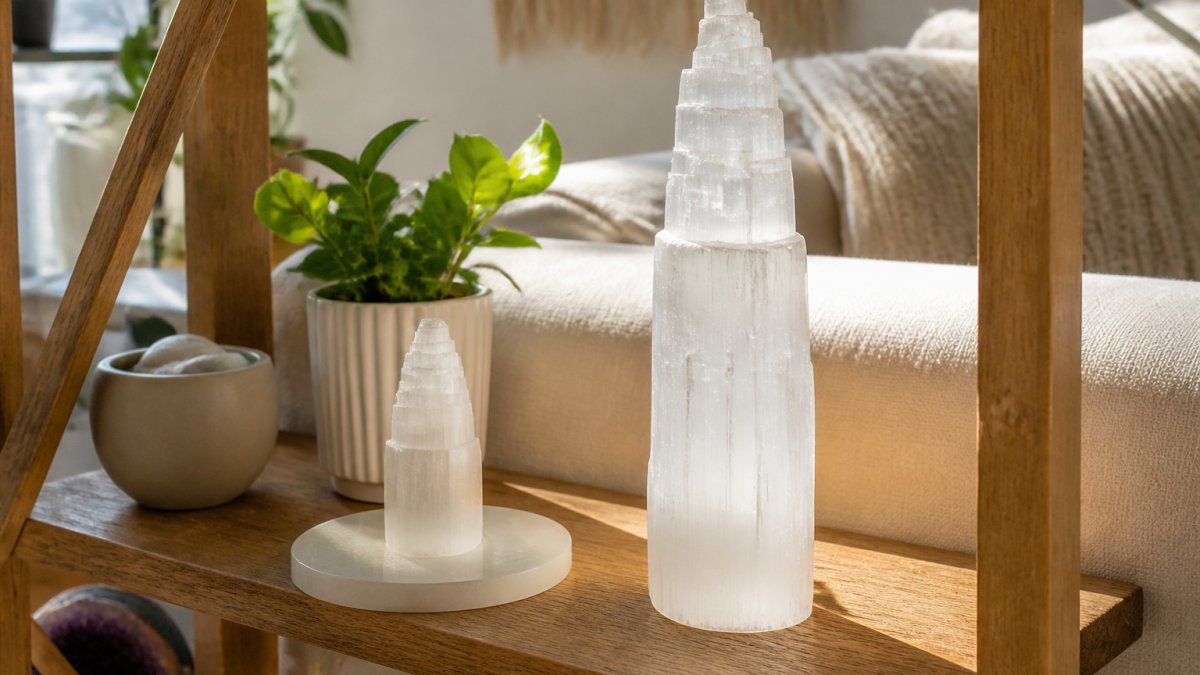
Here are practical ways to use selenite:
- Place a selenite tower on a nightstand to promote calm sleep
- Set a charging plate on a shelf to cleanse the room's energy
- Hold a raw selenite stick during meditation for spiritual clarity
- Arrange multiple pieces around your home to create an energetic grid
- Use a selenite bowl to cleanse and charge other crystals
One effective approach is a selenite grid: placing pieces in the corners of a room or around your bed so they work together to purify and protect the space.

Another common practice is an evening routine: hold the selenite for a few minutes before bed, set an intention for peaceful sleep, and place it on your nightstand.
The key is consistency. Selenite you place and forget won't feel meaningful; actively engaging with it makes the experience richer.
Where to Place Selenite in Your Home for Maximum Effect
Most articles say selenite "raises the vibration" and stop there.
A simple room-by-room plan
- Bedroom, 1 piece. A single tower or palm-size satin spar piece on the nightstand or dresser is enough. The goal is a calm cue, not coverage. Keep it out of arm's reach if you move around in your sleep.
- Living room, 1 to 2 pieces. A tower on a shelf or a bowl on a coffee table. In a large room, one piece near the main seating area does more than several scattered pieces you stop noticing.
- Entryway, 1 piece. A small tower or a raw stick on a console or shelf near the door. This is the most common "boundary" placement in the practice.
- Meditation or practice space, 1 piece. A tower or wand you can hold. Pick one that feels good in the hand.
- Home office, optional, 1 piece. A small piece on the desk as a focus cue. Keep it away from the edge and away from drinks.
- Bathroom, skip it, or use a non-gypsum alternative. Steam and splashes damage gypsum fastest. A candle or plant gives a calm bathroom without the risk.
How many pieces total
For a typical two- to three-bedroom home, three to five pieces is plenty: one per main room plus one you handle. More than that and you stop noticing them.
Forms matched to placement
- Towers stand on flat surfaces and catch light. Best for shelves, nightstands, and consoles.
- Charging plates lie flat and are the workhorse for cleansing other crystals. Best on a shelf or inside a drawer.
- Raw sticks are the most affordable and the easiest to hold. Best for meditation and for tucking into a small tray.
- Bowls are decorative and hold small stones. Best on a coffee table or vanity.
Maintenance schedule
- Dust weekly with a dry, soft cloth or makeup brush, no paper towels or abrasive pads.
- Check monthly for chips or moisture clouding, and move the piece if you find either.
- Reset your intention monthly if you use the piece in a practice.
- Rotate pieces seasonally to keep them visible.
Safety and durability rules
- Water is the enemy. Gypsum is water-soluble. Never rinse, soak, or wipe with a damp cloth, a splash can pit the surface.
- Humidity matters. Bathrooms, kitchens near the stove, and damp basements degrade gypsum. Keep pieces in stable, dry air.
- Direct sun fades the look. An overnight windowsill for a moonlight ritual is fine; weeks of direct afternoon sun dull and embrittle the piece.
- Temperature swings crack it. Keep pieces away from vents, radiators, space heaters, and AC returns.
- It is soft. At Mohs 2, a drop on tile will chip or shatter. Use stable surfaces, not shelf edges.
- Kids and pets. Selenite is brittle and breaks into sharp edges. Use high shelves, a closed cabinet, or a drawer.
- No harsh cleaners. No glass cleaner, alcohol, or abrasives, a dry cloth is the whole kit.
A note on "maximum effect"
There is no measurable physical "effect" to maximize, the energy-protection claim is a spiritual belief, not a tested outcome.
To see how different forms sit on a shelf or in the hand before you commit, visit our Lakewood location at 2680 Youngfield Street.
How to Cleanse Selenite and Keep It Effective
Selenite is believed to cleanse other crystals and spaces, but does it need cleansing itself?
The most common method is moonlight: place your crystal on a windowsill overnight during a full moon.
Some use sound: ringing a bell nearby or playing high-frequency music is believed to clear stagnant energy.
You can also place selenite on a selenite charging plate, the larger piece helping reset the smaller one.

Cleanse every few weeks if you use it daily, or monthly if occasionally. There's no strict rule, follow your intuition.
Selenite Crystal Care: What You Need to Know
Selenite needs specific care because it's soft and delicate.
Water exposure is the main concern. Selenite is water-soluble and can dissolve if soaked.
Temperature changes can crack selenite. Avoid sudden cold-to-hot moves and keep it away from vents, AC units, and radiators.
Storage matters. Keep selenite dry, a bedroom or living room shelf works well. Never store it in a steamy bathroom.
Handle it with care. Selenite is brittle and breaks if dropped.
Avoid harsh chemicals. No commercial cleaners or abrasives, a soft cloth is all you need.
Authenticity, Cost, and Realistic Expectations
Selenite is a trade name, not a mineral species, the mineral is gypsum.
How to tell what you have
- True selenite is transparent to translucent, often with visible internal planes, looks like ice or glass, flakes along flat planes, and is the more fragile variety.
- Satin spar is opaque to semi-translucent with a fibrous, cat's-eye sheen. It's the more durable carving material and the one most often sold as "selenite tower."
- Hardness: both are gypsum, at Mohs 2. A copper penny or even a fingernail will scratch them; if a piece resists a fingernail, it probably isn't gypsum.
- Water test, don't do this on a piece you want to keep. Gypsum is water-soluble; a tiny flake softens and dissolves within minutes. It's the most reliable field test and the most common way people ruin a piece.
- Heat and feel: gypsum feels cool and light for its size. An unusually heavy or warm "selenite" tower may be cast resin or another mineral.
Dyed, coated, and mislabeled pieces
- Dyed satin spar is common in blue, pink, and green, dye pools at the base and fiber edges, and a dry cotton swab rubbed along a fiber edge often picks up color.
- Coated pieces may have a lacquer or resin finish that looks glossier than raw gypsum and can trap moisture, causing clouding underneath.
- Mislabeling is the bigger issue: "selenite" is used loosely for satin spar and sometimes for other white minerals. If a seller can't name the mineral (gypsum) and variety (selenite or satin spar), that's a signal.
What you are actually paying for
Selenite and satin spar are abundant and cheap to mine, so you're paying for size, clarity, carving quality, and the retail channel. A few benchmarks:
- Small raw sticks and palm-size pieces are the entry point and best value for testing whether you enjoy the material.
- Charging plates are priced by surface area and thickness; a thin plate does the same job as a thick one for most home uses.
- Towers are priced by height and fiber alignment, a strong, even cat's-eye sheen with no base chips beats a taller cloudy piece.
- Polished bowls and spheres take more labor and carry a premium; they're decorative first, functional second.
- Anything with elaborate "energy" claims and a matching high price is priced on story, not material.
A useful rule: compare price to size and weight, not the language on the label.
Realistic expectations
Selenite's energy-protection reputation is a spiritual belief, not a scientifically established effect, no controlled research shows gypsum alters a room's energy, and "energy" here isn't a measurable physical quantity.
What selenite will not do: treat anxiety, depression, grief, or any clinical condition. It is not a substitute for therapy, medication, or professional care.
Decision criteria
To compare pieces side by side and see the difference between true selenite and satin spar in person, our Lakewood location at 2680 Youngfield Street carries towers, charging plates, raw sticks, and bowls, and our team can walk you through what you're looking at.
Is Selenite Worth the Investment for You?
Whether is selenite worth buying for home energy protection depends on your situation and expectations.
Buy selenite if:
- You're drawn to crystal work and spiritual practice
- You want an affordable way to enhance your meditation or ritual space
- You appreciate beautiful natural objects in your home
- You're open to the idea that intention and mindfulness create real shifts in how you feel
- You have realistic expectations about what crystals can and cannot do
Skip selenite if:
- You expect it to solve serious emotional or mental health issues
- You're skeptical about spiritual practices and won't feel comfortable using it
- You're on a tight budget and crystals feel like a luxury expense
- You don't have a dry, stable place to store it safely
For many people in the Denver metro area, selenite is a simple, affordable entry point into crystal work.
The real value comes when you use selenite intentionally: place it, set an intention, notice how you feel, and integrate it into your routine.
If you're curious about selenite and want to see it in person before buying, visit our Lakewood location at 2680 Youngfield Street.
Frequently Asked Questions
Can selenite actually protect your home from negative energy?
Selenite is believed by many spiritual practitioners to cleanse and purify energy in a space. Whether it works depends on your personal beliefs about crystal energy. Some people report feeling calmer after placing selenite in their home, while others view it primarily as a beautiful decorative piece. What matters most is your intention and whether using it supports your spiritual practice or sense of well-being.
Does selenite need to be cleansed or charged?
Yes, many crystal practitioners recommend cleansing selenite regularly to maintain its energetic properties. You can cleanse it with intention, moonlight, or sound. Unlike some crystals, selenite should not be immersed in water because it is water-soluble and can dissolve or become damaged. A soft cloth and dry methods are safest for maintaining its appearance and integrity.
Where should you place selenite in your home?
Common placements include entryways to protect incoming energy, bedrooms for calm and peace, meditation spaces for spiritual connection, and living areas for general home purification. Many people place selenite towers on shelves or nightstands where they can see them daily. The best placement depends on your intention, choose a spot where you'll notice it and where it feels right to you.
How do I know if the selenite I'm buying is authentic?
Authentic selenite has a translucent, glassy appearance and feels smooth when polished. It should be relatively lightweight and may show natural striations or slight imperfections. Buying from established metaphysical retailers who source their crystals carefully reduces the risk of receiving substitutes. Ask about the origin and handling of the crystal, reputable sellers can provide details about where their selenite comes from.
Selenite can be a meaningful addition to your home and spiritual practice when you approach it with realistic expectations. The key is understanding what it can and cannot do, caring for it properly, and using it as part of a larger wellness routine. Visit For Heaven's Sake to explore our selenite collection and discover which piece resonates with you.