

Quick Summary
To spot dyed agate, hold the stone to a neutral light and inspect its cracks, pits, and drill hole for color that is more concentrated than the surrounding surface. Natural banding fades gradually, while dyed color often looks flat and stops sharply at a boundary. No single clue is conclusive, so combine several checks and ask the seller directly.
- Judge color under neutral daylight or a daylight-balanced lamp, not warm bulbs.
- Dye often collects in cracks, pits, and drill holes as a concentrated, darker line.
- Natural banding blends gradually; dyed bands look flat and end at sharp edges.
- Require at least two independent indicators before treating a stone as dyed.
- Ask the seller in writing whether the stone has been dyed or treated.
Table of Contents
- Agate, Jasper, and Chalcedony: What Each Stone Is
- How to Tell Jasper from Agate by Translucency
- How to Tell If Agate Has Been Dyed
- A Step-by-Step Test for Dyed Agate and Jasper
- Assessing Dyed Jasper and Reliable Tests Beyond Looking
- Chemical Tests, Safety, and Why Visual Clues Can Mislead
- Your Next Step Before Buying a Stone
- Frequently Asked Questions
How to Spot Dyed Agate and Jasper at Home
Last Updated: November 9, 2026
Agate, Jasper, and Chalcedony: What Each Stone Is
Agate and jasper are both types of chalcedony, a form of microcrystalline quartz, and many people first learn to recognize a spot dyed agate by comparing it with these related stones. Chalcedony is the family name, and agate and jasper are the two members most shoppers meet in stores. Knowing this helps explain why the two stones look so alike.
Agate is a banded chalcedony. Its color bands form in layers, often in soft curves or rings. Many pieces are translucent, meaning light passes through the thinner edges.
Jasper is an opaque chalcedony. It is formed from fine silica and often contains iron or other minerals that give it red, yellow, brown, or green color. Jasper rarely lets light pass through.
The easiest first clue is simple: does the stone glow when held to light, or does it stay solid? Once you are ready to buy, you can browse bracelets with agate and jasper beads. That single question sorts most pieces quickly.
How to Tell Jasper from Agate by Translucency
Translucency is the fastest test you can do in a store. Hold the stone near a bright window or a lamp and look at the thin edge.
- Agate often shows a soft glow at the edges, and the bands may look deeper when light passes through.
- Jasper usually stays dark or solid, even at the thinnest point.
Keep in mind that some agates are less translucent than others, and some jaspers have thin, lighter areas. Use this test as a starting point, not a final answer.
How to Tell If Agate Has Been Dyed
Dyed agate is common in the market. Dye is often used to make bands look brighter or to create colors that rarely occur in nature. Some dyes are obvious. Others take a closer look.
Color Collecting in Cracks and Crevices
Look closely at any small crack, pit, or fracture in the stone. Dye often settles into these spots and leaves a concentrated line of bright color. Natural bands usually fade gradually instead of stopping sharply at a crack.
Check for:
- Color that looks more intense inside a crack than on the surface
- Sharp, uniform color lines that do not follow the natural band pattern
- Dark spots gathered in small pits
Unnatural Color Versus Natural Vivid Banding
Some agates are naturally vivid, so bright color alone does not prove dye. The question is whether the color looks like it belongs to the stone.
- Natural banding shows gradual transitions and varied tones within each band.
- Dyed banding often shows flat, neon-like colors with very even saturation.
Many shoppers find that a stone with a single, unusually bright color across the whole slice deserves a second look.
A Step-by-Step Test for Dyed Agate and Jasper
Most guides explain agate identification and dyed agate separately, then leave jasper out of the workflow. The sequence below treats both stones in one pass and tells you what each clue can and cannot prove. Work through it in order, and treat every result as a data point rather than a verdict.
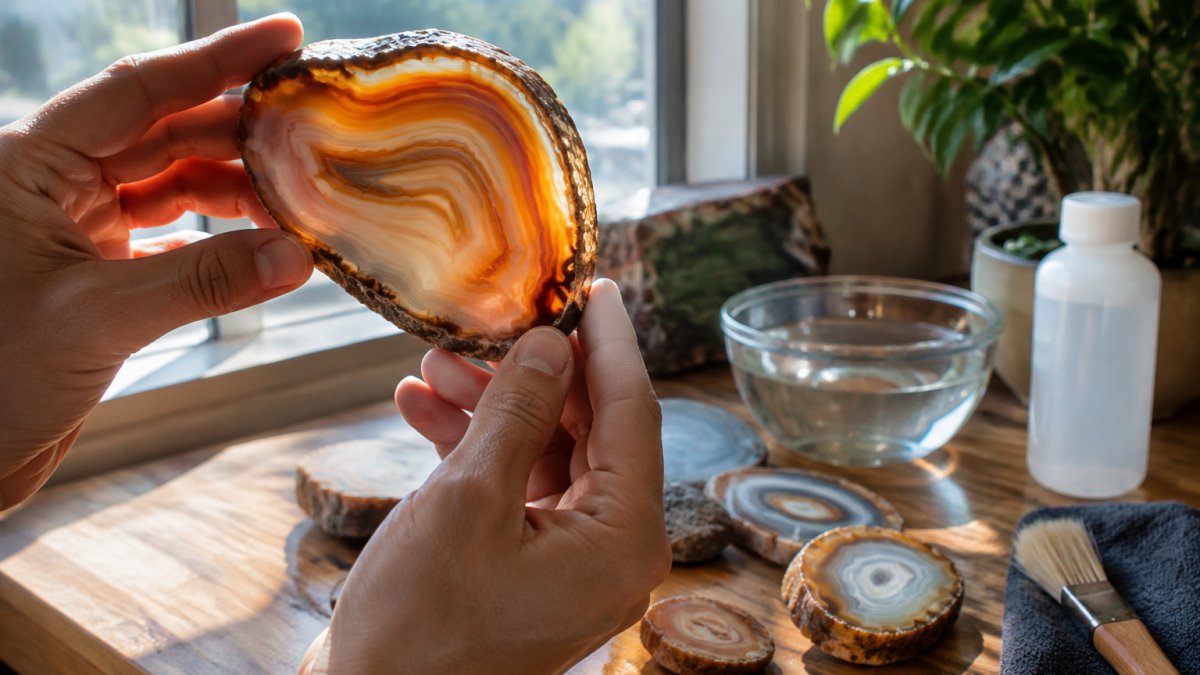
- Set up neutral light. Use indirect daylight or a daylight-balanced lamp. Warm incandescent bulbs push reds and yellows, and cool LEDs can make blues look artificial. Judge color only against a white background, not against your hand or a colored cloth.
- Scan the surface for color that sits on top. On agate, dye often reads as a thin film that follows the polish rather than the banding. On jasper, look at the boundary between polished face and rough edge: surface-only color tends to stop abruptly at the edge, while natural pigment continues into the stone.
- Inspect every crack, pit, and fracture. Dye migrates into openings and dries there, so a crack that is more saturated than the surrounding surface is a strong indicator. On banded agate, compare the color inside the crack with the color of the adjacent band; natural banding usually fades across a crack instead of intensifying inside it.
- Check the drill hole and stringing channel. On beads and pendants, the inside of the drill hole is the least polished and most revealing surface. Dye commonly pools there as a concentrated ring. A hole that is uniformly colored with the exterior is more consistent with through-coloring, though it does not prove natural origin.
- Hold the stone to light and read the edges. Agate typically glows at thin edges and may show deeper band contrast in transmitted light. Jasper usually stays solid. Use this to confirm which stone you are testing, not to confirm dye, because dyeing does not change translucency.
- Trace the color transitions. Natural agate bands blend and vary in tone within a single band. Dyed agate often shows flat, evenly saturated color that stops sharply at a band boundary. On jasper, natural mottling and veining usually show gradual tonal shifts, while dyed jasper can look uniformly tinted across areas that should vary.
- Compare against siblings from the same batch. Stones dyed together often share an identical hue that is unusual in nature. If several pieces in a tray match too closely, ask how they were colored.
- Ask the seller a direct question. "Has this stone been dyed or otherwise treated?" A clear yes or no is more useful than a vague "it's natural." Reputable sellers disclose treatment, and a willingness to answer in writing is a meaningful signal.
Watch out: no single clue settles the question. A naturally vivid agate can show sharp band boundaries, and a lightly dyed jasper can look convincingly mottled. Require at least two independent indicators before you treat a stone as dyed, and remember that this workflow identifies likely treatment, not gemological certainty.
Assessing Dyed Jasper and Reliable Tests Beyond Looking
Dyed jasper is harder to catch than dyed agate because jasper is opaque and often naturally bright, so the translucency test that helps with agate does nothing here. The indicators below are jasper-specific and rely on where color sits rather than how much light passes through.
Jasper-specific dye indicators
- Surface-only color at edges and fractures. Natural jasper pigment is part of the silica matrix and continues through the stone. Dye tends to sit near the surface, so a chipped edge or a rough spot may reveal a lighter interior beneath a darker skin.
- Color that ignores the stone's structure. Natural jasper color usually follows veins, breccia fragments, or mottling. Dyed jasper can show an even tint that crosses those features without respecting them.
- Concentrated color in pits and vugs. Jasper often has small cavities. Dye collects in them and dries as a darker speck or line, much as it does in agate cracks.
- Unnaturally uniform hue across a batch. If every piece in a tray is the same saturated red, blue, or purple, ask about treatment. Natural jasper varies piece to piece even within one deposit.
- Color that fades at the polish. A dyed surface can look slightly duller or more uniform than the surrounding natural stone, especially where the polish is thinnest.
Reliable non-destructive checks and their limits
Beyond looking, a few safe checks add evidence without risking the stone. Examine the drill hole and any unpolished area under a loupe; these surfaces are harder to dye evenly and often reveal concentration. Compare the stone's color under neutral daylight and under a warm lamp; a dye that looks convincing in one light can look flat or off-hue in another. Check for a color difference between the polished face and the rough back of a cabochon or slab.
These checks have real limits. They cannot distinguish a well-dyed stone from a naturally vivid one with certainty, and they say nothing about heat treatment or other processes that may accompany dyeing. Treat them as evidence, not proof.
Chemical and destructive tests: what to expect
Solvent swabs, acid drops, and scratch tests appear in older guidance, but they carry real downsides. A solvent such as acetone may lift a small amount of dye from a poorly sealed stone, but it can also dull a polish or damage a stabilized surface, and it will not detect dye that has been sealed under a treatment. Acid and heat tests can etch or crack the specimen and involve hazards that require proper training and protective equipment.
Treatment disclosure and questions to ask
Treatment disclosure is worth asking about, and many sellers state dyeing openly on a tag or invoice. Ask specifically: Has this stone been dyed? Was it also heated or stabilized? Can you put the answer in writing? What is the return policy if a jeweler or gemologist later disagrees? The problem is undisclosed treatment, not treatment itself.
Watch out: bright color alone is not evidence of dye. Natural jasper can be intensely red, yellow, or green, and some natural pieces show sharper color boundaries than a lightly dyed one. Weigh color against structure, surface behavior, and the seller's disclosure before you decide.
Chemical Tests, Safety, and Why Visual Clues Can Mislead
Some people try chemical or destructive tests, such as scratching a stone, applying acid, or heating it. We do not recommend these methods for everyday shoppers. They can damage a valuable piece, and some chemicals are hazardous to handle without proper training and protective equipment.
Visual clues also mislead. Natural agate can be intensely colored, and some dyes look very much like natural pigment. The most reliable approach combines careful looking, honest questions to the seller, and a clear return policy.
Your Next Step Before Buying a Stone
Now you know what to look for. Start with the light test, check the cracks, and ask the seller how the stone was colored. If you want to see unaltered agate and jasper for comparison, browse our tumbled stone selection at For Heaven's Sake, where you can look at natural banding up close. Visit our Agate Blue Lace tumbled stone to compare natural patterns, or see the Agate Moss tumbled stone for natural vivid banding. Shopping with a clear checklist makes it easier to choose a stone you can trust. For a tumbled option from our collection, see the ARAGONITE/BLUE - Tumbled stone, $3.00.


Frequently Asked Questions
How to tell if agate has been dyed?
Look for color that sits in cracks, crevices, and fractures rather than following the natural banding, and check whether the color seems to float on the surface. Hold the stone up to a bright light: natural agate shows its bands evenly through the stone, while dyed pieces often show concentrated color along breaks. Visual clues help, but they are not proof, so treat them as reasons to ask the seller about treatment rather than as a final verdict.
How to tell jasper from agate?
The main difference is translucency. Agate is typically semitransparent and banded, and light can pass through its thinner edges. Jasper is opaque, so light does not pass through it, and it usually shows a more uniform, earthy color with patterns rather than clear bands. Both are forms of chalcedony, so the distinction is about appearance and how the stone transmits light, not a sharp scientific line.
Is dyed agate worth anything?
The value of a stone depends on the quality of the cut, the size, and whether the seller discloses the treatment. Ask the seller directly whether a stone is dyed or treated, and get that answer in writing if the purchase matters to you.
Can you test whether agate or jasper is dyed without damaging it?
Yes, several checks are non-destructive: examining the stone under good light, looking closely at cracks and edges with a magnifier, and holding it up to a light source to see how color is distributed. These checks cannot prove dye on their own, but they can raise a clear flag. Avoid chemical tests on a stone you care about, since some involve acids and can harm the surface.
